
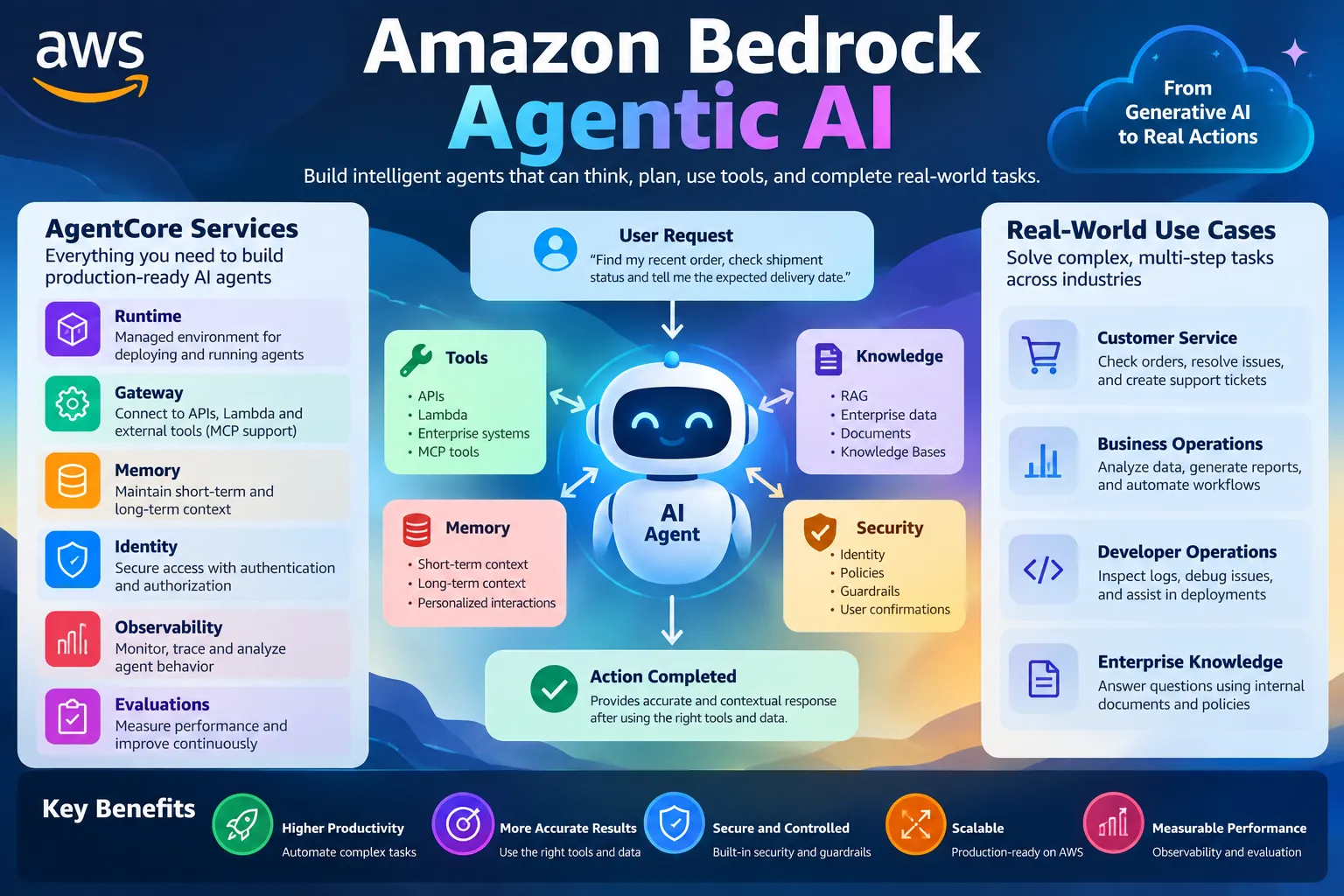
Amazon Bedrock Agentic Al: Building Production-Ready Al Agents
Explore how Amazon Bedrock AgentCore enables production-ready agentic AI by combining AI agents with tools, memory, knowledge retrieval, security, observability, and evaluation to build intelligent applications that can complete complex, multi-step tasks.

Amazon Bedrock Agentic AI: Building Production-Ready AI Agents
Traditional generative AI applications usually follow a simple pattern: a user asks a question, a foundation model generates an answer, and the interaction ends.
Agentic AI changes that model. Instead of only generating text, an AI agent can interpret a goal, decide which steps are required, use external tools or data, maintain context, and continue working until the task is completed.
Amazon Bedrock provides AWS capabilities for building these applications, and Amazon Bedrock AgentCore extends this approach with managed services for deploying, connecting, securing, monitoring, and evaluating AI agents.
What Is Agentic AI?
Agentic AI refers to AI systems that can take multiple steps to accomplish a goal instead of producing a single response.
A typical workflow looks like this:
1
2
3
4
5
6
7
8
9
10
11
12
13
14
15
User Request
     ↓
AI Agent
     ↓
Understand the Goal
     ↓
Plan the Required Steps
     ↓
Choose Tools / Data
     ↓
Execute Actions
     ↓
Evaluate Results
     ↓
Continue or Respond
For example, consider the request:
"Find my recent order, check whether it has shipped, and tell me the expected delivery date."
A normal chatbot may only explain how to track an order.
An agentic application can:
- Identify the required information.
- Call an order-management API.
- Retrieve the shipment status.
- Query a delivery service.
- Return the final answer to the user.
This is the fundamental difference between generating an answer and completing a task.
Amazon Bedrock AgentCore
Amazon Bedrock AgentCore provides composable services for deploying production-grade AI agents and tools. AWS documents capabilities including Runtime, Memory, Gateway, Identity, Observability, Evaluations, Policy, Browser, and Code Interpreter. It also supports agents built with different frameworks and models rather than requiring a single model or framework.
The major components can be understood as follows.
1. AgentCore Runtime
Runtime provides a managed environment for running AI agents and tools.
Instead of manually managing servers for an agent application, developers can deploy agents into AgentCore Runtime and allow AWS to handle the underlying runtime infrastructure. AWS describes Runtime as supporting different agent frameworks, models, and protocols such as MCP and A2A.
Example use cases:
- Deploying a customer-support agent that handles conversations and invokes business tools.
- Running a data-analysis agent that performs multi-step analysis and returns results.
2. AgentCore Gateway
An agent becomes much more useful when it can interact with external systems.
AgentCore Gateway provides a way to expose APIs, Lambda functions, and existing services as tools for agents. It also supports MCP-based integrations.
For example, an enterprise agent might have tools such as:
1
2
3
4
5
getCustomer()
getOrder()
createTicket()
checkInventory()
sendNotification()
The agent can decide which tool is required instead of the application developer writing a fixed sequence for every possible request.
Another example is a financial operations agent that can retrieve account information, call an internal risk service, and generate a report using several tools during one interaction.
3. AgentCore Memory
Many AI applications fail when they cannot maintain useful context across interactions.
AgentCore Memory provides managed memory capabilities for agents, including short-term and long-term context. This allows an agent to maintain information needed for more consistent interactions.
For example:
1
2
3
4
5
6
7
8
Conversation 1:
User: My preferred programming language is Java.

Conversation 2:
User: Show me an example of the solution.

Agent:
Here is a Java example...
Another example is a support agent that remembers previously discussed issues so the user does not need to repeat the same information every time.
Memory should still be designed carefully. Storing unnecessary information increases complexity, and sensitive information should be handled according to the application's security and data-governance requirements.
4. AgentCore Identity
An agent that can access real enterprise systems needs an identity model.
AgentCore Identity is designed to help agents securely access AWS resources and third-party services with controlled authentication and authorization.
This matters because an agent should not automatically receive unrestricted access to every system.
For example:
1
2
3
4
Agent
 ├── Read customer profile
 ├── Read order status
 └── Cannot delete customer account
A second example is an internal developer agent that can read CI/CD information but requires additional authorization before changing a production deployment.
Knowledge and RAG
Agentic applications often need information that is not contained in the model's training data.
Retrieval-Augmented Generation (RAG) can provide the agent with access to organizational knowledge and documents. Amazon Bedrock supports Knowledge Bases for retrieving information that can be used to augment generated responses.
A simple RAG workflow is:
1
2
3
4
5
6
7
8
9
10
11
User Question
      ↓
Agent
      ↓
Retrieve Relevant Information
      ↓
Knowledge Source
      ↓
Agent Processes Context
      ↓
Final Response
Example 1: An HR agent retrieves information from company policies before answering an employee's question.
Example 2: A technical-support agent retrieves product manuals and troubleshooting documentation before generating a solution.
The important point is that an agent can combine retrieved knowledge with tool execution rather than treating RAG as the entire application.
Tool Calling and Agentic Workflows
One of the most important concepts in agentic AI is tool use.
A model does not need to directly perform every operation. Instead, it can determine that a tool is required and provide the parameters needed to execute that tool.
For example:
1
2
3
4
5
6
7
8
9
10
11
12
13
14
User:
"Check whether order 12345 has shipped."

Agent:
I need the order-status tool.

Tool Call:
getOrderStatus(orderId="12345")

Tool Result:
Shipped

Agent:
Your order has shipped.
A more complex workflow might look like:
1
2
3
4
5
6
7
8
9
User Request
     ↓
Get Order
     ↓
Get Shipment Status
     ↓
Calculate Expected Delivery
     ↓
Return Result
The advantage is flexibility. The exact path can depend on the user's request and the results returned by previous steps.
Security and Guardrails
Giving an AI system the ability to call APIs creates a new security problem: the model is no longer only generating text; it may be influencing real actions.
Agentic applications therefore require stronger controls around permissions, authentication, tool access, monitoring, and potentially human confirmation.
AWS documents mechanisms for requiring user confirmation before an action-group function is invoked, specifically as a protection against potentially harmful actions and prompt-injection scenarios.
A secure architecture might look like:
1
2
3
4
5
6
7
8
9
10
11
12
13
User
  ↓
Agent
  ↓
Identity / Authorization
  ↓
Policy / Guardrails
  ↓
Gateway
  ↓
Approved Tool
  ↓
Enterprise System
Example 1: A support agent can create a support ticket automatically but cannot refund a payment without confirmation.
Example 2: A DevOps agent can inspect deployment logs but requires explicit authorization for a production deployment.
The principle is simple: the more capability an agent has, the more carefully its permissions must be controlled.
Observability and Evaluation
Traditional applications usually have predictable execution paths. Agentic applications are different because the agent may select different tools and reasoning paths for different requests.
This makes observability essential.
AgentCore Observability provides monitoring capabilities for agent workflows, including traces, logs, metrics, and other runtime information.
Suppose one customer request takes two tool calls while another takes eight. Without tracing, it can be difficult to understand why the second request was slower or more expensive.
Evaluation is equally important.
AgentCore Evaluations provides mechanisms to measure agent performance, including built-in and custom evaluators and evaluation workflows based on agent traces.
Useful evaluation questions include:
1
2
3
4
5
Did the agent complete the task?
Did it choose the correct tool?
Did it provide a grounded answer?
Did it follow security policies?
How much latency and resource usage did it require?
This creates a feedback loop:
1
2
3
4
5
6
7
8
9
10
11
Agent
  ↓
Production Traffic
  ↓
Observability
  ↓
Evaluation
  ↓
Identify Failures
  ↓
Improve Agent
A Practical Architecture
A production-oriented agentic AI system can combine the components like this:
1
2
3
4
5
6
7
8
9
10
11
12
13
14
15
16
17
18
19
20
21
22
23
24
25
26
27
28
29
30
31
                     ┌──────────────────┐
                     │      User        │
                     └────────┬─────────┘
                              ↓
                     ┌──────────────────┐
                     │   AI Agent       │
                     └────────┬─────────┘
                              ↓
        ┌─────────────────────┼─────────────────────┐
        ↓                     ↓                     ↓
   Foundation Model       Memory              Knowledge
        ↓                     ↓                  / RAG
        └─────────────────────┼─────────────────────┘
                              ↓
                       AgentCore Gateway
                              ↓
              ┌───────────────┼───────────────┐
              ↓               ↓               ↓
            APIs           Lambda           MCP Tools
              │               │               │
              └───────────────┼───────────────┘
                              ↓
                    Enterprise Systems

       Identity + Policy + Guardrails
                    ↓
             Security Controls

             Observability
                    ↓
               Evaluations
This architecture separates reasoning, tools, data, security, deployment, and monitoring instead of putting everything into one large application.
Two Real-World Applications
Customer Service Agent
A customer-service agent could:
1
2
3
4
5
6
7
8
9
10
11
Understand customer question
        ↓
Retrieve account information
        ↓
Search product documentation
        ↓
Check order status
        ↓
Create support ticket when required
        ↓
Respond to customer
This can reduce the number of manually coordinated steps required to resolve common support requests.
Developer Operations Agent
A DevOps agent could:
1
2
3
4
5
6
7
8
9
10
11
Receive incident description
        ↓
Inspect application logs
        ↓
Retrieve recent deployment information
        ↓
Identify possible causes
        ↓
Run approved diagnostic tools
        ↓
Create an incident report
The important distinction is that the agent is coordinating multiple operations rather than simply generating a paragraph describing what a developer should do.
Best Practices
Start with a narrow business task instead of trying to build a completely autonomous agent.
Give the agent only the tools and permissions it actually needs.
Use retrieval when the agent needs organization-specific or frequently changing information.
Add authentication, authorization, guardrails, and confirmation requirements before allowing agents to perform sensitive operations.
Enable observability from the beginning rather than waiting until production failures occur.
Evaluate tool selection, task completion, answer quality, latency, and failure cases continuously.
Most importantly, treat agentic AI as a software system, not simply as a prompt. The model is only one component. Tools, memory, data, security, deployment, monitoring, and evaluation determine whether the system works reliably in production.
Conclusion
Agentic AI represents a shift from AI that only answers questions to AI systems that can work toward goals.
Amazon Bedrock AgentCore provides AWS capabilities for turning these ideas into production systems by combining managed runtime infrastructure, memory, tool connectivity, identity, observability, evaluation, and other controls.
The most useful way to think about agentic AI is not:
"How do I make the model smarter?"
but:
"How do I give the model the right tools, information, permissions, and feedback to complete a task safely?"
That shift—from generating responses to completing controlled workflows—is what makes agentic AI useful for real-world applications.
Key Takeaways
- Generative AI produces responses; agentic AI can coordinate multi-step tasks.
- Tools allow agents to interact with real systems.
- RAG and knowledge sources provide access to external information.
- Memory enables context across interactions.
- Identity and policy controls are essential when agents can perform actions.
- Observability and evaluation are necessary for production reliability.
- Amazon Bedrock AgentCore provides composable infrastructure for deploying and operating agentic applications.
Sources
AWS Documentation — Amazon Bedrock AgentCore
AWS Documentation — Amazon Bedrock Agents
AWS Documentation — Amazon Bedrock Knowledge Bases
AWS Documentation — Amazon Bedrock AgentCore Evaluations
AWS Documentation — Amazon Bedrock AgentCore Observability
AWS Blog — Migrate agentic workloads to Amazon Bedrock AgentCore
AWS Documentation — Amazon Bedrock Agents
AWS Documentation — Amazon Bedrock Knowledge Bases
AWS Documentation — Amazon Bedrock AgentCore Evaluations
AWS Documentation — Amazon Bedrock AgentCore Observability
AWS Blog — Migrate agentic workloads to Amazon Bedrock AgentCore
Enjoyed reading this content? Let the author know!
Your likes, comments, shares, and saves help creators reach more builders.

Loading recommendations
Loading article