
Optimizing "Cold Starts" for AI/ML Inference on AWS Lambda
A practical guide to minimizing cold start latency when deploying Machine Learning models in Serverless environments. This article explores architectural patterns combining AWS Lambda, Amazon EFS, and Provisioned Concurrency to balance performance and cost for AI systems.

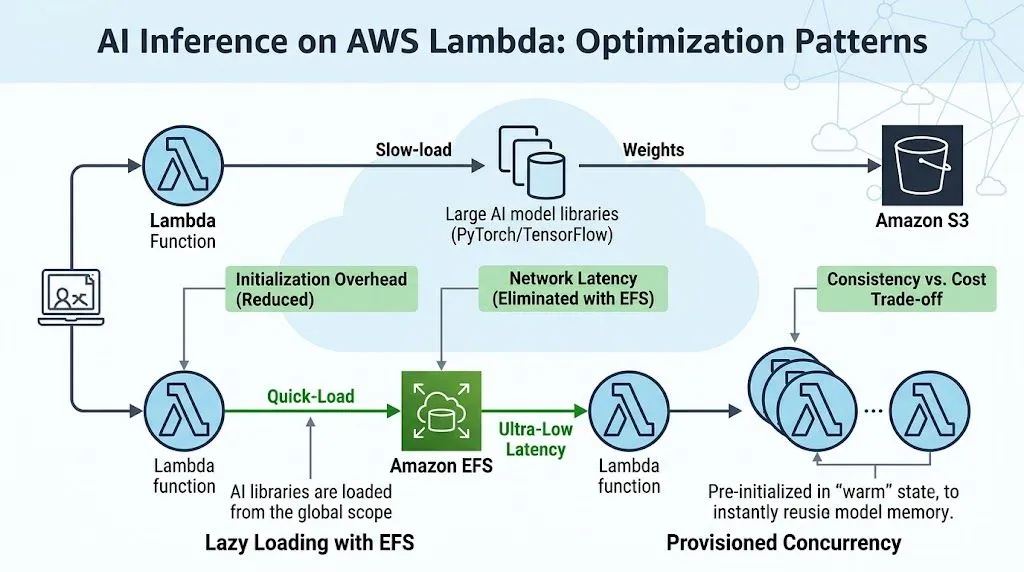
Running AI/ML inference on AWS Lambda offers massive benefits in terms of cost-efficiency and automatic scaling. However, the large footprint of machine learning libraries (such as PyTorch or TensorFlow) and model weights often leads to an architectural nightmare: prolonged Cold Starts.
Here are 3 core strategies to resolve this bottleneck from a system design perspective.
1. Lazy Loading and Global Scope Optimization
The most common mistake is loading the entire model inside the function handler. When Lambda scales out, every new container must spend time re-initializing from scratch.
Solution: Initialize your AI model at the Global Scope (outside the handler function) and utilize Lazy Loading.
This ensures the model is loaded only once during the container's initialization phase. Subsequent warm invocations can instantly reuse the model in memory, drastically reducing latency from tens of seconds to mere milliseconds.
This ensures the model is loaded only once during the container's initialization phase. Subsequent warm invocations can instantly reuse the model in memory, drastically reducing latency from tens of seconds to mere milliseconds.
2. Leveraging Amazon EFS over Deployment Packages
Lambda's deployment package size limit (250MB unzipped) is rarely sufficient for complex neural networks. Many engineers attempt to download the model from S3 to
/tmp during a cold start, which creates a severe network I/O bottleneck.Solution: Mount an Amazon EFS (Elastic File System) to your Lambda function.
Store your model weights directly on EFS. It provides high-throughput read access shared across thousands of concurrent executions, entirely eliminating the S3 payload download overhead during cold starts.
Store your model weights directly on EFS. It provides high-throughput read access shared across thousands of concurrent executions, entirely eliminating the S3 payload download overhead during cold starts.
3. The Trade-off: Provisioned Concurrency
If your system requires ultra-low latency for real-time applications (like conversational AI chatbots), code-level optimization tricks might not be enough.
In this case, Provisioned Concurrency is the silver bullet. It keeps a specified number of execution environments "warm" (with the model pre-loaded).
- Trade-off: You will incur a fixed hourly cost for this concurrency, which slightly diminishes the pure "pay-per-use" advantage of Serverless. However, pairing it with Application Auto Scaling to dynamically adjust the number of warm instances based on traffic patterns can effectively optimize your operational costs.
Conclusion:
No architecture is perfect. The right strategy depends entirely on whether your business prioritizes low infrastructure costs (EFS + Lazy Loading) or zero-latency user experiences (Provisioned Concurrency).
No architecture is perfect. The right strategy depends entirely on whether your business prioritizes low infrastructure costs (EFS + Lazy Loading) or zero-latency user experiences (Provisioned Concurrency).
Enjoyed reading this content? Let the author know!
Your likes, comments, shares, and saves help creators reach more builders.

Loading recommendations
Loading article