
Running Claude on Amazon Bedrock: What It Costs vs. the GPT Alternative on Azure
A builder's guide to picking a model on Amazon Bedrock — real per-token pricing across three Bedrock tiers, a worked cost example, what Bedrock adds beyond the raw model (Guardrails, Knowledge Bases, one AWS bill), and how that stacks up against the nearest GPT/Azure alternative.

If you're building on AWS, Amazon Bedrock is the natural place to call Claude from: it sits inside your existing AWS account, on your existing bill, with no separate vendor relationship to set up. This guide is about making a good model choice on Bedrock — what each tier costs, what you get beyond the raw per-token rate, and how that compares to the nearest alternative on Azure, for the moments you actually need that comparison.
What Bedrock gives you beyond the model itself
Before the pricing table, it's worth being clear on why "just call Claude" often means "call Claude through Bedrock" for AWS builders specifically:
- One AWS bill. Token usage shows up as a normal line item alongside your EC2, S3, and Lambda spend — no separate invoice, no separate vendor to reconcile in FinOps.
- Guardrails. Content filtering and PII redaction configured once, applied consistently across every model you call through Bedrock — Claude included.
- Knowledge Bases. Managed retrieval-augmented generation (RAG) over your own documents, without standing up a vector database yourself.
- IAM-native access control. The same permission model you already use for every other AWS resource controls who can invoke which model.
- Data stays inside the AWS security boundary. For teams with compliance requirements already built around AWS (HIPAA, FedRAMP), this matters more than the per-token rate.
None of that shows up on a pricing page, but it's a real part of the cost-of-ownership picture — and it's the reason a lot of AWS-native teams don't seriously shop the raw token price against a competing platform.
Bedrock's Claude tiers, and what they cost
Amazon Bedrock offers Claude across three tiers, priced on-demand, per million tokens (input / output), as of September 2026:
| Tier | Model | Price (input / output per 1M tokens) |
|---|---|---|
| Lightweight | Claude Haiku 4.5 | $1 / $5 |
| Balanced / production | Claude Sonnet 5 | $3 / $15 |
| Flagship reasoning | Claude Opus 5 | $5 / $25 |
Bedrock also offers batch inference (50% off standard rates, for asynchronous jobs) and prompt caching (up to 90% off the input-token portion for repeated context — system prompts, long chat histories) on top of these base rates. For any workload with a stable system prompt or repeated document context, caching is usually the single biggest lever on the bill, bigger than the choice between tiers.
A worked example, on Bedrock
Take a support chatbot handling 10,000 conversations a day: roughly 1,500 input tokens (system prompt + history) and 400 output tokens per conversation. That's 450M input tokens and 120M output tokens a month.
| Bedrock tier | Monthly cost (on-demand, no caching) |
|---|---|
| Claude Haiku 4.5 | ≈ $1,050 |
| Claude Sonnet 5 | ≈ $3,150 |
| Claude Opus 5 | ≈ $5,250 |
Notice output tokens dominate every row here — they're priced 3-5x above input on every Claude tier — so trimming response length moves the bill more than swapping tiers does. With prompt caching on the (likely static) system prompt, the input-token portion of this bill can realistically drop by half or more, which is worth prototyping before committing to a tier based on the sticker price alone.
How that compares to the GPT/Azure alternative
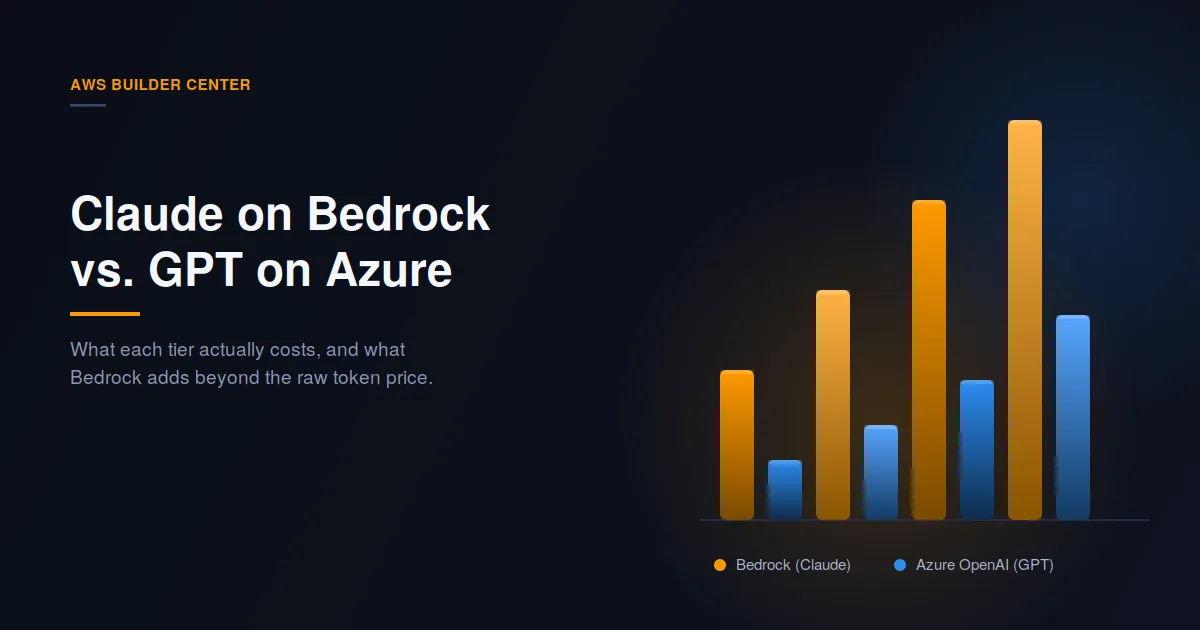
If you're evaluating Bedrock against building the same thing on Azure OpenAI, here's the same three tiers, side by side, at September 2026 list pricing:
| Tier | Bedrock (Claude) | Azure OpenAI (GPT-5.6) |
|---|---|---|
| Lightweight | Haiku 4.5 — $1 / $5 | Luna — $0.20 / $1.20 |
| Balanced | Sonnet 5 — $3 / $15 | Terra — $2 / $12 |
| Flagship | Opus 5 — $5 / $25 | Sol — $4 / $20 (promo, through Nov 30, 2026) |
At list price, Azure's lightweight tier is markedly cheaper, and GPT typically undercuts Claude by 20-30% at the balanced and flagship tiers too. But that comparison only tells you about raw inference cost — it says nothing about which bill you're already consolidating onto, which compliance boundary your data needs to stay inside, or which platform's adjacent tooling (Guardrails and Knowledge Bases on Bedrock; Azure AI Foundry's agent tooling on the other side) your architecture already leans on. For a team already building on AWS, those factors routinely outweigh a 20-30% token-price gap.
On benchmarks: worth a caveat, not a tiebreaker
Cross-provider benchmark numbers are inconsistent enough — different harnesses, different reasoning-effort settings, sometimes different benchmark versions entirely — that using them to break a Bedrock-vs-Azure tie is a mistake. Claude Sonnet 5's own system card reports 78.0% on GPQA Diamond and 63.2% on SWE-Bench Pro; third-party trackers report GPT-5.6 Sol considerably higher on GPQA but on a different coding benchmark entirely, which makes a clean comparison unreliable rather than simply unfavorable to either side. If the decision is close, the more reliable test is running your actual prompts and tools against both, on Bedrock's own playground or console, rather than trusting a leaderboard.
The practical takeaway
For a team already on AWS, the question usually isn't "Bedrock or Azure" — it's "which Bedrock tier." Start with Haiku 4.5 for anything high-volume or latency-sensitive, move to Sonnet 5 as the default production tier, and reserve Opus 5 for tasks where the harder reasoning genuinely pays for itself. Prototype prompt caching before assuming you need a bigger tier — it's often cheaper to cache a big prompt on Haiku than to run an uncached one on Sonnet.
Sources:
- Amazon Bedrock pricing — AWS official pricing page (aws.amazon.com/bedrock/pricing), September 2026
- Azure OpenAI Service pricing — Microsoft Azure official pricing page, and the GPT-5.6 Foundry launch announcement, September 2026
- Claude Sonnet 5 benchmark figures — Anthropic's Claude Sonnet 5 System Card
- GPT-5.6 Sol benchmark figures — third-party model trackers (Requesty, OpenRouter)
Enjoyed reading this content? Let the author know!
Your likes, comments, shares, and saves help creators reach more builders.

Loading recommendations
Loading article