
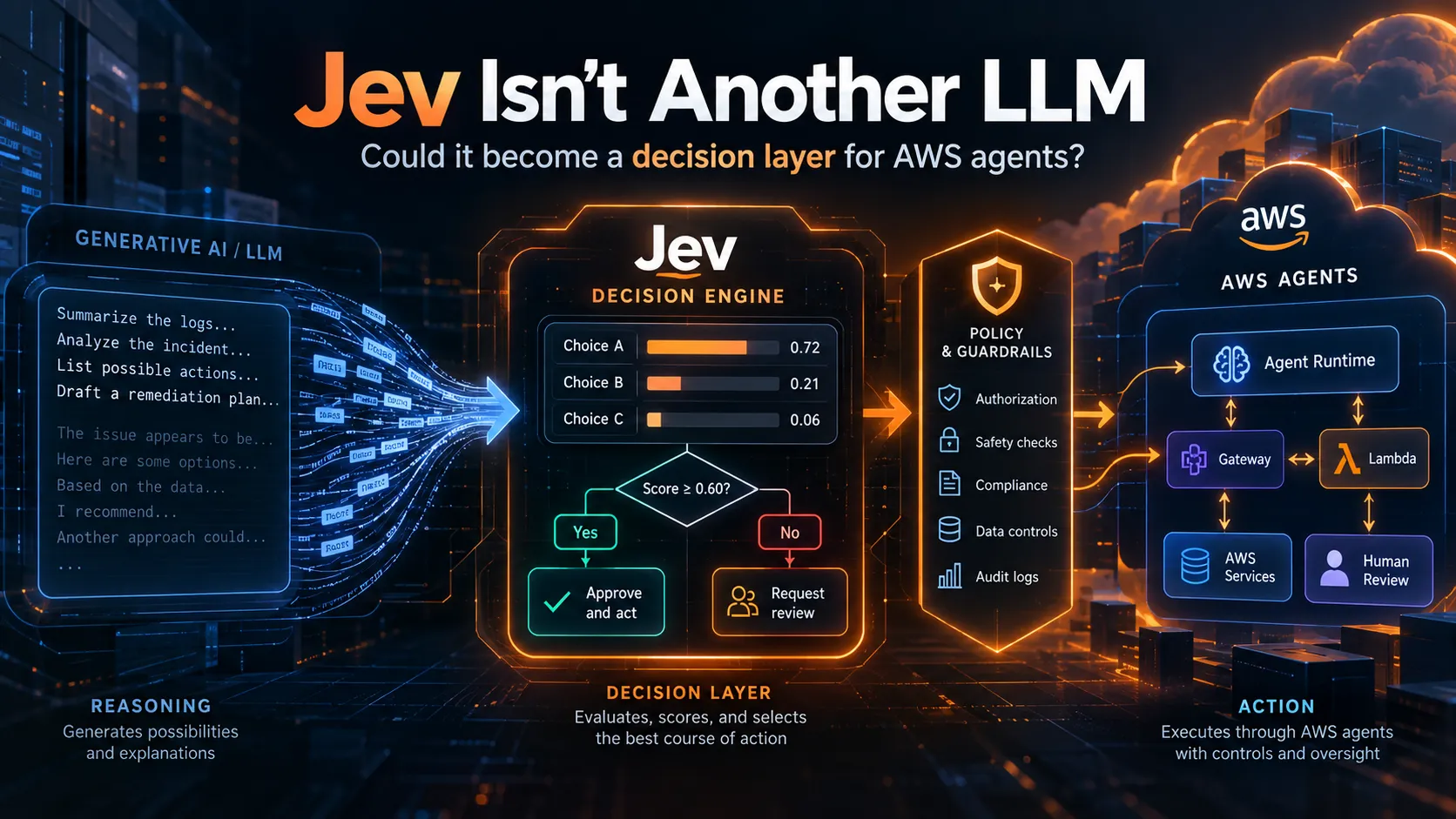
Jev Isn’t Another LLM: Could Decision Models Become a New Layer for AWS Agents ???
Jev does not generate prose like a traditional LLM: it returns bounded, probabilistic decisions designed for software. This article explores what that changes, where Jev could fit around Amazon Bedrock AgentCore, and why deterministic AWS security controls should still remain in charge.

Jev Isn’t Another LLM: Could Decision Models Become a New Layer for AWS Agents ???
AI agents do not only need to write. They constantly need to decide: Which tool should run? Is this event suspicious? Should a workflow continue automatically or be sent to a human? Large language models can make those choices, but they are still text-generating systems being asked to behave like decision functions.
That is why Jev caught my attention. TypeSafe AI introduced Jev on September 15, 2026 as its first “System One Model”: a model designed to take application state plus bounded questions and return structured probabilistic decisions instead of generated prose. For someone learning AWS from a networking and cybersecurity perspective, the interesting question is not whether Jev can replace an LLM. It is where a decision-focused model could fit around an AWS agent.
Jev changes the output, not just the model
A typical LLM receives context and generates tokens. Even when an application asks for JSON, the model is still generating a sequence that software then validates and interprets.
Jev takes a different approach. According to TypeSafe’s documentation, the model receives a
state and one or more typed questions. It currently exposes three primitives: Choice for selecting an option, Score for rating against a rubric, and Noul for a yes/no probability. Choice and Score also return confidence information.That makes the model look less like a chatbot and more like a probabilistic function inside a program.

TypeSafe reports end-to-end latency of roughly 70–500 ms for its service and a listed input price of $0.042 per million tokens, with output not separately charged. Those numbers are interesting, but they should be treated as vendor-reported measurements rather than independent benchmarks. TypeSafe itself notes limitations in its evaluation setup and says some published gains are likely at the high end of real-world results.
The more important idea is architectural: if the output space is defined before inference, software can branch on probabilities without asking a generative model to produce an explanation every time.
Where could Jev fit in an AWS agent?
Amazon Bedrock and Amazon Bedrock AgentCore are built around a broader agent architecture: models reason, agents access tools, and AWS services provide runtime, identity, observability and policy controls. AgentCore Gateway can expose APIs and AWS Lambda functions as tools through the Model Context Protocol (MCP).
As of September 24, 2026, I did not find Jev in the current Amazon Bedrock model catalog or an official AWS announcement describing a native Jev integration. Any AWS design involving Jev today should therefore be understood as an external integration pattern, not a native Bedrock capability.
A simple conceptual architecture could look like this:
1
2
3
4
5
6
7
8
9
10
11
12
13
14
15
16
17
18
19
20
21
22
Event / user request
        |
        v
Amazon Bedrock AgentCore Runtime
        |
        +--> Foundation model on Amazon Bedrock
        |       reasoning / generation
        |
        +--> AgentCore Gateway
                |
                v
             AWS Lambda
                |
                v
          TypeSafe Jev API
                |
                v
       probability / choice
                |
          threshold in code
          /             \
    continue          human review
In this pattern, Lambda would act as the controlled integration point to the external Jev API. The result could then be used as one signal in the workflow: route a support ticket, score whether an agent trace needs review, rank candidate tools, or decide whether a low-risk action is confident enough to continue.
That is a different job from asking an LLM to write an answer.
The security boundary matters more than the model
The part I find most important from a cybersecurity perspective is what Jev should not be allowed to decide alone.
A probabilistic model should not replace IAM permissions, AgentCore Policy, deterministic validation, or business rules. If a user is not authorized to delete a resource, a 99% model confidence should not change that.
AWS published a recent architecture using Step Functions with AgentCore where agents propose actions but deterministic code validates them before anything with financial or regulatory consequences is executed. That principle fits Jev well too: AI can classify, score or recommend; deterministic controls should still enforce what is allowed.

This separation is especially important if Jev is called as an external API. The application would need to consider what data leaves AWS, how credentials are managed, what gets logged, and whether sensitive state should be minimized or redacted before transmission. AgentCore Identity, tightly scoped IAM permissions and CloudWatch observability can help protect the surrounding integration, but they do not remove the need to review the external provider’s security and data-handling terms.
Jev does not remove the need for LLMs
The clearest way I understand the difference is to separate tasks by what they actually need.
Use a generative model when the system must explain, summarize, write, reason across a long problem or interact naturally with a person. Use deterministic code or policy when the answer must be exact and enforceable. A decision model like Jev is potentially useful in the middle: situations where the answer is bounded, but hard-coded rules are too brittle.
For example, “Which of these five queues best matches this incident?” is different from “Explain the incident to the analyst.” The first is a decision. The second is generation.
That distinction could become increasingly useful as AWS agents gain more tools. The more actions an agent can perform, the more valuable it becomes to separate reasoning, decision signals, and authorization instead of treating them as one model call.
The biggest question is reliability, not novelty
Jev is new, and “System One Model” is TypeSafe’s own category. The company has published technical results and workflow evaluations, but independent evidence is still limited. AWS Builder Center already has early community experiments with Jev, including a measured comparison against a fine-tuned BERT classifier, which is useful because it moves the discussion beyond launch claims.
For me, the interesting idea is not that Jev is “better than LLMs.” It is that some AI workloads may not need text generation at all.
If agent architectures continue to split reasoning, tools, policies and validation into separate layers, decision-focused models could become another specialized component rather than a replacement for existing ones.
Would you let a probabilistic decision model choose an agent’s next tool, or would you only use it as a confidence signal behind deterministic AWS policies?
Sources
- TypeSafe AI — Introducing System One Models & Jev — September 15, 2026
https://typesafe.ai/blog/introducing-system-one-models-and-jev - TypeSafe AI Documentation — Introduction — publication date not stated; accessed September 24, 2026
https://docs.typesafe.ai/introduction - AWS Machine Learning Blog — Introducing Amazon Bedrock AgentCore Gateway: Transforming enterprise AI agent tool development — August 15, 2025
https://aws.amazon.com/blogs/machine-learning/introducing-amazon-bedrock-agentcore-gateway-transforming-enterprise-ai-agent-tool-development/ - AWS Compute Blog — Validating multi-agent decisions with Step Functions and Bedrock AgentCore — September 14, 2026
https://aws.amazon.com/blogs/compute/validating-multi-agent-decisions-with-step-functions-and-bedrock-agentcore/ - Amazon Bedrock Documentation — Model availability & compatibility — publication date not stated; accessed September 24, 2026
https://docs.aws.amazon.com/bedrock/latest/userguide/models.html - AWS Builder Center — Jev vs BERT on Kyoto-ben Intent Classification, Measured — September 21, 2026
https://builder.aws.com/content/3JcBTYjvqJbHO2D6e72S9pPZ41d/jev-vs-bert-on-kyoto-ben-intent-classification-measured
Enjoyed reading this content? Let the author know!
Your likes, comments, shares, and saves help creators reach more builders.

Loading recommendations
Loading article