Introduction
Cloud computing has changed the way applications and services are developed, deployed, and managed. Instead of depending completely on physical servers, organizations can use cloud platforms to access computing resources through the internet.
Amazon Web Services (AWS) is one of the widely used cloud platforms. It provides many services that help developers build and deploy applications according to their requirements.
What is AWS Cloud Computing?
AWS Cloud Computing provides on-demand access to computing resources such as servers, storage, databases, and other services. These resources can be used when needed, which helps reduce the requirement for maintaining physical infrastructure.
For students and beginners, understanding the basic AWS services is a good starting point for learning cloud computing.
Important AWS Services
1. Amazon EC2
Amazon Elastic Compute Cloud (EC2) provides virtual servers in the AWS Cloud. An EC2 instance can be used to host websites, web applications, APIs, and other software.
For example, a developer can launch an Ubuntu EC2 instance, install the required software, and deploy a web application on the server.
2. Amazon S3
Amazon Simple Storage Service (S3) is an object storage service. It can be used to store images, documents, videos, backups, and static website files.
S3 is also useful for hosting static websites and storing files that need to be accessed by applications.
3. AWS IAM
AWS Identity and Access Management (IAM) helps manage access to AWS resources. It allows administrators to create users, roles, and policies with specific permissions.
Using appropriate IAM permissions is important for maintaining security in AWS environments.
4. AWS Lambda
AWS Lambda allows developers to run code without managing servers directly. It follows a serverless approach where AWS manages the underlying infrastructure.
Lambda can be useful for applications that need to perform tasks in response to events, such as file uploads or API requests.
5. Amazon DynamoDB
Amazon DynamoDB is a fully managed NoSQL database service. It provides fast and flexible data storage and can automatically scale based on application requirements.
It is commonly used in applications that need low-latency access to data.
Learning AWS Through Practical Projects
Learning cloud computing becomes more useful when concepts are connected with practical projects. Deploying a simple application on an EC2 instance, storing files in S3, managing permissions with IAM, or working with DynamoDB can provide a better understanding of how cloud services work together.
As a Computer Science Engineering student, exploring these services has helped me understand the basic process of cloud deployment and resource management.
Benefits of Learning AWS
Learning AWS can help students understand important concepts such as:
- Server and application deployment
- Identity and access management
These concepts are useful for students who are interested in cloud computing, DevOps, software development, and cloud support roles.
Conclusion
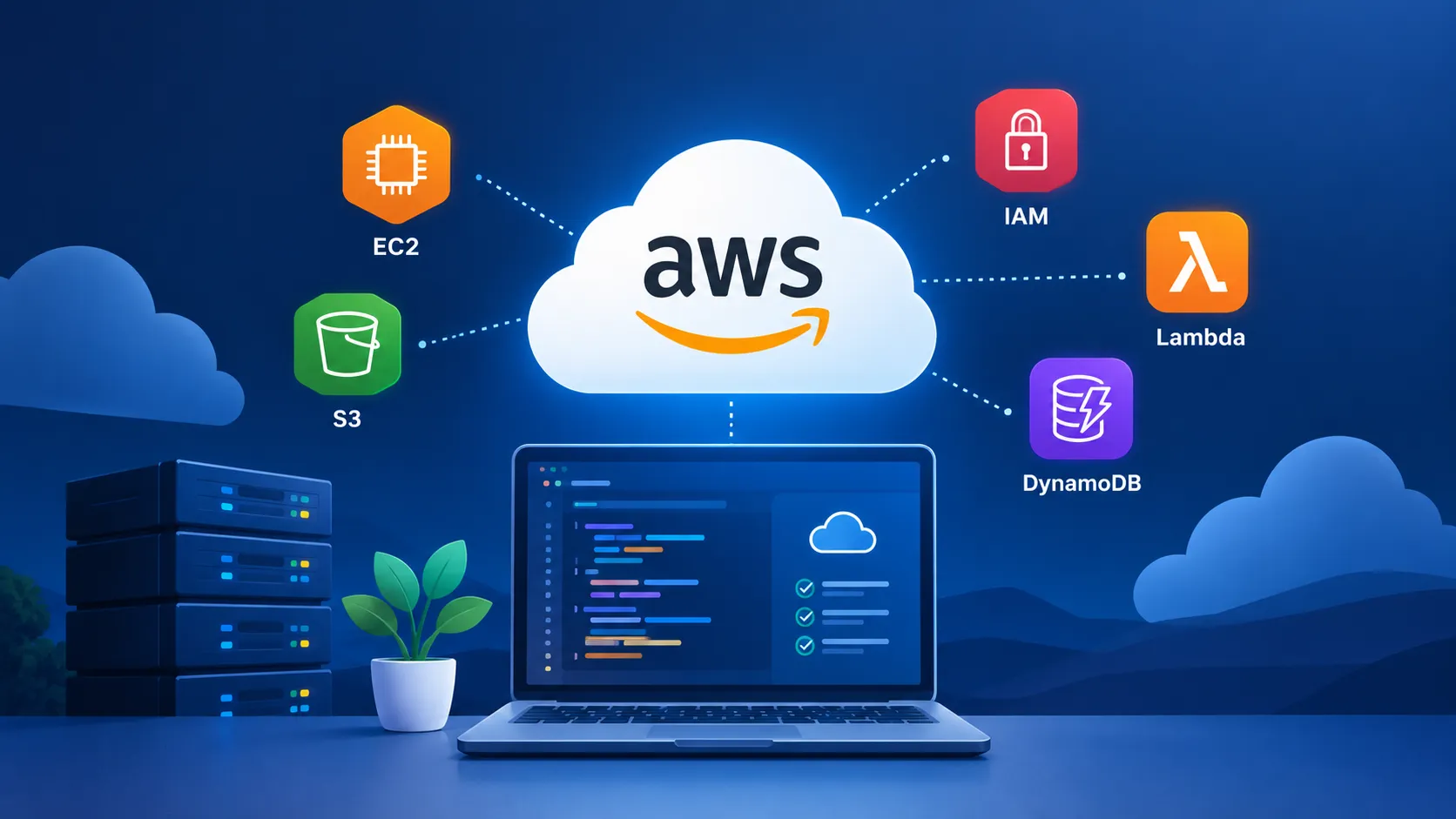
AWS provides a wide range of services for developing and deploying modern applications. Starting with fundamental services such as EC2, S3, IAM, Lambda, and DynamoDB can provide a strong foundation for learning cloud computing.
The best way to improve cloud skills is to combine theoretical knowledge with hands-on practice. Start with small AWS projects, experiment with different services, and gradually build more practical cloud solutions.




Loading article