
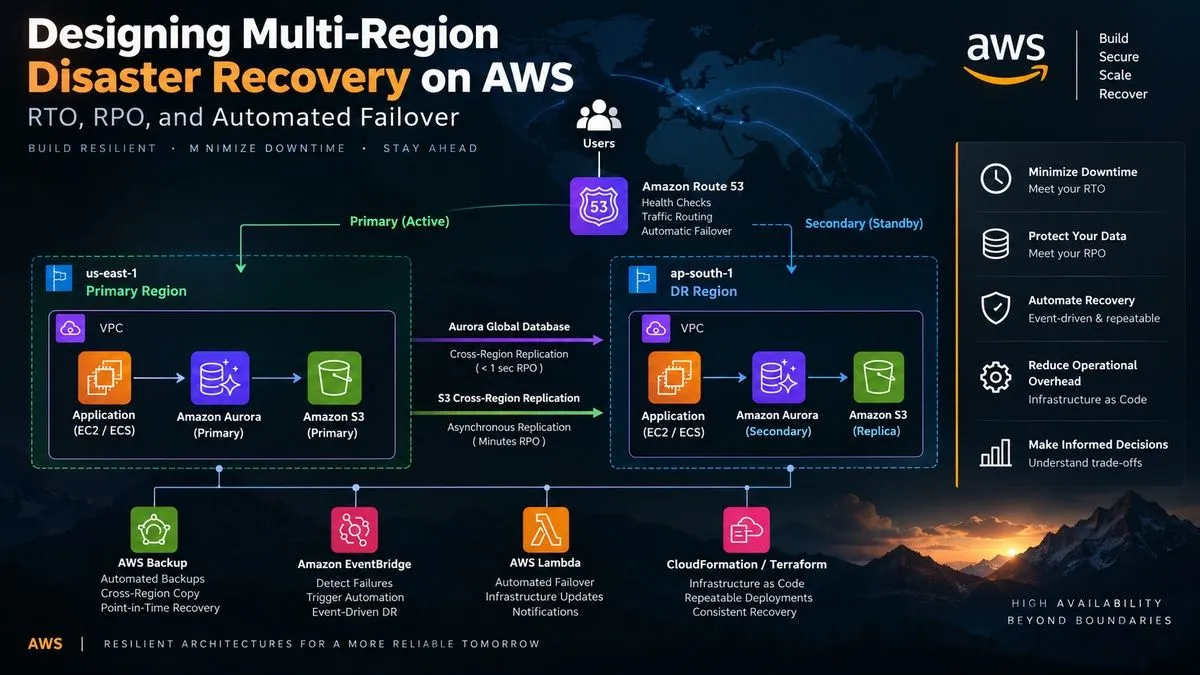
Designing Multi-Region Disaster Recovery on AWS: RTO, RPO, and Automated Failover
Regional outages are one of the most difficult failure scenarios for distributed applications. A highly available architecture inside a single AWS Region can still become unavailable if the Region itself experiences a major disruption.

Student
Designing Multi-Region Disaster Recovery on AWS: RTO, RPO, and Automated Failover
Introduction
Regional outages are one of the most difficult failure scenarios for distributed applications. A highly available architecture inside a single AWS Region can still become unavailable if the Region itself experiences a major disruption.
Multi-Region disaster recovery addresses this risk by maintaining critical application components in a separate AWS Region and designing a controlled mechanism to recover service when the primary Region becomes unavailable.
This article presents a reference architecture using Amazon Route 53, Amazon Aurora Global Database, Amazon S3 Cross-Region Replication, AWS Backup, Amazon EventBridge, AWS Lambda, and Infrastructure as Code with CloudFormation or Terraform.
The objective is not simply to create a second environment. The real goal is to engineer a recovery strategy around measurable Recovery Time Objective (RTO) and Recovery Point Objective (RPO) requirements.
1. RTO and RPO: Start With Recovery Requirements
Before selecting AWS services, define what the application actually needs to recover.
Recovery Time Objective (RTO)
RTO represents the maximum acceptable amount of downtime after a disaster.
For example:
text
RTO = 10 minutes
means the recovery process should restore application availability within approximately ten minutes.
Recovery Point Objective (RPO)
RPO represents the maximum amount of data that can be lost, measured in time.
For example:
text
RPO = 30 seconds
means the architecture should aim to recover data to a point no more than approximately 30 seconds behind the failure.
These requirements directly influence the architecture.
A system requiring an RPO measured in seconds cannot depend exclusively on periodic backups. Similarly, a system with a very aggressive RTO may require continuously replicated infrastructure rather than rebuilding everything after a failure.
2. Reference Multi-Region Architecture
A practical design can use two AWS Regions:
text
┌─────────────────────┐│ End Users │└──────────┬──────────┘│▼┌─────────────────────┐│ Route 53 ││ Health Checks + ││ Failover Routing │└──────────┬──────────┘│┌─────────────┴─────────────┐│ │▼ ▼┌─────────────────┐ ┌─────────────────┐│ Primary Region │ │ DR Region ││ │ │ ││ Application │ │ Application ││ EC2 / ECS │ │ EC2 / ECS ││ │ │ ││ Aurora Primary │───────▶│ Aurora Secondary││ │ │ ││ S3 Bucket │───────▶│ S3 Replica │└─────────────────┘ └─────────────────┘│ │└──────────┬────────────────┘│┌───────────▼────────────┐│ AWS Backup ││ Cross-Region Backups │└────────────────────────┘EventBridge ──▶ Lambda ──▶ Recovery Automation│▼CloudFormation /Terraform
The primary Region handles normal production traffic. The secondary Region contains replicated data and the infrastructure required to restore application functionality.
The important design principle is that each component has its own recovery mechanism.
3. Amazon Route 53: Traffic-Level Failover
Amazon Route 53 provides the traffic-management layer.
With a failover routing policy, Route 53 can direct traffic to a primary resource while it is considered healthy and route traffic to a secondary resource when the primary becomes unhealthy.
A simplified configuration looks like:
text
application.example.com│▼Route 53│┌────┴────┐│ │Primary SecondaryRegion Region│ │Healthy? Standby
Health checks are critical because DNS failover should be based on meaningful application availability rather than simply whether an infrastructure component exists.
For example, a health endpoint could validate:
text
GET /health200 OKDatabase connectivityCritical dependency availabilityApplication readiness
An important consideration is DNS caching. Route 53 can change which endpoint it returns, but clients and recursive resolvers may continue using cached DNS responses until their TTL expires.
Therefore, DNS failover is only one component of the overall recovery process.
4. Aurora Global Database: Database-Level Disaster Recovery
The database is usually one of the most critical components of a DR architecture.
Amazon Aurora Global Database provides a primary Aurora cluster in one Region and secondary clusters in other Regions.
Conceptually:
text
Primary Region┌─────────────────────┐│ Aurora Writer ││ ││ Primary │└──────────┬──────────┘││ Cross-Region│ Replication▼┌─────────────────────┐│ Aurora Secondary ││ ││ Read-only Cluster │└─────────────────────┘DR Region
Aurora Global Database uses cross-Region replication designed for low-latency data propagation.
For an unplanned Regional outage, a secondary cluster can be promoted through the Aurora Global Database failover process.
The important distinction is between switchover and failover:
- Switchover is intended for planned operations when the existing environment is healthy.
- Failover is intended for unplanned outages.
Because replication is asynchronous, an unplanned failover can result in some transactions not yet replicated to the secondary Region.
This is why database replication should be evaluated against the application's actual RPO rather than assuming that multi-Region automatically means zero data loss.
5. Amazon S3 Cross-Region Replication
Application data stored in Amazon S3 requires its own replication strategy.
S3 Cross-Region Replication (CRR) automatically copies objects from a source bucket to a destination bucket in another AWS Region.
For example:
text
Primary Regions3://production-data││ CRR▼DR Regions3://production-data-dr
Both buckets should be configured appropriately for replication, including versioning and the required IAM permissions.
S3 replication is particularly useful for:
- User-generated files
- Application assets
- Documents
- Backups
- Data exports
- Logs requiring regional redundancy
One important limitation is that replication does not automatically make previously existing objects appear in the destination merely because a new replication configuration was created. Existing objects may require S3 Batch Replication.
For workloads with strict replication-time requirements, S3 Replication Time Control can also be evaluated.
6. AWS Backup: Recovery Beyond Replication
Replication and backup solve different problems.
Replication helps maintain a current copy of production data.
Backups provide historical recovery points.
That distinction matters when the problem is not a Regional outage but something such as:
text
Accidental deletionData corruptionApplication bugMalicious modificationConfiguration error
A DR architecture can therefore use AWS Backup to create scheduled recovery points and copy supported backups to another Region.
Example:
text
Production│▼AWS Backup Plan│├── Local Recovery Point│└── Cross-Region Copy│▼DR Backup Vault
Cross-Region backup copies can be encrypted using the destination vault's encryption configuration.
For stronger isolation, organizations can also consider cross-account backup architectures so that production administrators do not have unrestricted control over every recovery copy.
7. EventBridge and Lambda: Automating Recovery
A DR architecture becomes significantly more useful when recovery actions are automated.
Amazon EventBridge can detect relevant AWS events and invoke automation workflows.
A simplified recovery workflow could look like:
text
AWS Event│▼EventBridge│▼Lambda│├── Validate failure├── Promote database├── Update configuration├── Trigger deployment└── Send notification
For example, an event indicating a database failover could trigger a Lambda function that performs controlled post-failover actions.
However, automation should not blindly react to every infrastructure event.
A robust workflow should include:
- Event validation
- Failure classification
- Idempotent operations
- Logging
- Alerting
- Human approval for high-risk operations where appropriate
The objective is to automate repetitive recovery work while preventing an incorrect signal from triggering a destructive failover.
8. Infrastructure as Code: Rebuilding the Environment Reliably
A DR Region should not depend on undocumented manual configuration.
Infrastructure as Code allows the architecture to be represented as version-controlled configuration.
AWS CloudFormation can define AWS infrastructure as templates, while Terraform can manage AWS resources using declarative configuration.
A conceptual Terraform structure might be:
text
terraform/│├── modules/│ ├── networking/│ ├── compute/│ ├── database/│ └── monitoring/│├── environments/│ ├── primary/│ └── disaster-recovery/│└── main.tf
This allows the recovery environment to be recreated consistently.
The key principle is:
If the infrastructure cannot be recreated from code, the DR environment is not truly reproducible.
Infrastructure code should therefore be stored in version control and subjected to review and automated validation.
9. Active-Passive vs Active-Active
There is no universal multi-Region architecture.
Two common models are active-passive and active-active.
Active-Passive
text
Primary Region││ 100% traffic▼ProductionDR Region││ Standby▼Recovery
Advantages:
- Lower operational complexity
- Lower steady-state compute cost
- Easier write consistency model
Trade-offs:
- Recovery requires a transition
- Capacity may need to be provisioned during recovery
- Failover testing is essential
Active-Active
text
Route 53/ \▼ ▼Region A Region B50% 50%
Advantages:
- Both Regions serve production traffic
- Potentially lower recovery transition time
- Better geographic distribution
Trade-offs:
- Higher cost
- More complex data consistency
- More complicated deployments
- More difficult operational model
The correct architecture depends on business requirements rather than simply choosing the most complex design.
10. The Hidden Challenge: Dependencies
A common DR mistake is replicating the primary application but forgetting its dependencies.
Consider:
text
Application│├── Database├── S3├── Secrets├── IAM├── DNS├── External APIs├── Queues└── Monitoring
If the application is deployed successfully in the DR Region but its secrets, queues, certificates, or external dependencies are unavailable, the recovery is incomplete.
A proper DR plan should therefore maintain a dependency inventory.
For every critical dependency, ask:
text
Is it regional?Is it replicated?Can it be recreated?How long does recreation take?Does it contain state?Does it have a recovery procedure?
11. Security Considerations
Disaster recovery should not create a weaker security boundary.
Important considerations include:
- Encrypting replicated data
- Using AWS KMS appropriately
- Applying least-privilege IAM
- Protecting backup vaults
- Restricting cross-Region replication permissions
- Monitoring recovery actions
- Logging administrative activity
- Protecting infrastructure-as-code pipelines
- Avoiding long-lived credentials
Recovery automation should have only the permissions required to perform its specific actions.
A Lambda function responsible for promoting a database should not automatically receive unrestricted administrator access to the entire AWS account.
12. Testing the DR Architecture
A DR architecture that has never been tested is an assumption, not a proven recovery strategy.
Testing should simulate realistic failure scenarios.
Example test matrix
Scenario | Expected Action | Target |
|---|---|---|
Application failure | Route traffic away | Application recovery |
Database failure | Promote secondary | Database recovery |
Regional outage | Cross-Region failover | Regional recovery |
S3 data issue | Restore/replicate data | Data recovery |
Infrastructure loss | Recreate using IaC | Environment recovery |
Configuration error | Restore known-good state | Operational recovery |
During each test, measure:
text
Actual RTOActual RPOFailover durationData consistencyApplication recovery timeManual interventionUnexpected dependencies
The measured values should be compared with the original business requirements.
13. Common Design Mistakes
Mistake 1: Assuming replication equals DR
Replication protects against some failures, but it does not automatically solve traffic routing, application deployment, secrets, dependencies, or recovery automation.
Mistake 2: Using backups as the only recovery mechanism
Backups are valuable for historical recovery, but restoring a large environment from backups may not satisfy an aggressive RTO.
Mistake 3: Never testing failover
A configuration can look correct while failing during an actual outage.
Mistake 4: Forgetting DNS behavior
Route 53 failover does not eliminate DNS caching.
Mistake 5: Manually building the DR Region
Manual recovery introduces configuration drift and increases recovery time.
Mistake 6: Ignoring data consistency
Cross-Region replication can be asynchronous. The architecture must explicitly define what level of data loss is acceptable.
14. A Practical Recovery Sequence
A controlled regional recovery could follow this sequence:
text
1. Detect regional failure↓2. Validate failure↓3. Promote Aurora secondary↓4. Verify database health↓5. Activate/recover application capacity↓6. Validate S3 and other dependencies↓7. Update Route 53 traffic routing↓8. Run application health checks↓9. Monitor recovery↓10. Begin controlled failback planning
The exact sequence depends on the workload and the services involved.
The key principle is to make recovery deterministic, observable, and repeatable.
15. Architecture Trade-Offs
Multi-Region DR improves resilience, but it is not free.
Area | Benefit | Trade-Off |
|---|---|---|
Aurora Global Database | Fast database recovery | Cross-Region replication cost |
S3 CRR | Regional data redundancy | Replication and storage costs |
AWS Backup | Historical recovery | Backup storage and copy costs |
Route 53 | DNS-level failover | DNS caching considerations |
EventBridge/Lambda | Automated recovery | Automation complexity |
IaC | Repeatable infrastructure | Requires disciplined code management |
Active-Active | Reduced dependency on one Region | Higher cost and complexity |
Active-Passive | Lower steady-state cost | Recovery transition required |
The architecture should therefore be optimized around business impact, not simply maximum redundancy.
Conclusion
Multi-Region disaster recovery on AWS is an architectural discipline rather than a collection of backup services.
A resilient design combines:
- Route 53 for traffic failover
- Aurora Global Database for cross-Region database recovery
- S3 Cross-Region Replication for object redundancy
- AWS Backup for independent recovery points
- EventBridge and Lambda for event-driven automation
- CloudFormation or Terraform for reproducible infrastructure
The most important step is to begin with measurable RTO and RPO requirements and then design every component around those targets.
The final measure of a DR architecture is not how impressive the diagram looks.
It is whether the organization can recover the application, recover the data, and prove that recovery works within the required business objectives.
Enjoyed reading this content? Let the author know!
Your likes, comments, shares, and saves help creators reach more builders.

Loading recommendations
Loading article