
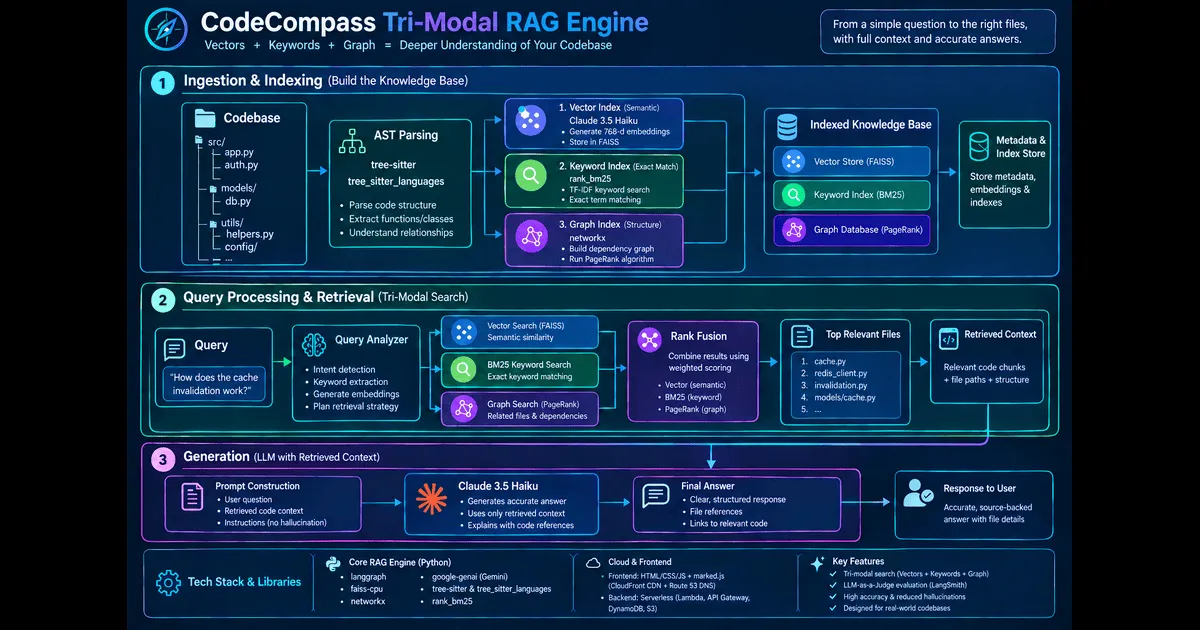
Code Compass (Tri-Modal Agentic Codebase RAG)
Discover the architecture behind CodeCompass, a state-of-the-art Tri-Modal RAG engine designed to comprehend massive codebases. This deep dive explores why traditional Vector-Only RAGs fail for code, and how I solved it using a Hybrid architecture. Learn how combining FAISS semantic vectors, BM25 keyword matching, PageRank graph centrality, and AST parsing creates an AI that understands complex architectural dependencies with 91% accuracy.

What is a RAG and Why Do We Need It?
Large Language Models (LLMs) like ChatGPT or Claude are incredibly smart, but they suffer from two major limitations when dealing with enterprise code:
- Lack of Knowledge: They don't know anything about your private, proprietary codebase.
- Context Limits: You cannot simply copy and paste an entire 100000-line repository into the AI's chat window. It will crash or aggressively forget information because it exceeds the model's memory (context window).
Because of this, if you ask a standard AI, "How does my custom authentication system work?", it will either guess (hallucinate) or simply tell you it doesn't know.
Retrieval-Augmented Generation (RAG) solves this. It acts as a highly intelligent search engine for the AI. When you ask a question, the RAG system Retrieves the exact, relevant files from your private codebase, hands those files to the AI, and asks the AI to Generate an answer based purely on that retrieved code. It gives the AI a perfect, instantaneous memory of your entire project.
______________________________________________________________________________
The Problem with Traditional Codebase RAGs
Traditional RAG systems try to build this "search engine" by blindly chopping text files into 500-word chunks and using basic vector similarity to find the right code. But code isn't a novel—it's a highly structured, interconnected web of logic. If you feed an entire repository into a standard RAG, it will likely get confused by chopped-in-half functions and missing context.
To truly understand an unfamiliar codebase, you need an architecture that understands concepts, precise variable names, and architectural dependencies simultaneously. Here is an in-depth breakdown of how the CodeCompass Tri-Modal RAG Engine processes and comprehends code behind the scenes to solve this massive problem.
______________________________________________________________________________
The Tech Stack & Python Libraries
Before diving into the architecture, here is the exact technology stack that powers CodeCompass:
Core RAG Engine (Python):
-
langgraph: Manages the agentic state machine and autonomous reasoning loops.
-
faiss-cpu: Handles the high-dimensional vector similarity search.
-
networkx: Constructs the dependency graph and executes the PageRank algorithm.
-
google-genai(Gemini): Generates the 768-dimensional text embeddings.
-
tree-sitter&tree_sitter_languages: Provides the Abstract Syntax Tree (AST) parsing for over 15 languages.
-
rank_bm25: Powers the TF-IDF exact keyword matching engine.
Cloud Infrastructure & Frontend:
- AWS: 100% Serverless backend using Lambda, API Gateway, DynamoDB, and S3.
- Frontend: Vanilla HTML/CSS/JS with
marked.js, hosted on Amazon CloudFront (CDN) & Route 53 (DNS).
The Evolution: From Vector-Only to Tri-Modal Hybrid

When building CodeCompass, I didn't start with this complex Tri-Modal architecture. Initially, I built a standard Vector-Only system (using just FAISS embeddings). It seemed to work fine for basic questions, but when I evaluated it using LangSmith to test its performance on complex codebase queries, the metrics were disappointing. It struggled to find exact variable names and often returned irrelevant helper scripts instead of core architectural files.
Realizing that Vector-Only was fundamentally flawed for codebases, I completely tore down the engine and rebuilt it as a Hybrid Tri-Modal system (combining Vectors, BM25 Keyword Search, and PageRank Graph Centrality).
______________________________________________________________________________
How I Evaluated: LLM-as-a-Judge using LangSmith
To prove this scientifically, I used LangSmith's Evaluation framework leveraging an "LLM-as-a-Judge" methodology. I constructed a rigorous dataset of 50 complex questions based specifically on the open-source
corsair repository.
For every single question, I fed the LangSmith AI Judge four specific inputs:
- The User Question (e.g., "How does the cache invalidation work?")
- The Ground Truth Answer & Documents (The manually verified correct answer, AND the exact file paths that should have been retrieved to answer it)
- The Retrieved Context (The raw code chunks the database actually found and retrieved)
- The Generated Answer (The final answer the AI produced based on that retrieved context)
The AI Judge then rigorously graded the system across 6 distinct metrics. Here is exactly what those metrics evaluated:
- Accuracy: Did the final generated answer correctly and fully address the user's question?
- Faithfulness: Was the answer based strictly on the retrieved code (proving zero hallucinations)?
- MRR@10 (Mean Reciprocal Rank): How close to the absolute #1 spot was the correct file?
- Precision@5: Out of the top 5 files retrieved, what percentage were actually useful?
- Recall@10: Out of all the files needed to answer the question, did the system find them all?
- Relevance: Was the retrieved code genuinely relevant to the original user intent?
Here is the direct head-to-head comparison proving why the Hybrid approach is mandatory for code:
Evaluation Metric | Exp #1 (Vector-Only) | Exp #2 (Tri-Modal) | Improvement |
|---|---|---|---|
Accuracy | 74% (0.74) | 91% (0.91) | +17% |
Faithfulness | 76% (0.76) | 94% (0.94) | +18% |
MRR@10 | 81% (0.81) | 97% (0.97) | +16% |
Precision@5 | 62% (0.62) | 71% (0.71) | +9% |
Recall@10 | 74% (0.74) | 95% (0.95) | +21% |
Relevance | 77% (0.77) | 97% (0.97) | +20% |
As the metrics prove, the addition of BM25 completely fixed the exact-keyword precision issues, and PageRank solved the relevance issues by boosting core architectural files to the top. Let's look at exactly how this new brain is built.
Phase 1: Ingestion (Building the Brain)
When you ask the system to index a repository, it doesn't just read the text. It surgically dissects it into four distinct "cheat sheets" so the AI can look up information in three entirely different ways.
1. The Master List & AST Parsing
Before building any databases, the system uses Abstract Syntax Trees (AST) via Tree-sitter. Instead of arbitrarily chopping code every few paragraphs, Tree-sitter parses the actual logic of the language (supporting Python, JS, Go, Rust, Java, etc.). It surgically extracts every single function and class individually.
The rule is: 1 Chunk = 1 Function/Class.
The system creates a "Master List" (saved as
chunks.pkl ), assigning an ID to each function. For example:- Chunk 0:
def login_user(request): ...
- Chunk 1:
class DatabaseConnection: ...
This Master List is the only place where the raw, human-readable code is actually stored. The following three databases only store math and pointers pointing back to this list.
2. FAISS (The "Vibes" Searcher)
Goal: Semantic Concept Matching
FAISS takes the entire body of a function (the signature, the comments, the internal math) and crushes it into a Vector Embedding—a mathematical coordinate in a 768-dimensional space.
If you ask the AI to "find where passwords are saved safely," it doesn't look for those exact English words. It translates that concept into a mathematical coordinate. It then looks at the FAISS grid and finds that a function named
hash_credential_to_db() is sitting at the exact same mathematical coordinate. FAISS allows the system to understand what a function does, even if the developer gave it a terrible, completely unrelated name.3. BM25 (The "Ctrl+F" on Steroids)
Goal: Exact Keyword Matching
If you search for the exact variable
retry_timeout_v2 , FAISS might get confused and return retry_timeout_v1 because their "vibes" are mathematically similar.BM25 solves this. It acts as an ultra-powerful dictionary index using an algorithm based on TF-IDF (Term Frequency - Inverse Document Frequency).
- IDF (Rarity Score): The system calculates how rare a word is across the entire project. Common words like
def,class, orreturnare given a score of 0. Highly unique words likestripe_payment_v2are given massive rarity scores.
- TF (Term Frequency): The system counts how many times the rare word appears in a specific file.
By multiplying these together, BM25 instantly zeroes in on the exact file containing specific variables, ignoring all the "useless" common words in your query. BM25 also includes mathematical guardrails (like length normalization) so massive 10,000-line files don't unfairly beat small, highly targeted files.
4. SQLite (The Detective's String Board)
Goal: Architectural Dependency Mapping
If you ask, "If I delete the Database class, what breaks?", FAISS and BM25 are useless. They only read text inside files; they don't know how files interact.
CodeCompass turns the codebase into a mathematical network (a Graph). Using a SQLite database, it explicitly maps out every relationship in two tables:
- Nodes: Every function and class.
- Edges: Every connection (e.g., "Chunk 0 calls Chunk 1").
With this map built, it runs Google's PageRank algorithm. The importance of this algorithm cannot be overstated: in traditional RAG, a tiny, unimportant helper script that happens to mention a keyword might unfairly beat out the main architectural file. PageRank fixes this. If a specific class (like
DatabaseManager ) is called by 50 other files, the algorithm proves it is a highly critical architectural pillar. By assigning it a massive PageRank score, the system mathematically guarantees that the most heavily-relied-upon code always rises to the top of the search results, completely filtering out irrelevant noise.
A Look Inside the Databases
To truly understand how this works, imagine what these four files actually look like when the system ingests a function like
def check_auth(user_token): .1. The Master List ( chunks.pkl )
This file assigns an ID to the chunk and saves the raw text.
- [Chunk 5]:
def check_auth(user_token): ...
2. FAISS ( faiss.bin )
A grid of raw math (768 numbers per row). Line 5 belongs to Chunk 5. It holds the mathematical "meaning" of the function.
text
Row 0: [0.11, 0.45, -0.99, ... ]...Row 5: [0.88, 0.12, -0.45, ... ]
3. BM25 ( bm25.pkl )
A dictionary mapping every word to chunks with BM25 scores.
JSON
{"check_auth": { "chunk_5": 14.5 },"user_token": { "chunk_5": 8.2, "chunk_10": 4.1 }}
4. SQLite ( graph.db )
A relational database mapping connections and storing the PageRank score directly in the
nodes table.nodes table:id | type | name | pagerank_score | chunk_id |
|---|---|---|---|---|
5 | function | check_auth | 2.45 | 5 |
edges table:source_id | target_id | relationship |
|---|---|---|
5 | 10 | calls |
When a query is made, FAISS votes based on math, BM25 votes based on the full TF-IDF score (combining word rarity and term frequency), and SQLite votes based on the PageRank score. The system aggregates these votes to find the ultimate winner.
Phase 2: Querying (The Chat)
When you finally type a question into the chat, an autonomous Agentic State Machine takes over to orchestrate the search.
1. Agentic Planning
Powered by a fast LLM reasoning engine, the Agent doesn't just blindly search your exact prompt. It plans out multiple sub-queries. It also uses HyDE (Hypothetical Document Embeddings), where it writes fake, hypothetical code answering your question, and uses that fake code to search FAISS for real code that looks mathematically similar.
2. Tri-Modal Search Execution
The system takes the planned queries and searches all three databases simultaneously:
- FAISS finds the concepts.
- BM25 finds the exact words.
- SQLite finds the architectural importance.
3. Reciprocal Rank Fusion (RRF)
The system now has three completely different lists of winning code chunks. It cannot simply add their scores together because the scoring systems are completely incompatible (FAISS scores are between 0-1, while BM25 scores can be 105).
To solve this, it uses Reciprocal Rank Fusion (RRF). RRF ignores the raw math scores entirely and only looks at the Rank Position (1st place, 2nd place, 3rd place).
It gives points based on a simple fraction:
1 / (60 + rank position) .
This mathematically guarantees that a code snippet which placed #3 in Vector, #2 in Keyword, and #5 in PageRank will beat a snippet that placed #1 in Vector but didn't even show up on the other two lists. RRF rewards code that is consistently relevant across multiple different types of search.4. The Final Synthesis
RRF crowns the ultimate winning chunk IDs. The system takes these winning IDs, goes back to the Master List (
chunks.pkl ), rips out the raw human-readable code for those specific functions, and hands them to the AI.The AI reads this highly-targeted, perfectly verified code and synthesizes a flawlessly accurate response to your original question.
Key Learnings
Building a production-grade, AI-powered codebase search engine yielded several critical insights:
- Pure Vector Search Fails for Code: Standard vector embeddings (FAISS) are excellent at capturing semantic meaning, but they fail catastrophically at exact matches (like specific variable names or obscure function parameters). Code requires a hybrid approach.
- PageRank Translates to Code Importance: Applying Google's PageRank algorithm to a codebase's Abstract Syntax Tree (AST) brilliantly solved the "noisy retrieval" problem. It ensures that widely used utility functions naturally surface higher than isolated, one-off scripts.
- RRF is the Great Equalizer: When combining three entirely different retrieval systems, the mathematical scores are fundamentally incompatible (e.g., FAISS cosine similarity vs. BM25 TF-IDF scoring vs. PageRank centrality). Reciprocal Rank Fusion (RRF) proved absolutely vital for normalizing these lists into a single, highly accurate ranking purely based on position.
- Empirical Evaluation Over "Vibes": Implementing the LangSmith "LLM-as-a-Judge" pipeline was a game-changer. It transformed our evaluation process from subjective "vibes" into hard data, proving across 6 concrete metrics that the Tri-Modal approach vastly outperformed standard Vector search.
- Autonomous Smart Caching: This system heavily optimizes AWS compute costs by completely bypassing expensive ML embedding and AST parsing runs for unchanged codebases, while simultaneously reducing ingestion latency to near-zero for valid cache hits. To achieve this and ensure the agent never answers based on stale code, the Dispatcher Lambda autonomously hits the GitHub API (/commits/HEAD) to fetch the repository's live commit SHA. It compares this against the exact SHA stored in DynamoDB, and if a new commit is detected, it autonomously invalidates the cache and re-indexes the fresh code entirely behind the scenes.
Conclusion
Code Compass represents a paradigm shift in how developers interact with complex, undocumented repositories. By combining the semantic understanding of Large Language Models, the exact precision of Lexical Search, and the structural awareness of Graph Theory into a unified Tri-Modal RAG Engine, it bridges the gap between human language and machine logic.
Furthermore, by grounding this intelligence in a fully serverless, highly decoupled AWS architecture, the system is exceptionally resilient, infinitely scalable, and capable of indexing and comprehending entire codebases autonomously.
_____________________________________________________________________________
Next Step: Deploying to the Cloud
Building this Tri-Modal engine locally was only half the battle. Deploying a massive, multi-agent AI system that relies on complex math and gigabytes of databases to the public internet using a 100% Serverless AWS Architecture was an entirely different beast.
If you are interested in learning exactly how I deployed this to production using AWS Lambda, API Gateway, DynamoDB, and S3—and the critical architectural mistakes I made (and fixed) along the way— check out Part 2: Code Compass AWS Deployment Architecture here!
Enjoyed reading this content? Let the author know!
Your likes, comments, shares, and saves help creators reach more builders.

Loading recommendations
Loading article