
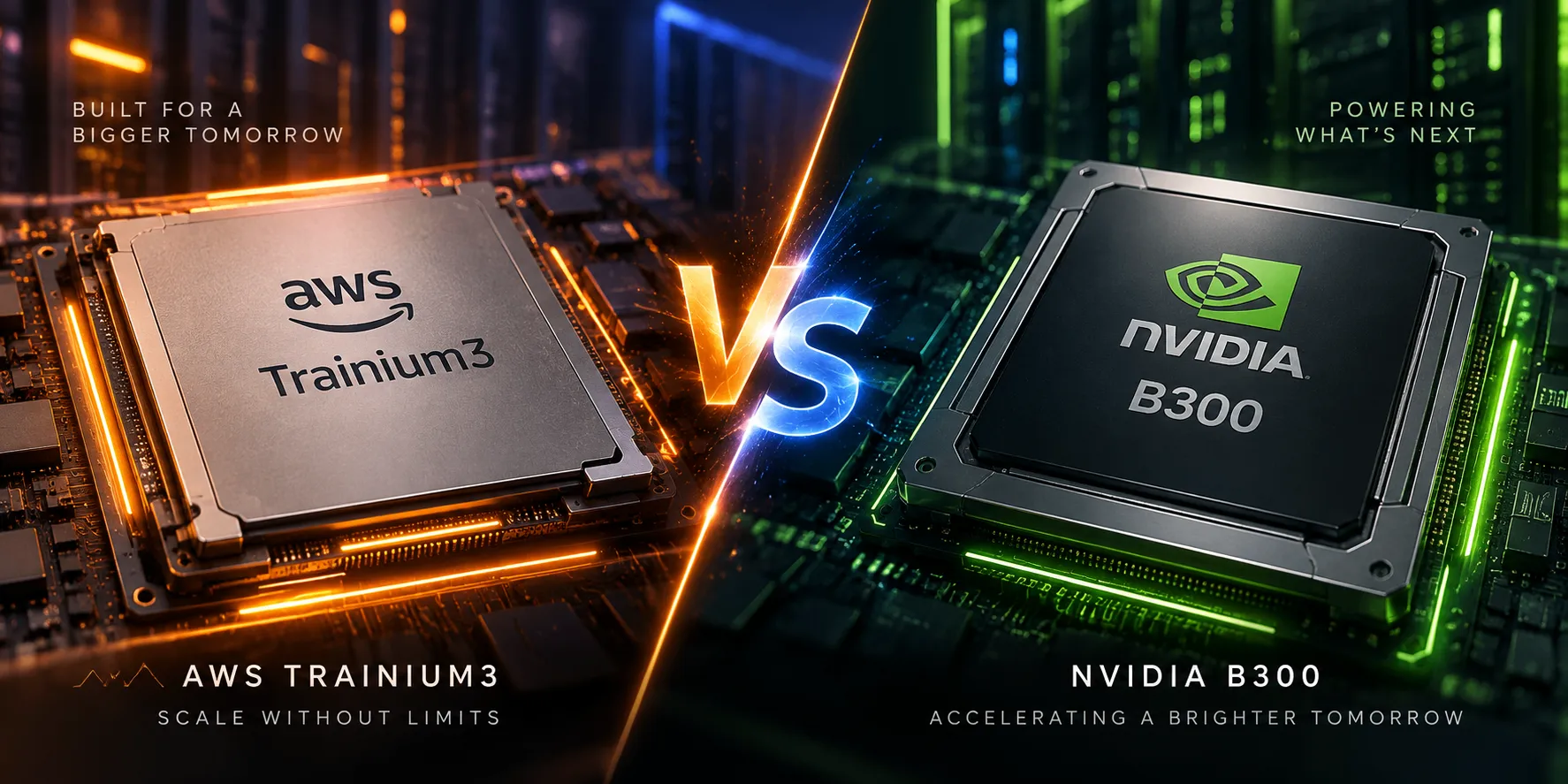
Top Tier chip comparison
A side-by-side look at AWS's Trainium3 and NVIDIA's B300: memory, bandwidth, precision formats, scaling, and software ecosystem, and when each one makes sense.

When people compare AI hardware on AWS, two names come up at the top end: AWS's own Trainium3 and NVIDIA's B300 Blackwell Ultra. Both are built for training and inference, both are available on AWS (Trainium3 as Trn3 instances, the B300 as P6-B300), and they take very different routes to the same goal. This article compares them on the specs that matter and explains when each one makes sense.
The specs side by side
Trainium3 is AWS's highest-generation AI accelerator. Each chip has 144 GB of HBM3e memory and 4.9 TB/s of memory bandwidth, and it supports formats including MXFP8, FP8, and FP16/BF16. It is programmed through NeuronLink networking and the AWS Neuron software stack.
The NVIDIA B300 has roughly 288 GB of HBM3e per GPU and up to 8 TB/s of memory bandwidth. It adds FP4 and FP6 support alongside FP8 and FP16/BF16. An eight-GPU HGX B300 system is quoted at 144 PFLOPS of sparse FP4 (108 PFLOPS dense) and 72 PFLOPS of FP8. GPUs are linked with 5th-generation NVLink, and the software stack is CUDA, TensorRT, cuDNN, and NGC.
Memory is a big deal
The clearest per-device difference is memory. The B300 offers about twice the memory of a Trainium3 chip, 288 GB against 144 GB. For large language models, that matters because you can fit bigger models and larger KV caches on fewer accelerators. AWS itself notes that model memory requirements can determine which accelerator instance is viable. On AWS, the B300 instance exposes about 268 GiB of usable memory per GPU.
Different scaling philosophies
Trainium3 is not really meant to be judged as a single chip. AWS builds from chip to server to UltraServer to UltraCluster. A Trainium3 UltraServer can combine 144 chips, reaching 20.7 TB of HBM3e and 362 MXFP8 PFLOPS. The idea is that AWS designs the chip, networking, software, and infrastructure together to optimize the cost of each training or inference workload.
NVIDIA does something similar at rack scale. Its GB300 NVL72 system combines 72 Blackwell Ultra GPUs with up to 20 TB of GPU memory and 576 TB/s of aggregate GPU memory bandwidth.
The software ecosystem
The most important difference may be software. NVIDIA has spent years building the CUDA ecosystem. PyTorch, TensorRT, CUDA libraries, Hugging Face tooling, inference frameworks, and most research code generally target NVIDIA first. That makes the B300 much more flexible: existing CUDA and PyTorch code usually runs with minimal changes.
Trainium3 is more specialized. The AWS Neuron SDK supports frameworks including PyTorch, vLLM, and Hugging Face, and AWS positions Trainium around economics and large-scale deployment. You get potentially better cost per token at production scale, in exchange for adapting your workflow to the Neuron stack.
So which one is more powerful?
FLOPS alone cannot settle it, because the two chips publish different precision metrics and use different architectures. At the individual accelerator level, though, the published numbers favor the B300 on memory capacity, memory bandwidth, and peak low-precision compute, and it comes with the more mature ecosystem. Trainium3 counters with a purpose-built AWS architecture, very aggressive scale-out, and AWS's claims of improved cost per token for production workloads.
## Which should you choose?
Choose the B300 when you need flexibility, when your code or research stack is built around CUDA, when you need the most memory per accelerator, or when you are working on general-purpose frontier AI.
Choose Trainium3 when you are running large-scale, AWS-native training or inference, when cost per token is your main metric, and when your team is ready to work with the Neuron SDK.
For most ordinary PyTorch research and reproduction work, NVIDIA is considerably easier. A sensible way to climb is by GPU tier rather than jumping straight to the top. On AWS that ladder runs from L4 (24 GB) to L40S (48 GB), then H100 (80 GB), H200 (141 GB), and finally B300. Trainium becomes attractive once you are operating at large scale and AWS cost efficiency matters more than drop-in compatibility.
Conclusion
Trainium3 and the B300 represent two philosophies. NVIDIA sells an extremely powerful, extremely flexible accelerator backed by the broadest AI ecosystem. AWS sells an integrated, cost-optimized platform that shines at scale. Pick based on your model size, your software stack, and your budget, not on a single headline number.
Enjoyed reading this content? Let the author know!
Your likes, comments, shares, and saves help creators reach more builders.

Loading recommendations
Loading article