
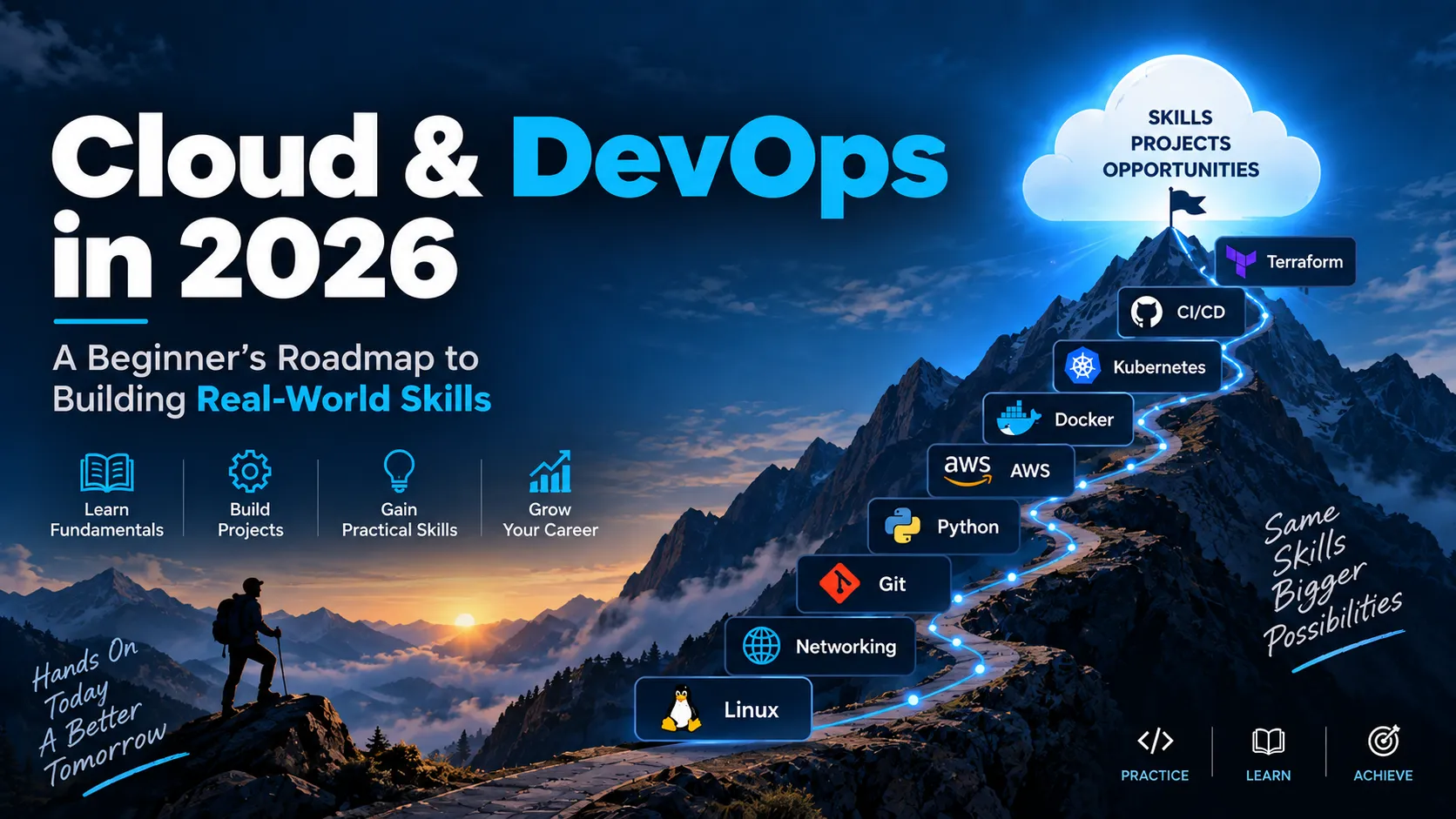
Cloud & DevOps in 2026: A Beginner’s Roadmap to Building Real-World Skills
Learn how to start your Cloud and DevOps journey from the ground up. This guide covers Linux, networking, Git, AWS, Docker, Kubernetes, CI/CD, Infrastructure as Code, and monitoring, with a focus on hands-on learning and real-world projects.

Cloud & DevOps in 2026: A Beginner’s Roadmap
Cloud computing and DevOps have become important parts of modern software development and infrastructure. Instead of simply learning individual tools, beginners should understand how these technologies work together to build, deploy, automate, and monitor applications.
A practical learning path starts with Linux and networking, then moves toward Git, scripting, cloud platforms, containers, CI/CD, and infrastructure automation.
1. Start With Linux
Linux is one of the most important foundations for DevOps. Cloud servers, containers, CI/CD runners, and many production systems commonly use Linux environments.
Focus on:
- File and directory management
- Users and permissions
- Processes and services
- Package management
- SSH
- Networking commands
- Logs
- Bash scripting
Don't try to memorize hundreds of commands. Learn how to use Linux to solve actual problems.
2. Learn Networking Fundamentals
Cloud infrastructure depends heavily on networking.
You should understand:
- IP addresses
- Subnetting and CIDR
- DNS
- DHCP
- TCP/IP
- Ports
- HTTP/HTTPS
- Firewalls
- NAT
- Routing
- Load balancers
These concepts become much easier to understand when you actually configure networks and troubleshoot connectivity.
3. Learn Git and GitHub
DevOps involves constant collaboration and automation, so version control is essential.
Learn:
1
2
3
4
5
6
7
8
git init
git clone
git add
git commit
git push
git pull
git branch
git merge
Then move toward branching strategies, pull requests, conflict resolution, and GitHub workflows.
4. Learn Bash and Python
Automation is a major part of DevOps.
Start with Bash for Linux automation:
- Variables
- Conditions
- Loops
- Functions
- Arguments
- Exit codes
- File handling
Then learn enough Python to automate more complex tasks and work with APIs.
5. Learn AWS
Once your fundamentals are strong, start working with a cloud platform such as AWS.
Important AWS services for beginners include:
- EC2 — Virtual servers
- S3 — Object storage
- IAM — Identity and access management
- VPC — Virtual networking
- RDS — Managed databases
- CloudWatch — Monitoring
AWS also provides services for building CI/CD workflows and deploying applications.
6. Learn Docker
Docker packages applications and their dependencies into containers.
Learn:
- Images
- Containers
- Dockerfiles
- Volumes
- Networks
- Docker Compose
- Container registries
Build a project where you containerize an application and run it locally.
7. Learn CI/CD
CI/CD automates parts of the software delivery process.
A typical workflow looks like:
Code → Build → Test → Package → Deploy → Monitor
Start with GitHub Actions or Jenkins and build your own pipeline rather than only watching tutorials.
8. Learn Kubernetes
After understanding Docker and container fundamentals, learn Kubernetes.
Focus initially on:
- Pods
- Deployments
- Services
- ConfigMaps
- Secrets
- Namespaces
- Scaling
- Basic troubleshooting
You don't need to master every Kubernetes feature as a beginner.
9. Infrastructure as Code
Infrastructure as Code allows infrastructure to be managed through configuration files rather than manually creating everything through a web console.
Learn Terraform and understand concepts such as:
- Providers
- Resources
- Variables
- Outputs
- State
- Modules
This becomes particularly useful when managing repeatable cloud environments.
10. Monitoring and Security
A DevOps engineer should not stop after deploying an application.
You also need to understand:
- Logs
- Metrics
- Alerts
- Monitoring
- IAM
- Secrets
- Network security
- Backups
Tools such as CloudWatch, Prometheus, and Grafana can help you understand application and infrastructure behavior.
Build Projects, Don't Just Watch Courses
The biggest difference between learning tools and developing practical skills is hands-on experience.
Try projects such as:
- Linux Server Health Monitor
- Static Website on AWS S3
- Web Application on EC2
- Dockerized Application
- GitHub Actions CI/CD Pipeline
- Terraform AWS Infrastructure
- Kubernetes Deployment
- Monitoring Dashboard
Document each project on GitHub with a clear README, architecture diagram, commands, screenshots, and lessons learned.
Final Thoughts
Cloud and DevOps can seem overwhelming because there are many technologies involved. The solution is not to learn everything at once.
Build your foundation first:
Linux → Networking → Git → Bash/Python → AWS → Docker → CI/CD → Kubernetes → Terraform → Monitoring
Most importantly, build while you learn. A small working project teaches you more than simply completing another course.
The goal isn't to collect tools. The goal is to understand how systems are built, deployed, automated, secured, and monitored.
Enjoyed reading this content? Let the author know!
Your likes, comments, shares, and saves help creators reach more builders.

Loading recommendations
Loading article