
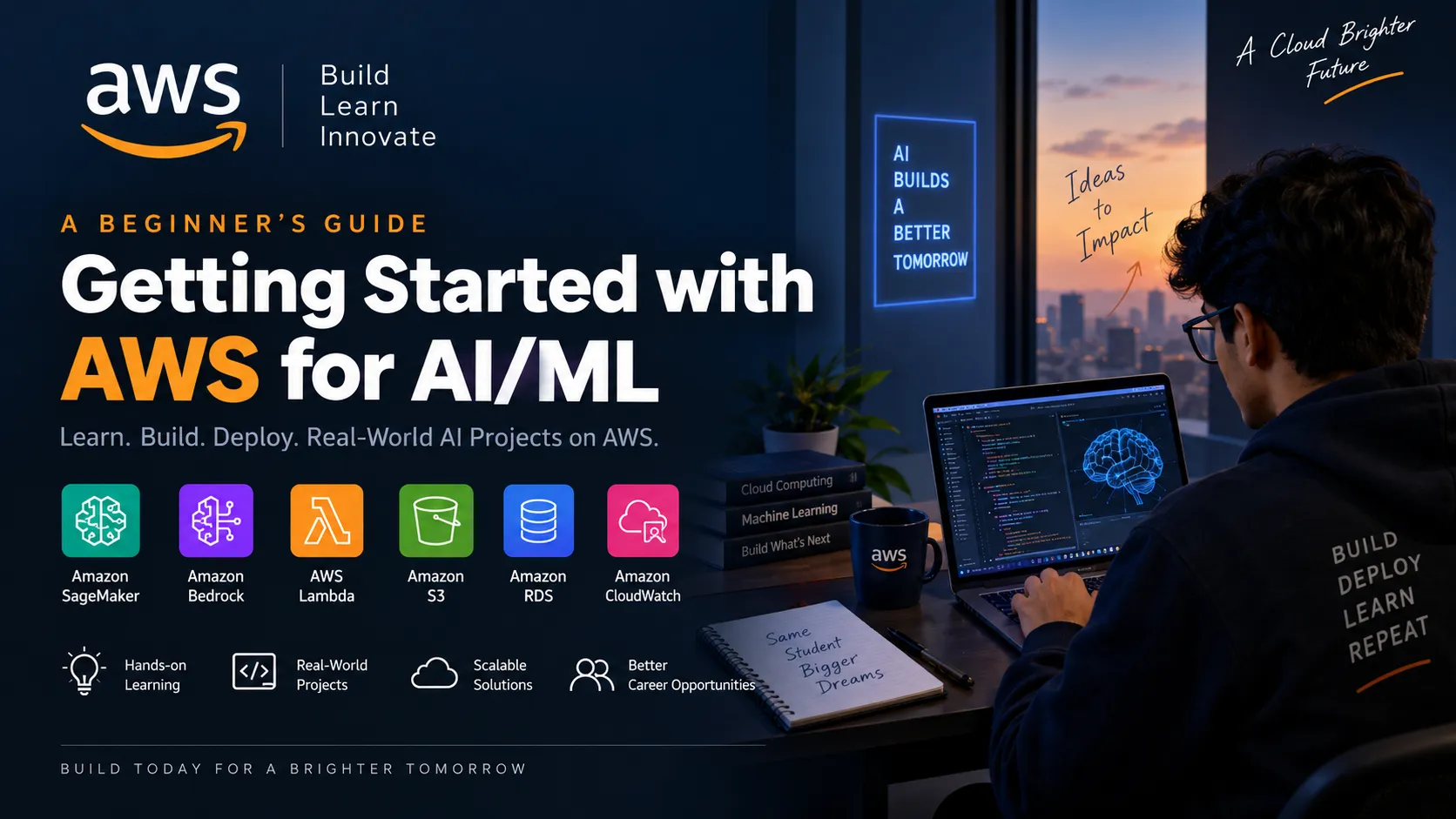
Getting Started with AWS for AI/ML: A Beginner's Learning Journey
Explore how students and aspiring developers can begin their AWS AI/ML journey through practical learning, cloud services, and real-world projects. Discover key AWS services and a roadmap for building AI-powered applications.

Getting Started with AWS for AI/ML: A Beginner's Learning Journey
Introduction
Cloud computing and artificial intelligence are transforming the way applications are designed, developed, and deployed. As a Computer Science graduate specializing in AI & Robotics, I have been exploring full-stack development, machine learning, and cloud technologies.
AWS provides a broad ecosystem of services that can help developers move from learning concepts to building practical applications. For students and beginners, starting with the right services and learning approach can make the cloud journey more structured and achievable.
In this article, let's explore how beginners can start learning AWS for AI/ML and build a foundation for real-world projects.
Why Learn AWS for AI/ML?
Machine learning models are only one part of an AI application. A complete solution may also require data storage, APIs, authentication, deployment, monitoring, and scalable infrastructure.
AWS offers services that can support different parts of this development process.
Learning AWS can help developers understand:
- How cloud infrastructure supports applications.
- How AI/ML models can be developed and deployed.
- How applications store and process data.
- How APIs and backend services connect to AI solutions.
- How cloud technologies support scalable applications.
Combining software development with cloud knowledge can help learners understand the complete application lifecycle.
Key AWS Services to Explore
1. Amazon SageMaker
Amazon SageMaker is a platform for building, training, and deploying machine learning models.
Beginners interested in AI/ML can explore model development workflows, data preparation, training, and deployment.
Learning idea: Build a simple machine learning model and explore how it can be deployed through a cloud-based workflow.
2. Amazon Bedrock
Amazon Bedrock provides access to foundation models through APIs and AWS capabilities.
It is useful for exploring generative AI applications such as chatbots, text generation, and intelligent assistants.
Learning idea: Build a basic AI-powered question-and-answer application using an appropriate foundation model.
3. Amazon S3
Amazon S3 is an object storage service that can be used to store datasets, files, and application assets.
Data storage is an important part of many machine learning and software development workflows.
Learning idea: Upload a sample dataset and explore how applications can access stored data securely.
4. AWS Lambda
AWS Lambda enables code execution without managing servers directly.
It can be useful for creating event-driven functionality and lightweight backend operations.
Learning idea: Create a simple function that processes an incoming request or performs a basic data transformation.
5. Amazon CloudWatch
Amazon CloudWatch provides monitoring and observability capabilities for AWS resources and applications.
Understanding monitoring is valuable when developing applications that need to be maintained after deployment.
Learning idea: Explore application logs and basic monitoring concepts in a small AWS project.
A Beginner-Friendly Learning Roadmap
Learning cloud and AI technologies becomes easier when concepts are combined with practical projects.
Step 1: Understand Cloud Fundamentals
Start with core concepts:
- What is cloud computing?
- What are regions and availability zones?
- What are IAM users, roles, and permissions?
- How do cloud services communicate?
Build a foundation before moving into more complex services.
Step 2: Learn Basic AWS Services
Explore services such as Amazon S3, AWS Lambda, and Amazon EC2.
Focus on understanding what each service does and when it may be useful.
Step 3: Explore AI/ML Services
Move toward Amazon SageMaker and Amazon Bedrock.
Learn the difference between traditional machine learning workflows and generative AI applications.
Step 4: Build a Practical Project
Choose a project that connects your existing programming skills with AWS.
For example:
AI-Powered Document Classification Application
A possible architecture could include:
- A frontend built with React.
- A backend API built with Python and FastAPI.
- Cloud storage for uploaded documents.
- A machine learning model for classification.
- An AWS-based deployment and monitoring workflow.
The architecture should be adapted to the selected services, project requirements, and security considerations.
Step 5: Document and Improve
After building a project, document the architecture, challenges, and lessons learned.
Try improving the application through:
- Better error handling.
- Secure access management.
- Monitoring and logging.
- Testing.
- Performance optimization.
These practices help connect learning with software engineering workflows.
My Learning Perspective
My background in full-stack development and AI/ML has encouraged me to explore cloud technologies further.
While working on software projects, I have seen how important backend services, APIs, databases, and deployment processes are to building useful applications.
I believe hands-on learning is especially valuable for students because it allows us to connect theoretical knowledge with practical development.
AWS learning labs, guided projects, and beginner-friendly documentation can help aspiring developers gain confidence while exploring cloud technologies.
Challenges Beginners May Face
Getting started with cloud computing can be challenging. Some common areas that require attention include:
- Understanding cloud service pricing.
- Managing permissions and security.
- Selecting the right service for a project.
- Learning deployment workflows.
- Debugging cloud-based applications.
Beginners should carefully review AWS pricing, available free-tier benefits, and service limitations before running resources. Always follow security best practices and avoid exposing credentials.
Final Thoughts
AWS provides opportunities to explore cloud computing, machine learning, and application development through a wide range of services.
For students and early-career developers, a combination of structured learning and practical projects can be a useful way to develop cloud skills.
My goal is to continue learning, build AI-powered applications, and explore how cloud technologies can support innovative solutions.
Learn. Build. Experiment. Repeat.
What AWS service are you currently learning, and what project would you like to build with it? Share your thoughts in the comments! 🚀
Enjoyed reading this content? Let the author know!
Your likes, comments, shares, and saves help creators reach more builders.

Loading recommendations
Loading article