
Kiro: A New Approach to AI-Powered Software Development
Kiro is designed to help developers move from an idea or natural-language prompt toward a structured, production-oriented implementation. Instead of focusing only on code generation, Kiro introduces concepts such as spec-driven development, steering files, agent hooks, and AI agents to provide more structure and automation throughout the development process.

Artificial intelligence is changing the way software is built. AI coding assistants can already generate code, explain errors, and help developers solve problems. However, building a real-world application involves much more than writing code. Developers also need to understand requirements, design the system, write tests, maintain documentation, and ensure that the implementation follows project standards.
This is where Kiro, AWS's agentic development environment, takes a different approach.
Kiro is designed to help developers move from an idea or natural-language prompt toward a structured, production-oriented implementation. Instead of focusing only on code generation, Kiro introduces concepts such as spec-driven development, steering files, agent hooks, and AI agents to provide more structure and automation throughout the development process.
What is Kiro?
Kiro is an agentic development environment from AWS. It is available as an IDE and also provides CLI and web-based development experiences.
At its core, Kiro allows developers to interact with their codebase using natural language while maintaining context about the project. Developers can ask Kiro to explain existing code, implement features, generate tests, troubleshoot problems, or work through a larger development task.
The important difference is that Kiro is designed around the idea that AI should not simply generate code from a short prompt. For complex software projects, the AI needs structured requirements, technical context, and clear development rules.
This philosophy is reflected in one of Kiro's main concepts: spec-driven development.
Spec-Driven Development
One of the most interesting features of Kiro is its specification-based development workflow.
Imagine that a developer wants to build an authentication system. A simple AI coding assistant might immediately start generating login pages, APIs, database models, and authentication logic.
Kiro can instead help break the requirement into structured artifacts.
A typical workflow can move through:
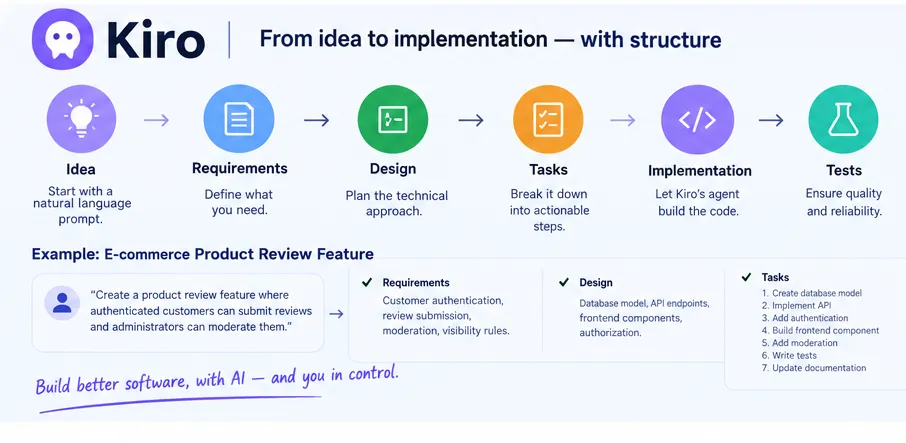
Idea → Requirements → Design → Tasks → Implementation → Tests
This approach gives the developer an opportunity to review the plan before the implementation is completed.
Kiro specifications can formalize requirements, technical design, and implementation tasks. This is particularly useful for larger features where directly asking an AI agent to "build everything" could result in missing requirements or inconsistent implementation.
For example, instead of simply asking:
"Build a student attendance system."
A developer can use Kiro to define requirements such as:
- Students can register for courses.
- Teachers can record attendance.
- Students can view their attendance percentage.
- Administrators can generate reports.
- Authentication must be implemented securely.
- The application should include automated tests.
These requirements can then become the foundation for the technical design and implementation.
This makes the AI development process more structured and easier to review.
Steering Files: Giving AI Project-Specific Knowledge
Another useful Kiro feature is steering.
In traditional AI coding workflows, developers often have to repeatedly explain project conventions to an AI assistant.
For example:
- Which framework should be used?
- What naming conventions does the project follow?
- Where should API files be located?
- What testing framework is required?
- Which libraries should developers use?
- What coding standards should be followed?
Kiro's steering files provide persistent project-specific instructions and context through Markdown files. This allows developers to define standards and conventions that Kiro can use while working on the project.
This can be especially valuable for teams because the AI agent can consistently follow established project patterns instead of relying on developers to repeat the same instructions in every conversation.
Agent Hooks and Automation
Kiro also introduces agent hooks, which can automate repetitive development activities.
An agent hook can trigger an AI-powered action when a particular event occurs, such as creating, modifying, or deleting a file.
For example, a development team could create an automation that helps:
- Generate or update documentation.
- Create unit tests.
- Review changes.
- Check coding conventions.
- Perform repetitive maintenance tasks.
This changes the role of AI from something a developer manually asks for every time into something that can participate in the development workflow automatically.
Kiro and MCP
Kiro also supports the Model Context Protocol (MCP), which allows agents to connect with external tools, services, documentation, APIs, and other sources of information.
This is important because modern software development rarely happens inside a single codebase.
A developer might need information from:
- Documentation
- Databases
- APIs
- Cloud services
- Monitoring systems
- Internal development tools
By connecting agents to additional tools and data sources, Kiro can become more useful for workflows that extend beyond simply editing source code. AWS describes MCP as one of the capabilities shared across Kiro's IDE, CLI, and web experiences.
Kiro Powers
Kiro also provides Powers, which package specialized capabilities for particular development workflows.
For example, AWS has introduced a Kiro Power for the AWS Serverless Application Model (SAM). It provides guidance for building, testing, and deploying serverless applications and supports AWS event-driven services and Lambda development patterns.
AWS has also introduced an AWS Observability Power, which brings together capabilities for investigating application and infrastructure health using services such as CloudWatch, Application Signals, and CloudTrail.
This shows how Kiro can be extended beyond general-purpose coding into specialized AWS development workflows.
Kiro Web
Kiro is not limited to the desktop IDE.
Kiro Web provides a browser-based development experience where developers can work with repositories through an AI agent. It supports interactive development as well as specification-based and autonomous workflows.
According to the current Kiro documentation, Kiro Web can work with GitHub and GitLab repositories and can create pull requests or merge requests. Developers review the resulting work before it reaches the repository's default branch.
This creates an interesting development model where some software tasks can be delegated to an AI agent while developers remain responsible for reviewing the result.
Why Kiro Matters for Developers
The biggest value of Kiro is not simply that it can generate code.
Many AI coding tools are excellent at producing individual functions, components, or files. But software engineering is a much larger process.
A successful application requires:
Requirements + Design + Code + Testing + Documentation + Maintenance
Kiro attempts to connect these parts together.
Its spec-driven approach helps developers think about requirements before implementation. Steering provides persistent project context. Hooks automate repetitive activities. MCP and Powers extend the agent's capabilities.
Together, these features create a more structured approach to AI-assisted software engineering.
A Simple Example
Consider a developer building an e-commerce application.
They might start with a requirement such as:
"Create a product review feature where authenticated customers can submit reviews and administrators can moderate them."
Instead of immediately generating code, a Kiro workflow can help transform this idea into:
Requirements
- Customers must be authenticated.
- Customers can submit one or more product reviews.
- Reviews contain a rating and written feedback.
- Administrators can approve or reject reviews.
- Unapproved reviews should not appear publicly.
Design
The system could then define:
- Database changes
- API endpoints
- Authentication requirements
- Frontend components
- Authorization rules
- Testing strategy
Tasks
The implementation can then be divided into smaller tasks:
- Create the database model.
- Implement the API.
- Add authentication and authorization.
- Build the frontend component.
- Add administrative moderation.
- Write automated tests.
- Update documentation.
This process gives developers much greater visibility into what the AI is actually going to build.
Kiro and the Future of Software Engineering
AI is moving software development toward a model where developers increasingly work alongside agents.
However, giving an AI agent complete freedom without sufficient context can introduce problems. Requirements can be misunderstood, architectural decisions can be inconsistent, and generated code may not follow project conventions.
Kiro's approach is interesting because it focuses on structure and collaboration, rather than treating AI as simply an automatic code generator.
The developer remains involved in defining requirements, reviewing designs, controlling project conventions, and validating the implementation.
At the same time, the agent can handle many repetitive and complex tasks.
This creates a potential shift from:
Developer writes every line of code
to:
Developer defines the problem, architecture, constraints, and desired outcome while AI agents help execute the engineering work.
Conclusion
Kiro represents an important direction in AI-assisted software development.
Its focus on spec-driven development, steering, agent hooks, MCP, Powers, and agentic workflows goes beyond traditional autocomplete and basic code generation.
For students, developers, and engineering teams, Kiro can provide a practical way to experiment with agentic software development while maintaining a structured development process.
The most important lesson is that AI-assisted development is not only about generating code faster. It is also about giving AI better requirements, better context, better tools, and better boundaries.
As AI agents become increasingly capable, tools like Kiro point toward a future where developers spend less time on repetitive implementation and more time on problem solving, architecture, verification, and building useful software.
If you're interested in modern AI-powered development, Kiro is worth exploring—not just as another coding assistant, but as an example of how the software development workflow itself is evolving.
Enjoyed reading this content? Let the author know!
Your likes, comments, shares, and saves help creators reach more builders.

Loading recommendations
Loading article