
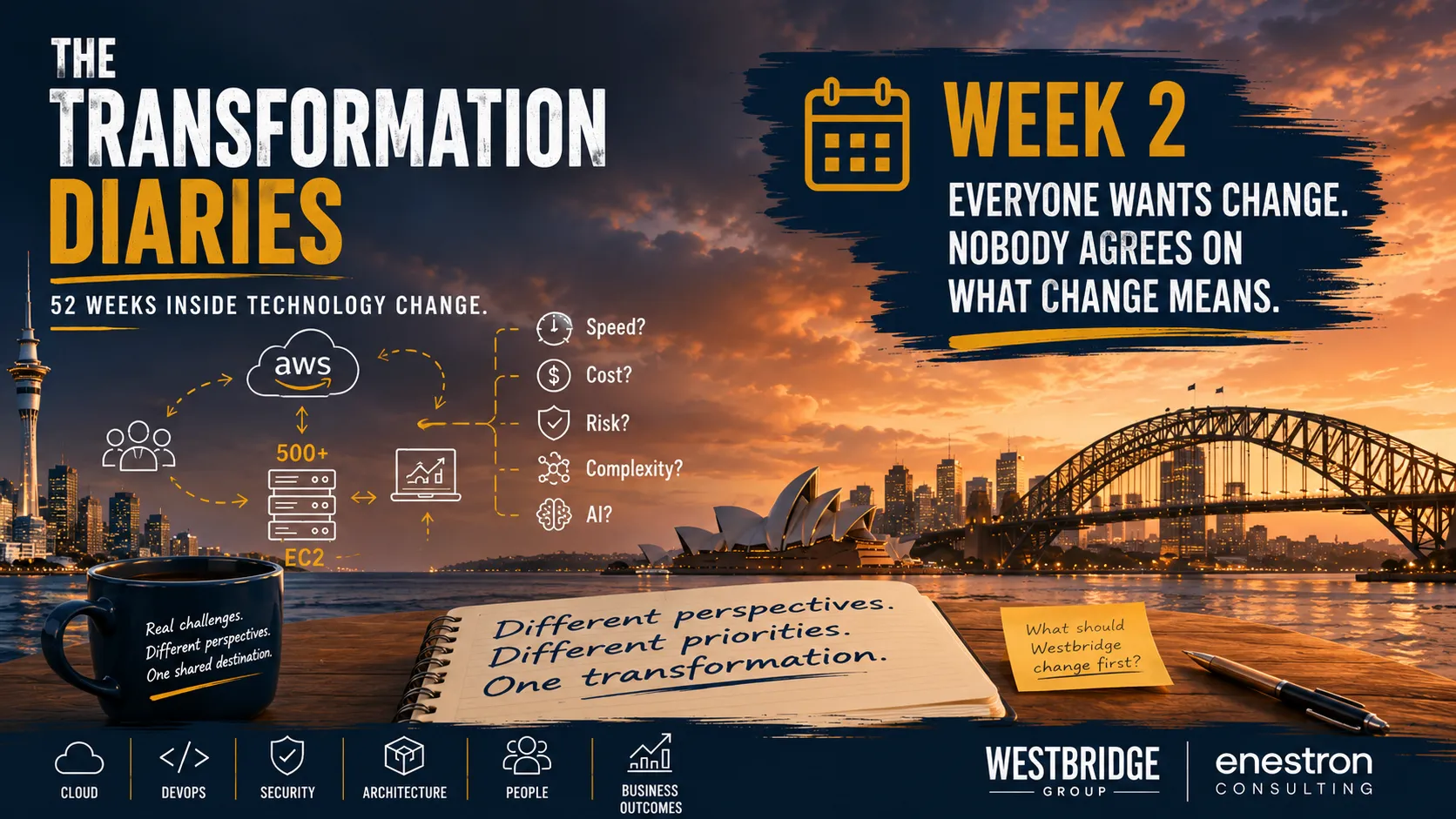
Transformation Diaries: Week 2 — Everyone Wants Change. Nobody Agrees on What Change Means
Week 2 of The Transformation Diaries is here. Everyone at Westbridge wants change — but Operations, Engineering, Security, Architecture and Leadership all see transformation through a different lens. The challenge isn’t getting people to want change. It’s aligning different priorities into one transformation. Week 2 — Everyone Wants Change. Nobody Agrees on What Change Means.
Series: The Transformation Diaries - 52 Weeks Journey (10 articles)
- 2Transformation Diaries: Week 2 — Everyone Wants Change. Nobody Agrees on What Change Means This article
Week 2 — Everyone Wants Change. Nobody Agrees on What Change Means
By the end of his first few days at Westbridge, Narayan had realised something. Westbridge didn't have a shortage of people who wanted change. It had almost the opposite problem.
Everyone wanted change. They just didn't necessarily want the same change.
In Week 1, Narayan had arrived at Westbridge with four questions in mind:
- Where are we today?
- Where do we need to go?
- Why do we need to go there?
- And are we ready for the journey — and for what comes after it?
They sounded simple enough.
A week inside Westbridge was beginning to show him just how complicated the answers could become.
The same Westbridge, seen very differently
Narayan had spent the week talking to people across the organisation. Not just leadership. Engineers. Architects. Operations teams. Security. Application owners. People who had been at Westbridge for more than a decade and others who had joined recently.
The more people he spoke to, the more he understood why transformation programmes could become difficult before any technology had actually changed.
Rachel Chen, the CIO, was focused on the business.
Westbridge needed to respond faster. New business initiatives couldn't continue waiting months for technology teams to work through infrastructure, security and deployment dependencies.
For Rachel, transformation was about making technology a stronger business enabler.
Priya Nair, Head of Engineering, saw friction.
Some engineering teams had good CI/CD practices and could release regularly. Others depended heavily on infrastructure teams, manually coordinated deployments and approval processes. Priya wanted more automation, better developer experience and greater autonomy for engineering teams.
Sarah Mitchell, the CISO, wanted many of the same things.
But Sarah also knew that accelerating delivery without improving governance could simply allow Westbridge to make mistakes faster. Security couldn't continue being something checked at the end. It needed to become part of how Westbridge built and operated technology.
And then there was Mark Bennett, Head of Infrastructure & Operations.
Mark's concerns were much more immediate. His team had to keep Westbridge running. And Westbridge had a lot to keep running.
More than 500 servers and an Operations team feeling the pressure
On AWS alone, Westbridge was running more than 500 EC2 instances, with another 100+ servers still on-premises. But it was the EC2 estate that particularly caught Narayan's attention.
Nearly 80% of those instances were either created manually or had originally been provisioned using Infrastructure as Code but had since drifted from the code. The Terraform or CloudFormation might still exist, but it could no longer be confidently used to manage the running infrastructure.
In practical terms, most of the EC2 estate was being managed like traditional servers. That meant patching, configuration changes, OS upgrades, vulnerability remediation and general server management continued to require significant manual effort. Add another 100+ on-premises servers, and it was easy to understand the pressure on Mark's Operations team.
A large part of their time was being spent simply keeping the existing estate healthy, leaving less capacity to automate, simplify and improve it.
Narayan understood why this mattered so much to Mark.
Transformation, from Mark's perspective, needed to reduce that operational burden and not add another platform for his team to manage.
But why did Westbridge need 500+ EC2 instances?
The number stayed in Narayan's mind.
More than 500 EC2 instances in AWS, with nearly 80% either manually provisioned or no longer reliably managed through Infrastructure as Code.
During one of their conversations, Mark summed up his frustration with a bit of infrastructure humour.
“We moved the servers to the cloud. Unfortunately, the servers didn't get the memo that they were supposed to become cloud-native.”
Narayan laughed, but there was a serious point underneath it.
His technical instincts naturally started asking questions.
Why did Westbridge need so many?
Could some of the applications become stateless? Could some eventually move to containers? Could managed AWS services remove some of the infrastructure Westbridge was maintaining itself? Were some workloads simply rehosted years ago and never reassessed?
And perhaps some of those EC2 instances were completely justified.
Narayan didn't know yet.
He had been at Westbridge for barely a week, and jumping from “we have 500 EC2 instances” to “we should containerise” would be exactly the kind of technology-first transformation thinking he wanted to avoid.
Five hundred EC2 instances weren't a conclusion. They were a question.
So he wrote it down. And left it there.
At least for now.
Then Narayan met Raghu
There was another person Narayan found himself spending more time with during the week.
Raghu, Westbridge's Enterprise Architect.
Raghu had a useful talent: he could understand a complicated problem without making his explanation of it equally complicated.
He was technically strong, forward-looking and pragmatic. He understood why Priya wanted engineering to move faster, why Mark was feeling the pressure of the existing estate, and why Sarah was concerned that governance hadn't always kept pace with cloud adoption.
But Raghu had something Narayan didn't yet have.
Context.
He had been close to many of Westbridge's technology decisions over the years and knew the stories behind some of the architecture that people now casually labelled technical debt.
Not all of it had been bad architecture.
The business had changed. Teams had changed. AWS had changed. Westbridge itself had changed.
Raghu had a simple way of explaining it.
“Architecture doesn't come with an expiry date. It just reaches an age where people start looking at it and asking, ‘Why on earth did we do that?’”
He smiled.
There was usually a perfectly reasonable answer. The context around the decision had simply moved on.
“The answer wasn't necessarily wrong. The question had changed.”
That was something Narayan immediately liked about Raghu.
He didn't defend the past simply because he had been part of it. But he didn't dismiss it just because something newer now existed either.
Later that week, another discussion had gone in circles around whether Westbridge's real problem was applications, infrastructure, engineering practices or security.
Raghu listened for a while before offering another characteristically simple observation.
“We've separated the problems because that's how our teams are organised. The technology doesn't know our org chart.”
That one stayed with Narayan.
He was beginning to realise that Raghu wasn't going to be someone who simply agreed with him. He understood Westbridge too well for that.
Narayan suspected he was going to enjoy working with him. Discovering that Raghu was as hopelessly interested in cricket as he was only improved the odds.
Alignment doesn't mean agreement
By the middle of the week, Narayan had stopped expecting everyone to agree. In fact, he wasn't sure they should.
Rachel, Mark, Priya, Sarah and Raghu had different responsibilities, so their priorities were naturally different. The goal wasn't to make everyone see transformation in exactly the same way; it was to connect those perspectives. Rachel wanted Westbridge to respond faster to the business. Priya wanted to remove engineering friction. Mark wanted to reduce operational burden and simplify the estate. Sarah wanted Westbridge to move faster without losing control. Raghu wanted the organisation to stop treating interconnected problems as isolated technology projects.
Those outcomes could support each other, but only if Westbridge treated them as parts of the same transformation. Otherwise, Infrastructure would run an infrastructure transformation, Engineering a DevOps transformation, Security a security transformation, Architecture a modernisation programme, and Finance a cost-optimisation programme.
And then there was AI.
Leadership was understandably excited about it, and ideas were already appearing in presentations and conversations. Narayan wasn't against AI, but something about the discussion felt backwards.
It was beginning to sound as though Westbridge had found the solution and was now searching for the problem.
AI would have its place in the transformation. Narayan just wasn't convinced Westbridge was ready to decide what that place was yet.
Without alignment, Westbridge could end up running six transformations at once and an AI programme on top without actually transforming as an organisation.
Then the conversations became harder
By Thursday, the conversations had changed. People were no longer discussing what transformation meant in principle. They were arguing about what Westbridge should do first.
Mark was clear that Operations couldn't keep carrying the existing estate while being asked to support another wave of change.
“My team is already keeping more than 600 servers alive. We can't transform everything while keeping everything exactly as it is.”
Priya saw it differently. Continuing to invest heavily in managing servers was, in her view, part of the problem.
“If all we do is make the current model easier to maintain, we'll still have the same model two years from now.”
Sarah agreed that Westbridge needed to move faster, but wasn't comfortable accelerating change while security and governance remained inconsistent.
Nobody was being unreasonable. That almost made it worse.
The discussions became harder. Priorities collided. Meetings ran over. Decisions that had looked straightforward on a transformation roadmap suddenly had dependencies everywhere.
Narayan found himself listening, challenging, mediating and occasionally wondering which problem they were actually trying to solve.
By Friday afternoon, there was still no neat answer.
And Narayan was exhausted.
Friday
By Friday afternoon, Narayan was exhausted. It wasn't the hours. It was the conversations.
The week had been full of difficult discussions, competing priorities and moments where Narayan could understand both sides of an argument.
Everyone wanted Westbridge to change, but the harder they talked about what needed to change first, the further apart some of the teams seemed to become.
As Narayan closed his laptop, a thought crossed his mind.
What the hell have I got myself into?
The Friday traffic wasn't going to make things any better. He sat in the car and started the engine. The radio was already on. Narayan wasn't much of a rap fan, but “All the Way Up” by Fat Joe was playing.
He was about to change it, then stopped.
Maybe it was a sign.
Keep going. Trust the journey. One step at a time.
He let the song play. And somewhere in the heavy traffic on the way home, he played it again.
Then again.
Monday could wait.
Next week in The Transformation Diaries
Week 3 — The Cloud Estate Nobody Really Understands
Series: The Transformation Diaries - 52 Weeks Journey (10 articles)
- 2Transformation Diaries: Week 2 — Everyone Wants Change. Nobody Agrees on What Change Means This article
Enjoyed reading this content? Let the author know!
Your likes, comments, shares, and saves help creators reach more builders.

Loading recommendations
Loading article