

Overcoming Cyclic Dependencies in AWS CDK
A graph-first guide to diagnosing and resolving CloudFormation resource cycles, cross-stack reference cycles, and export-removal deadlocks in AWS CDK, with tested TypeScript implementations.

AWS CDK lets us describe infrastructure with familiar TypeScript objects and method calls. That convenience can hide the artifact that ultimately matters: the directed dependency graph AWS CloudFormation must create, update, and delete.
When that graph contains
A → B → A , there is no valid first node. The correct response is not to “force the order.” It is to remove, defer, reverse, or externalize one of the edges.This article builds that mental model and applies it to three reproducible scenarios:
- An S3 bucket notification, Lambda function, execution role, and invocation permission form a resource cycle inside one CloudFormation template.
- An ECS Fargate service consumes an Aurora endpoint while a database-owned security-group rule imports the service security group, creating a cycle between CDK stacks.
- A valid DynamoDB-to-Lambda cross-stack reference becomes an update-time deadlock when CDK tries to remove an export that a deployed consumer still imports.
The complete TypeScript implementations, tests, diagrams, and validation script are available in the public repository: aws-cdk-cyclic-dependency-patterns .
The examples were compiled against
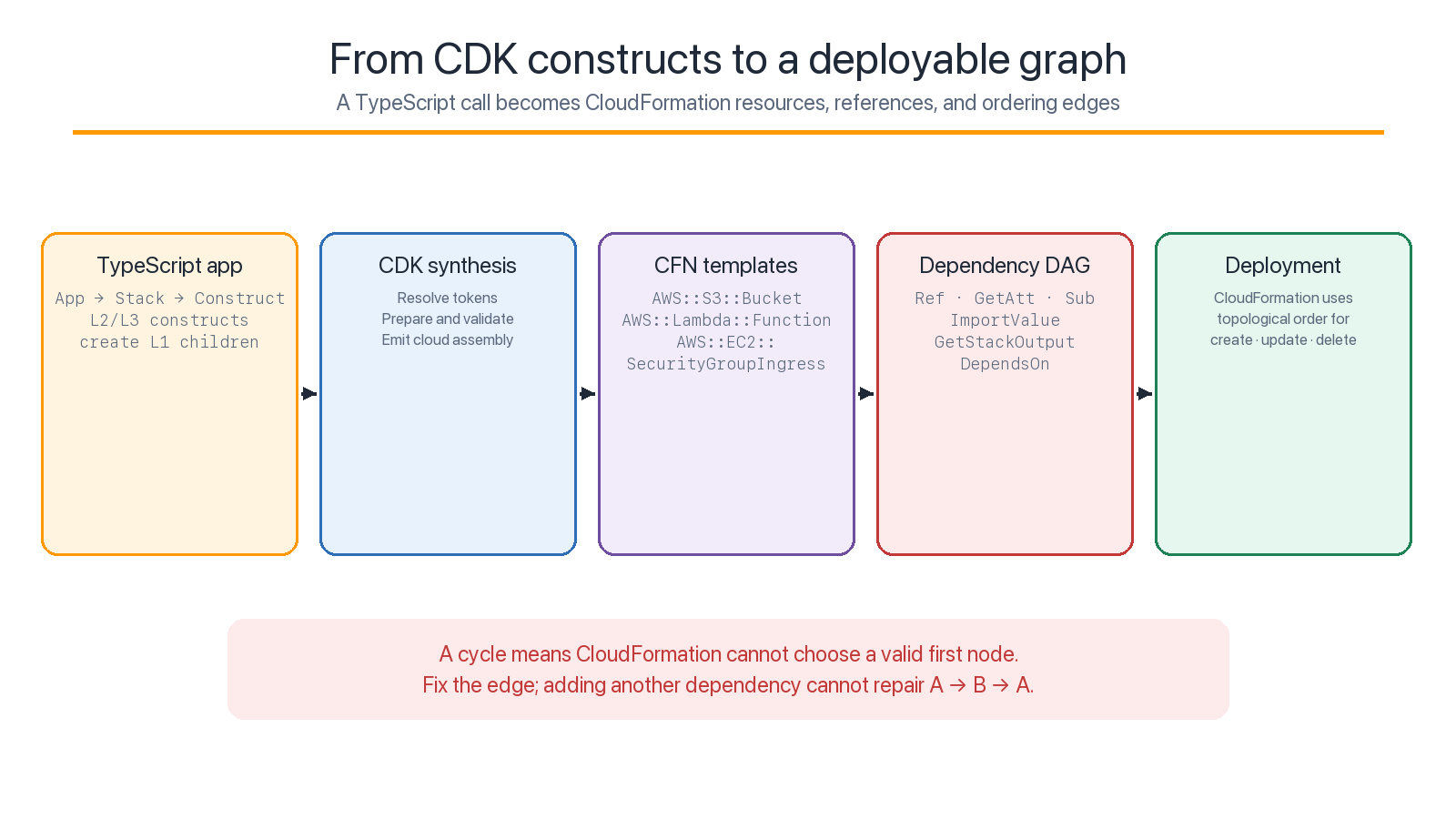
aws-cdk-lib 2.267.0. On September 2, 2026, the repository passed eight tests, credential-free synthesis, CloudFormation validation for sixteen valid templates, and both expected negative checks using an isolated test identity. The validation path did not deploy any AWS resources, and the repository stores neither a profile name nor credentials. View architecture diagram: CDK constructs to CloudFormation dependency graph
CDK source is transformed into a deployable graph; CloudFormation evaluates that graph for cycles.
1. The deployment model behind a CDK application
A CDK application contains two related structures:
- a construct tree, built while the TypeScript program runs; and
- one or more CloudFormation resource graphs, generated during synthesis.
The construct tree describes composition and ownership. The CloudFormation graphs determine deployment ordering.
Consider an ordinary property reference:
new lambda.Function(this, 'Worker', { environment: { QUEUE_URL: queue.queueUrl, },});
During TypeScript execution,
queue.queueUrl is usually a token rather than the final URL. When the function and queue are in the same stack, CDK turns that token into Ref , Fn::GetAtt , Fn::Join , or a related intrinsic. If the consumer and producer are in different stacks, CDK also needs a cross-stack reference mechanism.Template expression in resource A | Meaning |
|---|---|
Ref to resource B | A depends on B |
Fn::GetAtt from B | A depends on B |
Resource-dependent Fn::Sub | A depends on every referenced resource |
DependsOn: B | A explicitly depends on B |
Fn::ImportValue | The consumer stack strongly references an export from the producer |
Fn::GetStackOutput | The value is looked up from another stack without creating an export deletion lock |
CloudFormation creates independent nodes in parallel. It orders only the nodes connected by these edges. The same rule is reversed for deletion: the consumer must be removed before the producer it references.
A data dependency is not merely an ordering dependency
These operations solve different problems:
// Transfers a value. CDK must synthesize a cross-stack mechanism.new CfnOutput(consumerStack, 'QueueArn', {  value: queue.queueArn,});
// Adds deployment ordering only. No value is transferred.consumerStack.addStackDependency(producerStack);
If a consumer needs a value that does not exist until a producer deploys,
addStackDependency() cannot manufacture that value. If two value references already form A → B → A , another ordering edge cannot make the graph acyclic.Runtime flow and deployment flow are different
An S3 bucket can invoke a Lambda function while the function reads from the same bucket at runtime. An ECS task can connect to a database that returns query results. Bidirectional runtime behavior is normal.
The deployment graph asks a different question: which resource definition contains the identifier of which other resource, and which template owns the relationship resource?
This distinction prevents a common debugging mistake: trying to redesign the application's runtime request path when only CloudFormation resource ownership needs to change.
2. “Cyclic dependency” can refer to different failures
Before changing code, identify the layer that reported the error.
Failure | Detection point | Typical evidence | Correct response |
|---|---|---|---|
TypeScript module cycle | Compile, bundle, or runtime | Partially initialized import or undefined | Refactor modules or move composition to an entrypoint |
CDK stack cycle | cdk synth | would create a cyclic reference | Change cross-stack reference direction or relationship ownership |
CloudFormation resource cycle | Template validation or deployment | Circular dependency between resources | Split or defer an inline relationship |
Cross-stack export deadlock | Stack update or deletion | Export ... cannot be deleted as it is in use by ... | Migrate the consumer mechanism before removing the export |
Runtime event loop | After deployment | Recursion, event storm, or repeated invocation | Add filtering, idempotency, or change the event design |
The repository demonstrates the middle three. They require different fixes even though teams often describe all of them as “a CDK circular dependency.”
3. Scenario one: S3 notifications and Lambda permissions
Requirement
An uploads bucket must invoke a processor Lambda function for object-created events. The function also needs
s3:GetObject permission on the uploads bucket.The intentionally broken L1 implementation
The problem stack uses L1 constructs so the CloudFormation edges remain visible. The essential code from
problem-stack.ts is:const bucket = new CfnBucket(this, 'Uploads');
const role = new CfnRole(this, 'ProcessorRole', { assumeRolePolicyDocument: new PolicyDocument({ statements: [ new PolicyStatement({ effect: Effect.ALLOW, principals: [new ServicePrincipal('lambda.amazonaws.com')], actions: ['sts:AssumeRole'], }), ], }), policies: [ { policyName: 'ReadUploads', policyDocument: new PolicyDocument({ statements: [ new PolicyStatement({ actions: ['s3:GetObject'], resources: [`${bucket.attrArn}/*`], // Role → Bucket }), ], }), }, ],});
const handler = new CfnFunction(this, 'Processor', { runtime: 'nodejs22.x', handler: 'index.handler', role: role.attrArn, // Function → Role code: { zipFile: 'exports.handler = async () => undefined;', },});
const permission = new CfnPermission(this, 'InvokeFromS3', { action: 'lambda:InvokeFunction', functionName: handler.attrArn, // Permission → Function principal: 's3.amazonaws.com', sourceArn: bucket.attrArn, // Permission → Bucket sourceAccount: Aws.ACCOUNT_ID,});
bucket.notificationConfiguration = { lambdaConfigurations: [ { event: 's3:ObjectCreated:*', function: handler.attrArn, // Bucket → Function }, ],};
// S3 validates destination permission when notification configuration is set.bucket.addResourceDependency(permission); // Bucket → Permission
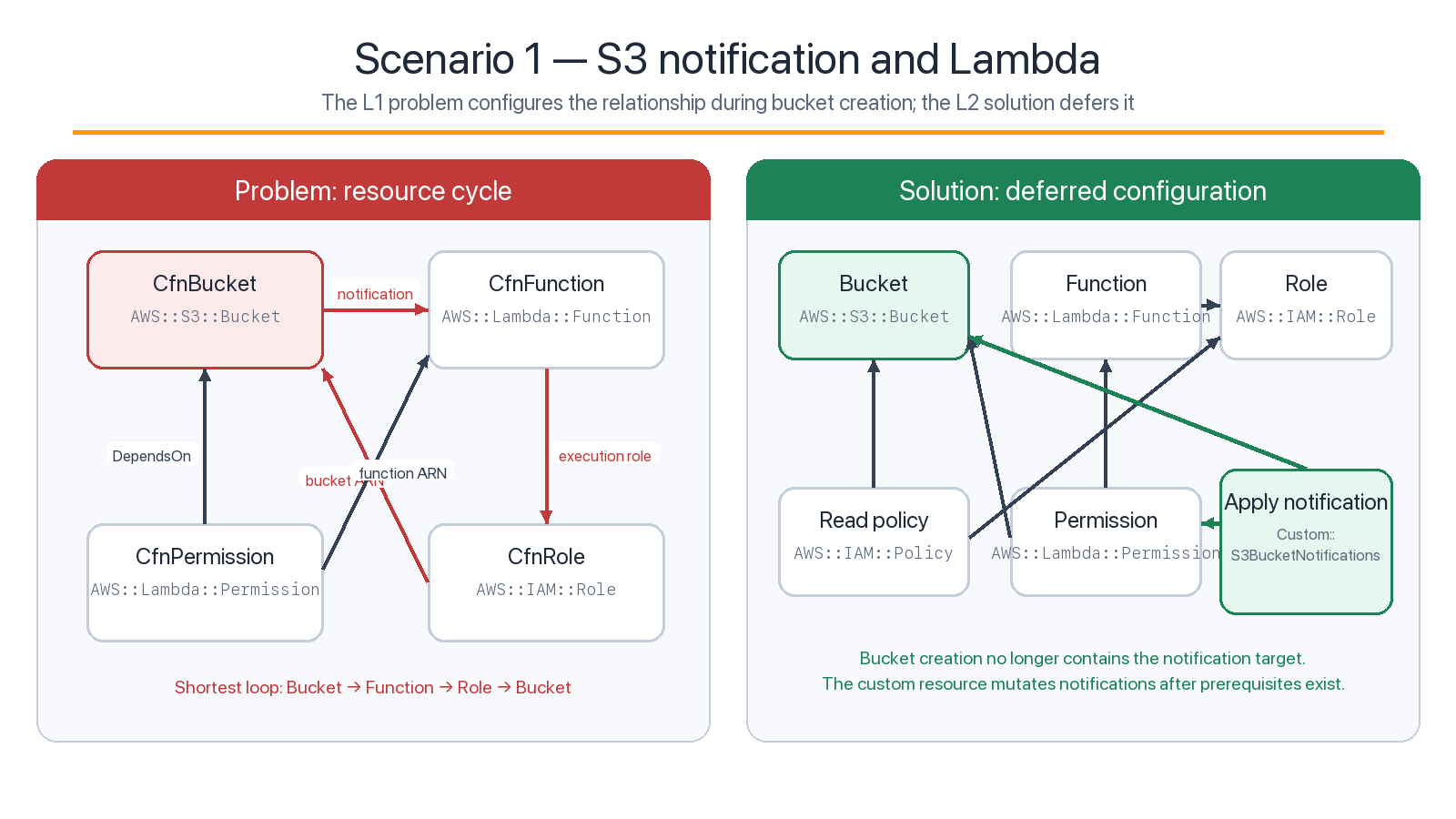
The most important edges are:
Consumer | Producer | Why |
|---|---|---|
S3 bucket | Lambda function | The bucket's create-time notification configuration contains the function ARN |
Lambda function | IAM role | The function's Role property contains the role ARN |
IAM role | S3 bucket | The inline role policy contains the bucket ARN |
Lambda permission | Function and bucket | The permission scopes invocation to both resources |
S3 bucket | Lambda permission | The explicit dependency waits for permission before applying notifications |
The shortest closed path is
Bucket → Function → Role → Bucket . View architecture diagram: S3/Lambda cycle and deferred-notification solution
Moving the notification relationship into a second-phase custom resource breaks the create-time resource cycle.
The stack can synthesize because CDK is able to emit the L1 resources. CloudFormation rejects the resulting template:
npm run synth:s3:problem
aws cloudformation validate-template \  --template-body \  file://"$PWD/cdk.out/problems/s3-lambda/Problem-S3LambdaCycle.template.json"
Expected result:
Circular dependency between resources: [...]
Why another DependsOn does not help
DependsOn adds an edge. It can express a prerequisite that CloudFormation cannot infer, but it does not remove any existing reference. The bucket already depends on the function, the function depends on the role, and the role depends on the bucket. Adding an edge from the bucket to the permission only adds another path.Solution: defer notification mutation with L2 constructs
The solution stack uses
Bucket , Function , LambdaDestination , and addEventNotification() :const bucket = new Bucket(this, 'Uploads', { blockPublicAccess: BlockPublicAccess.BLOCK_ALL, enforceSSL: true, removalPolicy: RemovalPolicy.DESTROY, autoDeleteObjects: true,});
const handler = new LambdaFunction(this, 'Processor', { runtime: Runtime.NODEJS_22_X, handler: 'index.handler', code: Code.fromInline( 'exports.handler = async (event) => console.log(JSON.stringify(event));', ),});
bucket.grantRead(handler);bucket.addEventNotification( EventType.OBJECT_CREATED, new LambdaDestination(handler),);
This is not simply shorter syntax. It changes the resource graph.
bucket.grantRead(handler) produces a standalone IAM policy that can depend on both the bucket and the execution role. The role itself no longer needs an inline property that points back to the bucket.bucket.addEventNotification() produces Custom::S3BucketNotifications . The bucket can be created without an inline Lambda target, and the custom resource applies the notification after the bucket, function, and invocation permission exist.The important synthesized relationships are therefore:
Lambda function → execution roleStandalone read policy → bucket and execution roleLambda permission → function and bucketNotification custom resource → bucket, function, and permission
There is no create-time
Bucket → Function property, so the old closed path no longer exists.npm run synth:s3:solution
The repository test verifies both architectural outcomes:
test('solution defers notifications to a custom resource', () => {  const app = buildS3LambdaSolutionApp({ env: TEST_ENV });  const stack = app.node.findChild('Solution-S3LambdaCycle') as Stack;  const template = Template.fromStack(stack);
  template.resourceCountIs('Custom::S3BucketNotifications', 1);  expect(findResourceCycles(template.toJSON())).toEqual([]);});
Production notes
- Review the custom resource provider's IAM policy. It must update the bucket's notification configuration.
- Coordinate all writers to the bucket notification document. A CDK-managed custom resource and an external process can overwrite each other's settings.
- A synthesis-time physical bucket name can remove some attribute dependencies, but global S3 name uniqueness and replacement constraints turn that name into a long-lived contract.
- The repository uses destructive removal settings only because it is a disposable example. Production data retention requires an explicit decision.
The lesson is broader than S3: when a relationship cannot exist until both endpoints exist, model the relationship as a second-phase resource or custom operation instead of embedding it in an endpoint's create-time properties.
4. Scenario two: ECS, Aurora, and cross-stack security groups
This scenario demonstrates why construct ownership matters even when the source code looks reasonable.
Stack and construct layout
The repository declares:
Stack | Important CDK constructs |
|---|---|
NetworkStack | Vpc, public subnets, isolated subnets |
DatabaseStack | SecurityGroup, Aurora PostgreSQL DatabaseCluster, serverless v2 writer |
ComputeStack | SecurityGroup, ECS Cluster, FargateTaskDefinition, FargateService |
ConnectivityStack | Standalone CfnSecurityGroupIngress and CfnSecurityGroupEgress |
DatabaseStack and ComputeStack both consume VPC attributes from NetworkStack .ComputeStack also injects the Aurora endpoint into the container environment:const container = taskDefinition.addContainer('Api', { image: ContainerImage.fromRegistry( 'public.ecr.aws/docker/library/nginx:stable', ), environment: { // This token establishes ComputeStack → DatabaseStack. DB_HOST: props.database.clusterEndpoint.hostname, },});
At this point the graph is valid:
ComputeStack → DatabaseStack → NetworkStackComputeStack ─────────────────→ NetworkStack
The method call that closes the graph
The problem application then calls:
database.databaseSg.addIngressRule( compute.serviceSg, Port.tcp(5432), 'Incorrect cross-stack rule ownership',);
The receiver,
databaseSg , belongs to DatabaseStack . With the default remoteRule behavior, CDK creates the standalone ingress resource under the current security group. That resource needs the ID of ServiceSg , which belongs to ComputeStack .The new edge is therefore
DatabaseStack → ComputeStack . Together with the existing endpoint reference, the stack graph becomes:ComputeStack → DatabaseStack → ComputeStack
View architecture diagram: security-group cycle and two acyclic solutions
The broken bidirectional stack graph is replaced by consumer-owned rules or a downstream connectivity stack.
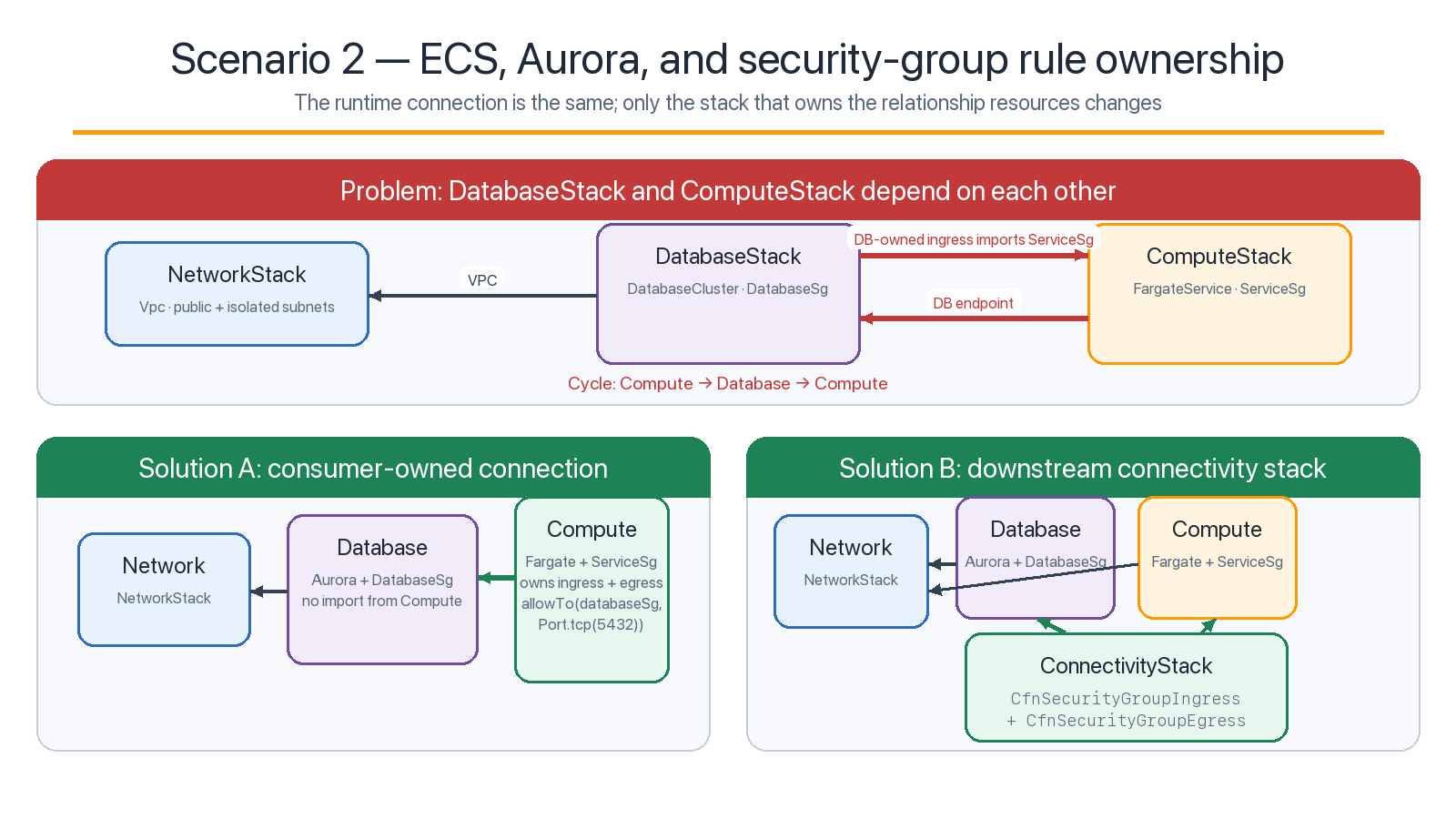
The failure appears during CDK synthesis:
npm run synth:sg:problem
Expected evidence includes:
would create a cyclic reference
The exact paths in the message can be verbose. Reduce them to the two stack directions:
- Which property makes compute consume database?
- Which generated rule makes database consume compute?
Solution A: create the connection from the already-dependent stack
The most direct fix is to let
ComputeStack own the connection:if (props.createConnectionInConsumer) { this.service.connections.allowTo( props.databaseSg, Port.tcp(5432), 'ECS tasks to Aurora PostgreSQL', );}
The AWS CDK EC2 cross-stack connections documentation specifically recommends making a connection in the stack that already depends on the other stack. A call through the caller's
connections object creates both ingress and egress security-group rules in the caller's stack.That last detail matters in this repository because
ServiceSg is created with:this.serviceSg = new SecurityGroup(this, 'ServiceSg', { vpc: props.vpc, allowAllOutbound: false,});
The service therefore needs an explicit TCP 5432 egress rule as well as an ingress rule on the database group. The test asserts that both resources are in
ComputeStack .The fixed graph remains one-directional:
ComputeStack, including the relationship rules → DatabaseStack → NetworkStack
npm run synth:sg:solution
Solution B: use a downstream connectivity stack
Sometimes database and compute teams should remain peer owners while a platform team controls connectivity. In that case, put the relationship in a third stack that imports both security-group IDs.
Because the service group denies default outbound traffic, the edge stack owns both halves of the connection:
export class ConnectivityStack extends Stack {  constructor(scope: Construct, id: string, props: ConnectivityStackProps) {    super(scope, id, props);
    new CfnSecurityGroupIngress(this, 'DatabaseFromService', {      groupId: props.databaseSg.securityGroupId,      sourceSecurityGroupId: props.serviceSg.securityGroupId,      ipProtocol: 'tcp',      fromPort: 5432,      toPort: 5432,      description: 'ECS tasks to Aurora PostgreSQL',    });
    new CfnSecurityGroupEgress(this, 'ServiceToDatabase', {      groupId: props.serviceSg.securityGroupId,      destinationSecurityGroupId: props.databaseSg.securityGroupId,      ipProtocol: 'tcp',      fromPort: 5432,      toPort: 5432,      description: 'ECS tasks to Aurora PostgreSQL',    });  }}
The resulting directions are:
ConnectivityStack → DatabaseStack → NetworkStackConnectivityStack → ComputeStack ──→ NetworkStack
Neither endpoint stack imports from the connectivity stack. That constraint is essential: if the edge stack exports a value back to either endpoint, the cycle can reappear.
npm run synth:sg:connectivity
What about remoteRule: true ?
SecurityGroup.addIngressRule() and addEgressRule() accept a remoteRule argument. If the peer is another security group in a different stack, remoteRule: true places the rule under the peer instead of the current group.This can redirect the edge without changing the apparent call direction:
database.databaseSg.addIngressRule( compute.serviceSg, Port.tcp(5432), 'PostgreSQL from ECS', true,);
It is valid, but
service.connections.allowTo(databaseSg, port) more clearly communicates that compute is the consumer and owns the relationship. Whichever API you choose, test the template containing the rule. Method names describe intent; construct scope determines CloudFormation ownership.Choosing between the solutions
Situation | Preferred default |
|---|---|
Compute already imports the database endpoint, secret, or SG | Let ComputeStack call service.connections.allowTo(...) |
Neither endpoint should own network policy | Use a downstream ConnectivityStack |
Existing code must call from the database group | Use remoteRule deliberately and document it |
Resources always deploy and change together | Put them in one stack and model the capability as a higher-level construct |
AWS CDK's best-practices guide recommends modeling logical capabilities with constructs and splitting stacks according to deployment requirements. “One AWS service per stack” is rarely a useful boundary by itself.
5. Scenario three: the export deadlock during an update
The first two scenarios are graph cycles. The third is different: both the current deployment and the desired final deployment can be valid, while the direct transition between them is blocked.
Initial strong reference
DataStack owns a DynamoDB table:export class DataStack extends Stack { readonly table: Table;
constructor(scope: Construct, id: string, props: DataStackProps) { super(scope, id, props);
this.table = new Table(this, 'Orders', { partitionKey: { name: 'orderId', type: AttributeType.STRING, }, removalPolicy: RemovalPolicy.DESTROY, });
CrossStackReferences.of(this.table).produce( props.referenceStrength, ); }}
ApiStack consumes the table name and ARN:const handler = new LambdaFunction(this, 'Handler', { runtime: Runtime.NODEJS_22_X, handler: 'index.handler', code: Code.fromInline('exports.handler = async () => undefined;'), environment: { TABLE_NAME: props.table.tableName, },});
props.table.grantWriteData(handler);
With
ReferenceStrength.STRONG , the producer template contains CloudFormation outputs with Export , and the consumer contains Fn::ImportValue .This is useful referential integrity. As the
Fn::ImportValue documentation states, an exported value cannot be modified or deleted while any deployed stack imports it.How removal becomes a deadlock
Suppose one code change removes the consumer's table use and also causes CDK to remove the producer's automatically generated export. If CDK attempts the producer update first, the old deployed
ApiStack still imports the export. CloudFormation rejects the update:Export ... cannot be deleted as it is in use by ExportMigration-Api
The final templates may contain no reference at all, but CloudFormation cannot jump directly to that final state without a safe intermediate deployment.
Current CDK migration: STRONG → BOTH → WEAK
Current AWS CDK versions expose three reference strengths:
Strength | Producer | Consumer | CloudFormation lifetime coupling |
|---|---|---|---|
STRONG | Output with Export | Fn::ImportValue | Producer export cannot disappear while imported |
BOTH | Keeps the export and a plain output | Fn::GetStackOutput | Transitional bridge; old strong consumers remain safe while new consumers move |
WEAK | Plain output without export lock | Fn::GetStackOutput | Producer can be deleted independently of consumers |
View architecture diagram: cross-stack reference migration
The safe STRONG → BOTH → WEAK sequence removes the consumer’s export lock before the producer removes the export.
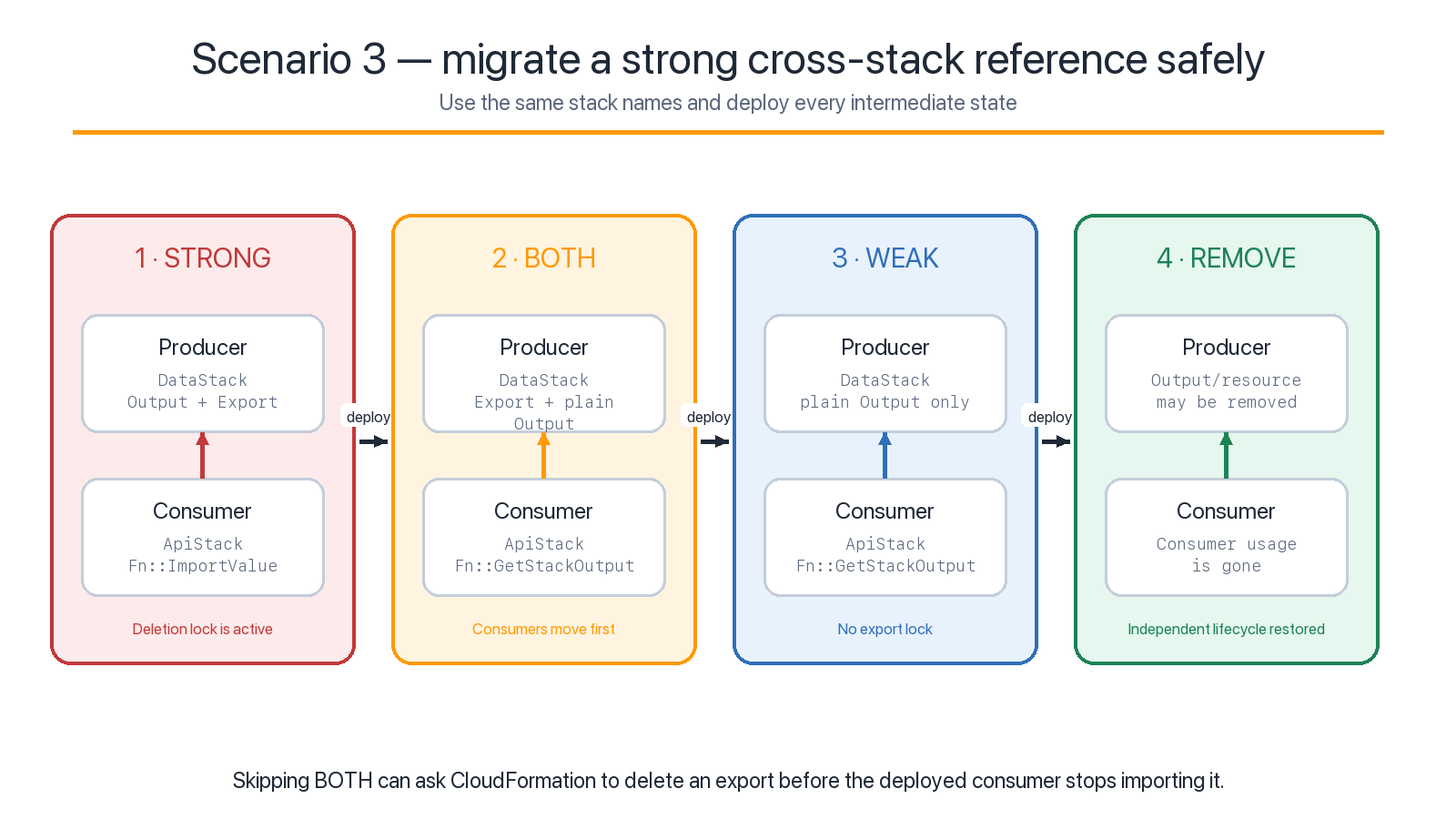
The repository has a separate entrypoint for each state while deliberately keeping the same CloudFormation stack names.
Deployment 1: switch to BOTH
CrossStackReferences.of(this.table).produce( ReferenceStrength.BOTH,);
Deploy both stacks. The producer keeps the export, while the consumer switches from
Fn::ImportValue to Fn::GetStackOutput .Deployment 2: switch to WEAK
CrossStackReferences.of(this.table).produce( ReferenceStrength.WEAK,);
Deploy again. The consumer no longer imports the export, so the producer can remove the strong-side artifact safely.
Deployment 3: remove the reference or resource
Only after the weak phase has deployed should you remove the consumer usage, producer output, table, or stack.
For a real environment, every phase should have its own review and deployment:
npm run synth:export:strongnpm run synth:export:bothnpm run synth:export:weak
Do not edit the code through all three states and deploy only the final commit. The intermediate deployed state is the solution.
Weak references are a trade-off, not a free upgrade
CloudFormation's
Fn::GetStackOutput resolves an output when the consumer stack is created or updated. It avoids the export deletion lock and can support cross-Region or cross-account references with the appropriate role.That flexibility deliberately weakens referential integrity:
- deleting the producer does not automatically update consumers;
- a later consumer update fails if the producer stack or output is missing;
- changing the producer output does not automatically redeploy consumers;
- cross-account access requires a narrowly scoped role that can describe the producer stack;
- current
Fn::GetStackOutputexpression-placement limitations still apply.
CDK can still retain deployment ordering in the cloud assembly so a first deployment creates the producer before the consumer. “Weak” means there is no CloudFormation export lifetime lock; it does not mean that the consumer can resolve a missing output.
Compatibility fallback for older CDK versions
If a project does not support reference strengths, use a two-deployment bridge:
- Remove the consumer's use, but preserve the producer's automatic export with
stack.exportValue(resourceAttribute). Deploy the consumer change while the export still exists.
- Confirm that no deployed stack imports the export. Then remove the retained export and resource.
// Temporary producer-side migration bridge.this.exportValue(table.tableArn);
Do not guess CDK's generated export name.
exportValue() retains the export for the referenced token and is designed for this migration.
6. A repeatable diagnostic workflow
Step 1: identify the failing phase
- TypeScript compile or runtime: inspect module imports.
-
cdk synth: inspect construct and stack edges.
- CloudFormation validation/create: inspect one template's resources.
- CloudFormation update/delete: inspect deployed exports and imports.
Step 2: synthesize the smallest entrypoint
npm run buildnpm testnpm run synth:sg:problem
Reducing the app to the smallest failing graph makes the edge direction easier to see than synthesizing an entire platform.
Step 3: inspect the cloud assembly stack graph
jq ' .artifacts | to_entries[] | select(.value.type == "aws:cloudformation:stack") | { stack: .key, dependencies: (.value.dependencies // []) }' cdk.out/manifest.json
Look for two artifacts that list or imply one another, or for an integration stack that has accidentally become an upstream producer.
Step 4: locate reference and relationship resources
rg -n \  'Fn::ImportValue|Fn::GetStackOutput|Export|DependsOn|Fn::GetAtt|"Ref"' \  cdk.out
rg -n \  'AWS::EC2::SecurityGroup(Ingress|Egress)' \  cdk.out
For security groups, the template containing the standalone rule is often the decisive evidence.
Step 5: inspect deployed exports for update failures
aws cloudformation list-exports
aws cloudformation list-imports \  --export-name 'the-exact-export-name'
Do not remove an export until every deployed import is gone or has migrated to a weak mechanism.
Step 6: draw the smallest closed path
Create one node for each resource or stack mentioned by the error. Add an arrow from consumer to producer for each:
-
Ref;
-
Fn::GetAtt;
- resource-dependent
Fn::Sub;
-
Fn::ImportValue;
- explicit
DependsOn;
- CDK method that creates or mutates a resource in another stack.
Find the shortest path that returns to its starting node. A working fix must change at least one edge on that path.
Step 7: verify the synthesized graph, not only the source refactor
After changing the code, confirm that:
- the relationship resource moved to the intended template;
- the reverse
Fn::ImportValuedisappeared;
- only one inter-stack dependency direction remains;
- expected ingress and egress rules both exist;
-
cdk diffdoes not replace a protected stateful resource;
- migration phases preserve the contracts required by currently deployed consumers.
7. Test dependency direction as architecture
The repository treats graph behavior as testable output.
Detect the intentional same-template cycle
dependency-graph.ts collects Ref , Fn::GetAtt , resource-dependent Fn::Sub , and DependsOn relationships, then performs a depth-first search for closed paths.const assembly = app.synth();const template = assembly.getStackArtifact(stack.artifactId).template;
expect(findResourceCycles(template).length).toBeGreaterThan(0);
Assert security-group rule ownership
Template.fromStack(database).resourceCountIs(  'AWS::EC2::SecurityGroupIngress',  0,);
Template.fromStack(compute).hasResourceProperties(  'AWS::EC2::SecurityGroupIngress',  {    IpProtocol: 'tcp',    FromPort: 5432,    ToPort: 5432,  },);
Template.fromStack(compute).hasResourceProperties(  'AWS::EC2::SecurityGroupEgress',  {    IpProtocol: 'tcp',    FromPort: 5432,    ToPort: 5432,  },);
The dedicated connectivity test makes the equivalent assertions against
ConnectivityStack and then synthesizes the entire app.Assert the migration mechanism
expect(both.api).toContain('Fn::GetStackOutput');expect(both.api).not.toContain('Fn::ImportValue');expect(both.data).toContain('"Export"');
expect(weak.api).toContain('Fn::GetStackOutput');expect(weak.data).not.toContain('"Export"');
This matters because the intermediate
BOTH template is part of the solution. Testing only the final weak template would not prove that the deployed strong consumer can migrate safely.
8. Reproduce the validation safely
Clone the repository and install the exact dependency lock:
git clone \  https://github.com/proton0210/aws-cdk-cyclic-dependency-patterns.git
cd aws-cdk-cyclic-dependency-patternsnpm ci
Run local checks without AWS credentials:
npm run buildnpm testnpm run synth:all:valid
Run AWS-backed template validation:
npm run validate:aws
# Optional: select any locally configured profile.AWS_PROFILE=my-test-profile npm run validate:aws
The script calls only:
- STS
GetCallerIdentity;
- CDK synthesis;
- CloudFormation
ValidateTemplate.
It does not bootstrap, deploy, update, or delete a stack. The positive path validates six aggregate solution templates, four downstream-connectivity templates, and six export-migration templates. The negative path confirms that the S3/Lambda template and security-group stack graph fail for the intended reasons.
If you manually deploy the examples, review
cdk diff first. Aurora Serverless v2 and ECS Fargate can incur charges, and the lab uses destructive lifecycle settings that are not production defaults.
Conclusion
AWS CDK dependency errors become much less mysterious when the synthesized infrastructure is treated as a directed graph.
The workflow is consistent:
- Identify whether the failure occurs in TypeScript, CDK synthesis, CloudFormation creation, or a deployed update transition.
- Inspect generated templates and the cloud assembly.
- Find the shortest closed dependency path.
- Remove, defer, reverse, or externalize one edge.
- Verify the new graph and protect it with tests.
For S3 and Lambda, the decisive change is to apply notification configuration after the endpoints and permission exist. For ECS and Aurora, it is to put the security-group relationship in the stack already downstream—or in a third stack that remains downstream of both. For an export deadlock, it is to migrate the consumer mechanism before removing the producer-side export.
A maintainable CDK application does not have zero dependencies. It has a small, intentional, observable, and acyclic set of dependencies.
References
Primary AWS documentation
Community references
- Dakota Lewallen, CDK Dependency Strategies
- Serverless Advocate, AWS CDK Stack Dependencies
The article's explanations, examples, diagrams, tests, and validation workflow were independently written around the companion repository rather than copied from those community posts.
Enjoyed reading this content? Let the author know!
Your likes, comments, shares, and saves help creators reach more builders.

Loading recommendations
Loading article