Patterns this week:
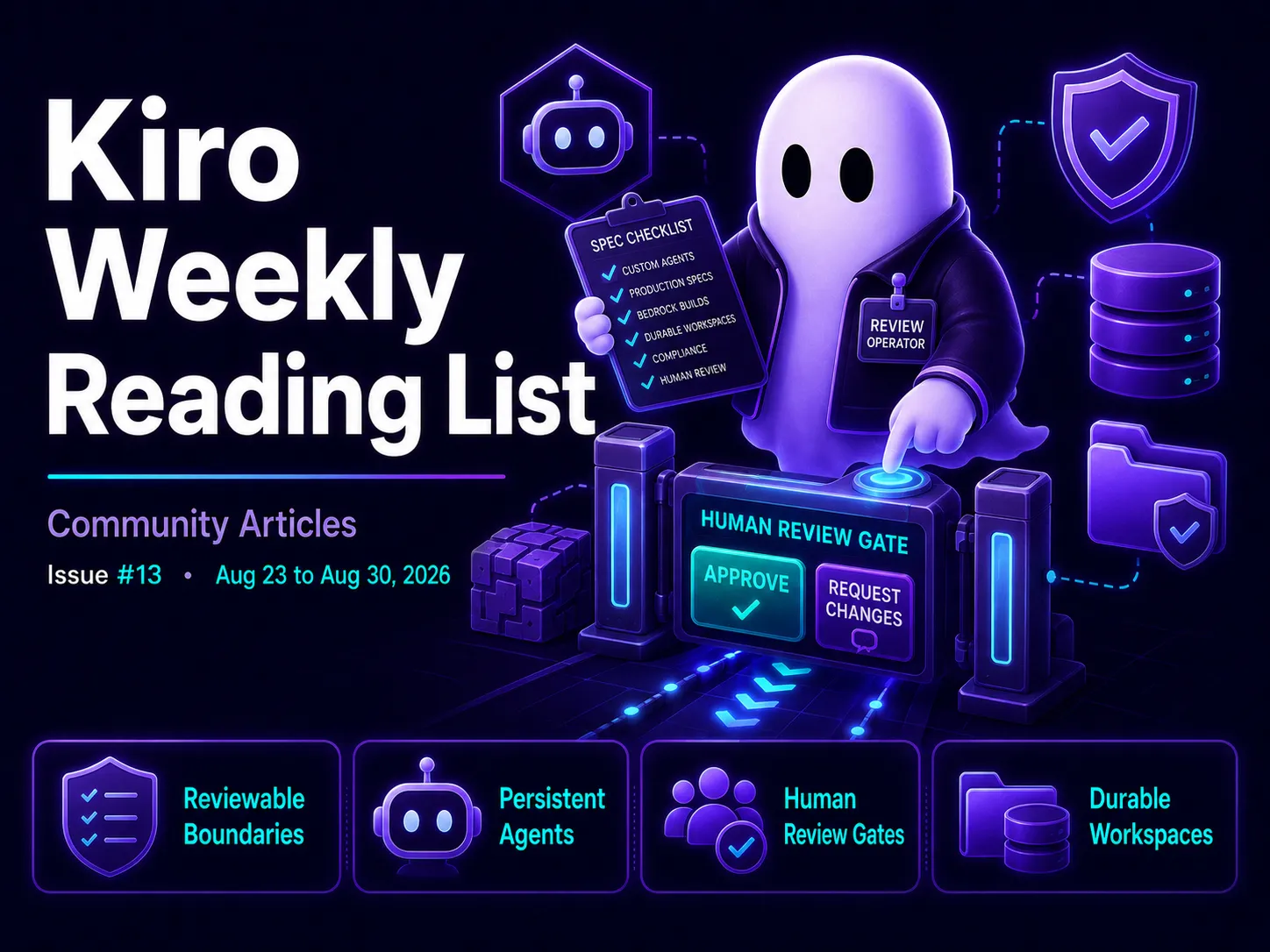
- Reviewable boundaries make agent work safer. Shruti Saraswat uses Specs to expose product decisions before implementation. Contardo Acuña applies the same idea to infrastructure review, where failed checks block progress and a human controls remediation.
- Persistent agents need operational limits. Shivam Kadwade describes retained context and scheduled background work in Kiro Crew. Acuña 's workflow complements that promise with explicit approval and independent verification before a change can be considered safe to ship.
Make the decision visible first
Dev.to · Shruti Saraswat · 2026-08-25
Shruti Saraswat walks a password-reset feature through Kiro Specs, from EARS-style requirements to design, sequenced tasks, implementation, and ordinary project tests. The example focuses on decisions an agent should not have to invent, including token expiry, single use, rate limits, privacy-preserving responses, and audit events. Saraswat argues that the value lies in finding those ambiguities while they are still Markdown, then testing implementation against the agreed behaviour.
AWS Builder Center · Contardo Acuña · 2026-08-24
Contardo Acuña presents ChangeGuard AI, a local Terraform-review workflow built for the Kiro Summer Hackathon. It compares baseline and candidate plans, runs specialised checks for four defined risky transitions, blocks incomplete reviews, and requires force_approval before remediation. The article describes an independent verifier that produces SAFE_TO_SHIP only after the required evidence and re-reviews are present; it also says the demo does not contact AWS or apply infrastructure changes.
Build specialised agents deliberately
Medium · Vitor Hansen · 2026-08-25
Vitor Hansen gives a practical tour of Kiro custom agents: where their definitions live, how to create and activate them in the IDE and CLI, and how external prompt files fit into the setup. The guide also covers environment variables in MCP configuration, excluding tools, built-in agents, practical examples, and sub-agents.
Medium · Elijah Chimera · 2026-08-29
Elijah Chimera explains a Kiro and Bedrock Agents build through its infrastructure, model, and CI/CD decisions rather than presenting only the result. The article includes concrete model-pricing comparisons and closes with advice for someone starting a similar build.
Keep background work bounded
AWS Builder Center · Shivam Kadwade · 2026-08-24
Shivam Kadwade frames Kiro Crew as a persistent workspace rather than a disposable coding chat: project context and corrections can survive restarts, while schedules, webhooks, and heartbeats can trigger background work. The article also lists safeguards the author associates with that model, including sandboxing, approvals, sensitive-path restrictions, credential redaction, and signed audit logs.
Treat compliance scope as a design constraint
Dev.to · sylvainbruas · 2026-08-25
sylvainbruas examines the source-defined scope of Kiro's HIPAA eligibility for French health-software teams serving the United States. The article says the coverage applies to the IDE and CLI, excludes Kiro Web, and still depends on the customer's AWS Business Associate Agreement and its own controls. It recommends data minimisation, synthetic test data, explicit steering for healthcare standards, and treating service eligibility as distinct from application compliance.
More Kiro content this week
These additional community articles were verified in the browser by title and date. They remain link-only because the rendered pages did not expose enough body text for a responsible recap.
Enjoyed this?
This week's authors turned broad questions about trust into specific choices: agent tools, model costs, review gates, retained context, and compliance boundaries. Which decision has made your own Kiro workflow easier to trust, and which one are you still working through?


Loading article