
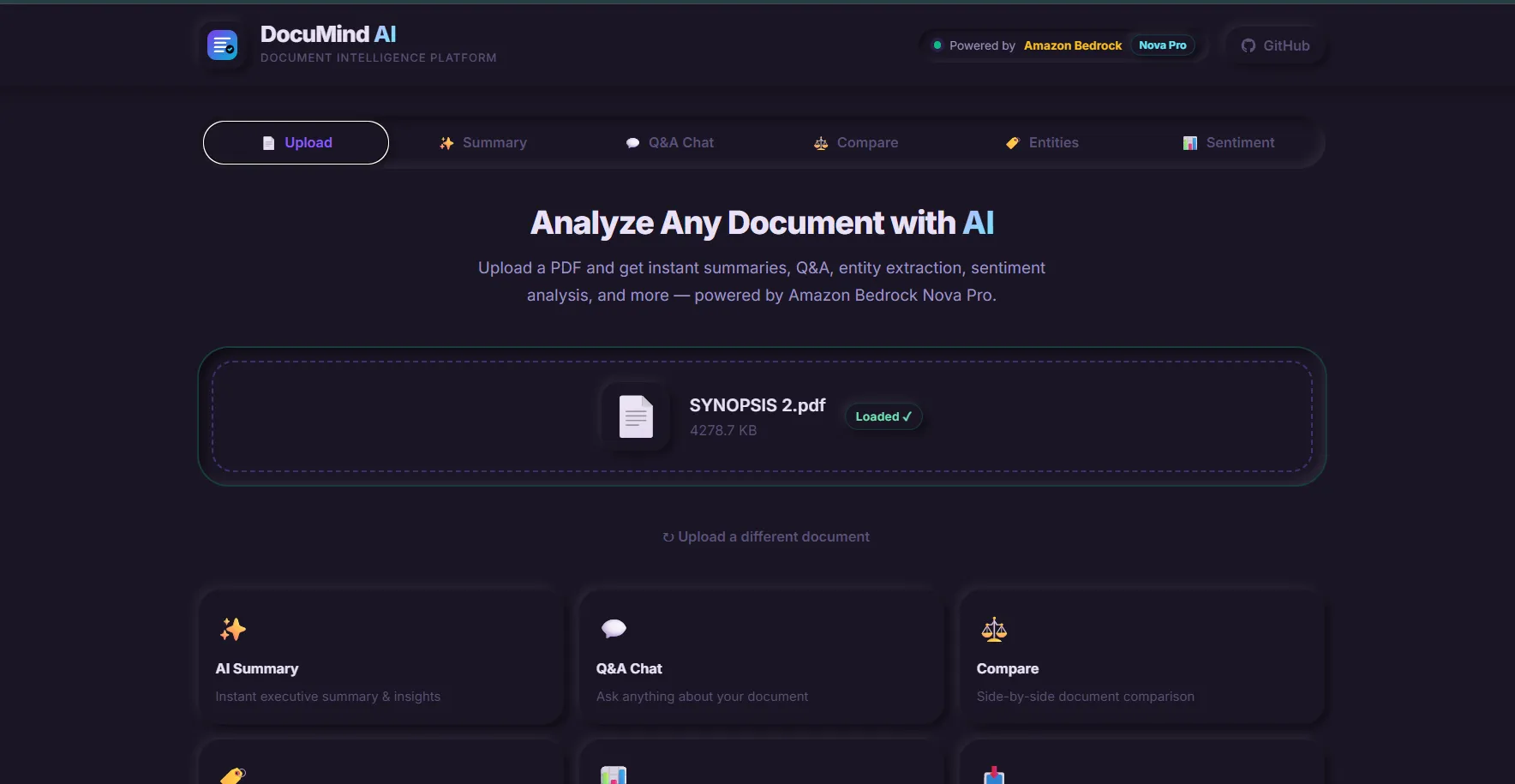
Weekend Showcase Challenge: DocuMind AI
A serverless, full-stack document intelligence platform built with React, AWS Lambda, and Amazon Bedrock (Nova Pro) for instant PDF summarization, grounded Q&A, multi-document comparison, NER, sentiment analysis, and report exports.

Tag:
#application
🌟 Vision and What It Does
In our fast-paced digital world, knowledge workers, researchers, software engineers, and business leaders are continuously inundated with extensive textual information. Crucial insights are often buried deep within multi-page whitepapers, legal agreements, research studies, and architecture blueprints. Manually combing through these documents to extract actionable points, trace relationships, and evaluate tone consumes countless hours of valuable cognitive bandwidth.
DocuMind AI was built to solve this problem. It is a full-stack, serverless document intelligence platform that transforms static, passive PDF files into interactive, dynamic knowledge hubs powered by generative AI on AWS.
Plain text
Upload PDF ──► In-Memory Extraction ──► Amazon Bedrock (Nova Pro) ──► Multi-Dimensional Intelligence
Core Capabilities
- Executive Summarization & Key Insights: Instantly extracts the central theme into a 2-3 sentence executive brief, alongside 5 prioritized bulleted takeaways, estimated reading duration, and thematic tags.
- Context-Grounded Q&A Chat: A conversational interface that answers specific, nuanced questions grounded exclusively in the uploaded document's context, preventing hallucinations.
- Multi-Document Comparative Engine: Allows users to drop two distinct PDFs side-by-side to receive an automated similarity score meter, shared core themes, and unique differentiators for each document.
- Named Entity Recognition (NER): Detects and organizes structured entities into interactive, color-coded tag clouds across 7 distinct dimensions: people, organizations, geographical locations, dates, monetary figures, technologies, and specialized domain terms.
- Tone & Sentiment Analytics: Visualizes overall document sentiment with an interactive needle gauge, formality rankings, readability scores, and paragraph-by-paragraph sentiment progress bars.
- Exportable Intelligence Dossiers: Generates clean, publication-ready multi-page downloadable PDF reports incorporating all completed analyses with a single click.
🛠️ How I Built It
1. Engineering Process & Architecture Strategy
Building a responsive, low-latency AI application over a single weekend requires intentional architecture choices. I designed DocuMind AI as a completely decoupled, serverless system to maximize developer velocity, eliminate server maintenance, and keep operational costs within the AWS Free Tier.
The frontend is built using React and Vite styled with a bespoke dark neumorphic design system. Neumorphic aesthetics—featuring dual-source soft shadow extrusions (
box-shadow: -6px -6px 14px rgba(255,255,255,0.07), 6px 6px 14px rgba(0,0,0,0.55) ) and recessed inset states—give the platform a tactile, modern interface that makes data analysis intuitive and engaging.2. Key Architectural Decisions
- Amazon Bedrock with Nova Pro (
amazon.nova-pro-v1:0): I selected Amazon's new Nova Pro model for its exceptional multi-modal capabilities, rapid token generation, and remarkable adherence to strict JSON output schemas.
- Stateless Serverless Compute: Instead of maintaining a persistent container or VM cluster, the Python backend runs on AWS Lambda with in-memory stream processing using
pypdf. Documents are parsed on the fly without writing sensitive user files to disk, upholding strict privacy standards.
- Amazon API Gateway (HTTP API): Chosen for ultra-low latency request routing and native wildcard CORS handling between the single-page application and the serverless backend.
- Amazon S3 Static Hosting: Serves the optimized production build globally with high reliability and zero compute overhead.
3. Challenges Overcome
- Strict JSON Enforcement: LLMs can occasionally wrap structured responses in markdown code blocks. To guarantee 100% frontend reliability, I implemented a resilient regex parser with JSON boundary recovery in
bedrock_client.py.
- Token Budgeting & Context Windows: Large documents risk overflowing context constraints. I developed intelligent paragraph and sentence boundary chunking in
pdf_parser.pythat preserves semantic coherence while optimizing token consumption.
☁️ AWS Services & Architecture Overview
DocuMind AI leverages a serverless AWS architecture:
Plain text
┌─────────────────────────────────────────────────────────────┐│ User Browser │└──────────────────────────────┬──────────────────────────────┘│┌──────────────────┴──────────────────┐│ (Static Assets) │ (REST API)▼ ▼┌───────────────────────────────┐ ┌───────────────────────────────┐│ Amazon S3 Bucket │ │ Amazon API Gateway (HTTP) ││ (Static Website Hosting) │ └──────────────┬────────────────┘└───────────────────────────────┘ │▼┌───────────────────────────────┐│ AWS Lambda ││ (Python 3.12 Handler) │└──────────────┬────────────────┘│▼┌───────────────────────────────┐│ Amazon Bedrock Runtime ││ (Nova Pro Foundation Model) │└───────────────────────────────┘
- Amazon Bedrock (Nova Pro): Serves as the intelligent inference engine across summarization, entity extraction, sentiment analysis, and comparative reasoning.
- AWS Lambda: Orchestrates API routing, payload decoding, PDF text extraction, and prompt dispatching in a stateless runtime.
- Amazon API Gateway: Provides the managed HTTPS gateway managing routing and CORS.
- Amazon S3: Hosts the compiled React bundle with zero maintenance.
- AWS IAM: Enforces least-privilege security roles for secure service-to-service communication.
💡 What I Learned Across the Summer
Participating in the AWS Builder Series this summer has been a transformative experience. Over the last three months, I explored building wishlist features, crafting interactive apps, and deploying autonomous agents.
Key takeaways from this journey include:
- The Power of Foundation Model Selection: Amazon Bedrock's unified API simplifies switching and evaluating state-of-the-art models like Nova Pro, Nova Lite, and Claude with zero code rewrites.
- Serverless AI is Production-Ready: You do not need complex Kubernetes clusters or dedicated GPU instances to build responsive, enterprise-grade AI products. Serverless primitives provide instant scale and cost-efficiency.
- UI Polish Transforms Utility: Building functional AI is only half the battle; combining strong AI models with thoughtful design systems (such as glassmorphism and neumorphism) creates trust and elevates user engagement.
🔗 Project Links
- 🌐 Live Application Demo: http://documind-ai-frontend-935824161374.s3-website-us-east-1.amazonaws.com
- 💻 GitHub Repository: https://github.com/MdIbuA/DocuMind-AI
- ⚡ Live Backend API Health: https://bkam36fa0k.execute-api.us-east-1.amazonaws.com/health
👏 Community Inspiration & Builder Shoutout
A huge shoutout to @benfowleraws and the entire AWS Developer Relations team for curating this incredible summer challenge series! Special inspiration goes to Lewis Sawe for his standout build The Museum That Grows, which demonstrated how autonomous agents can operate continuously on AWS serverless tech.
Enjoyed reading this content? Let the author know!
Your likes, comments, shares, and saves help creators reach more builders.

Loading recommendations
Loading article