
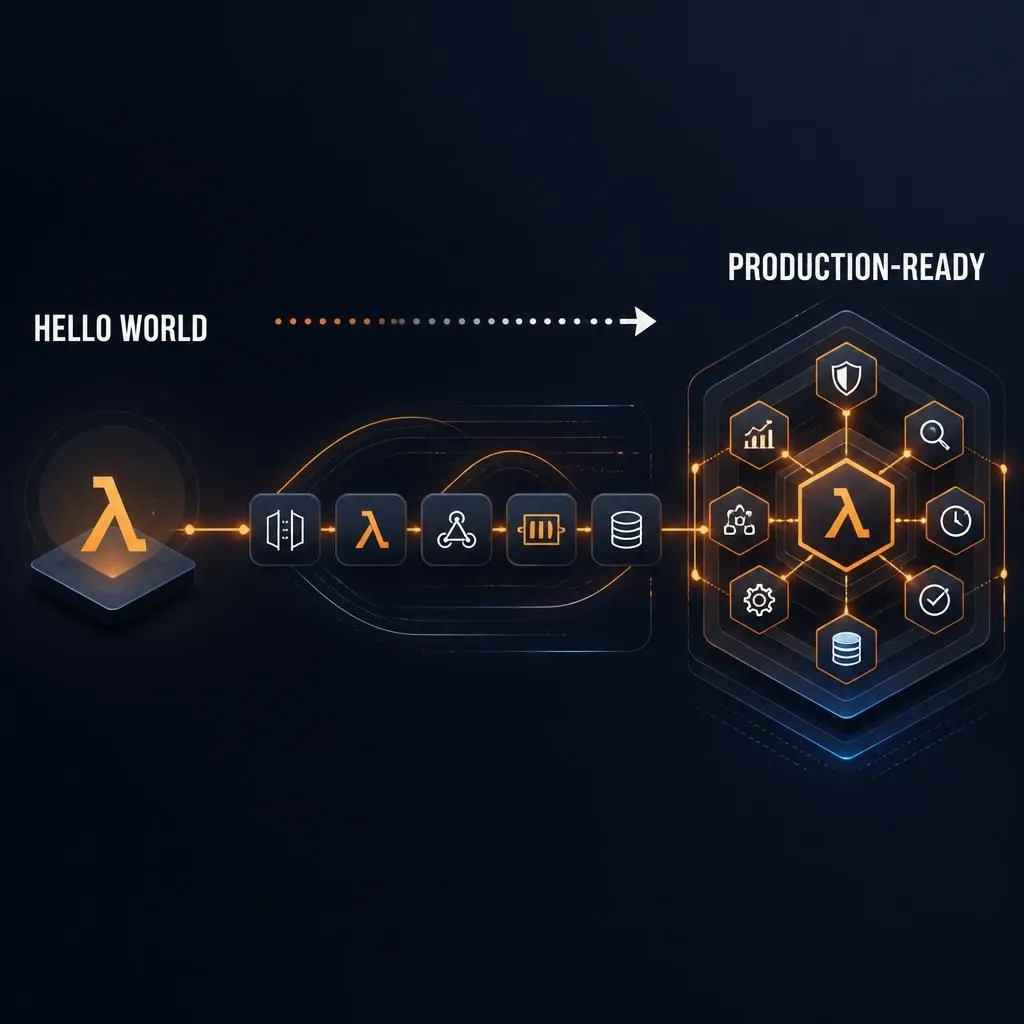
Building Production-Ready Serverless Applications: Engineering Lessons Beyond "Hello World"
Moving from a working serverless demo to a system you can actually operate requires more than connecting AWS services. Explore the engineering decisions behind security, event-driven architecture, infrastructure as code, CI/CD, observability, debugging, and production readiness.

Article Overview
Most serverless tutorials end once an application works. Production systems are where the real engineering begins. This article explores the architectural decisions, security practices, automation, observability, debugging challenges and trade-offs involved in moving a serverless application beyond "Hello World" toward something that can be operated and maintained.
Who Is This Article For?
This article is for developers, cloud learners, and aspiring cloud engineers who have already worked through AWS tutorials, labs, or workshops and are now asking: “How do I take what I’ve built in a tutorial and start thinking about it as a real application?”
You don’t need years of production experience to follow along. If you’ve built your first Lambda functions, connected APIs, worked with databases and events, or completed a few cloud projects, you’re ready for the conversation.
The focus here isn’t on teaching another step-by-step serverless tutorial. Instead, we’ll explore what changes when you move from “I can build this” to “I can design, secure, deploy, observe, troubleshoot, and maintain this.”
We’ll look at the engineering decisions behind a production-oriented serverless architecture, the trade-offs those decisions introduce, and the lessons that emerge from working through the challenges.
1. "It Works" Is Only the Beginning
You deploy a function. The API responds. The database contains the expected data. On the screen, everything looks right.
So... are you done?
That question is where most serverless tutorials stop, and where most of the real engineering work actually starts. A working demo answers one narrow question: does the code do what I intended, right now, while I am watching it. Production asks a much longer list of questions, most of which have nothing to do with whether the happy path works.
Can I secure it? Can I deploy it consistently? Can I observe it when something goes wrong? Can I recover it? Can it scale? Can I control its cost? Can someone else maintain it after I move on to something else?
None of those questions show up when a function returns a 200 response in a demo. They show up later in an incident, in a code review, in a cost report, or in a colleague trying to understand a system they did not build. This article is an attempt to walk through those questions honestly, using a reference serverless application as the anchor, without pretending that "it works" and "it is production-ready" mean the same thing.

Figure 1. Moving from "It Works" to "I Can Operate It"
A flow showing the progression from a working application to questions about security, deployment, observability, recovery, and maintainability.
2. Start With the Problem, Not the AWS Services
It is tempting to start designing a system by asking which AWS service to use. API Gateway or an Application Load Balancer? DynamoDB or RDS? SQS or EventBridge? Those are real decisions, but they are not the first decision.
The more useful starting question is: what actually needs to happen before I can respond to the customer? Everything else including which AWS service fits follows from that.
Consider an order-processing scenario, which is the reference scenario used throughout this article. A customer submits an order. Somewhere in that flow, payment needs to be handled, inventory needs to be checked or reserved, and the customer needs a confirmation. The question is not "which AWS services handle payment, inventory, and notifications," but "which of these steps does the customer actually need to wait for before they get a response?"
That question is what engineers usually call identifying the critical path: the minimum sequence of work that has to complete synchronously before the caller can move on. Everything outside that path is a candidate for decoupling. Getting this distinction right, before touching the AWS console, is what separates an architecture built around actual system behavior from one built by picking services first and rationalizing the design afterward.
3. The Reference Event-Driven Architecture
The diagram below represents the architectural model being discussed in this article: an order-processing workflow built on API Gateway, Lambda, DynamoDB, EventBridge, and SQS, with supporting identity, security, and observability services around it.
At a high level, a request enters through API Gateway and is handled by an order-intake Lambda function, which validates the request and writes the order to a DynamoDB table. Once the order is recorded, an event is published to EventBridge. From there, independent downstream consumers connected through their own SQS queues pick up the event and handle payment processing, inventory handling, and customer notification separately from one another. A dead-letter queue captures messages that fail repeatedly, and CloudWatch provides centralized logging, metrics, and alarms across the workflow.
It is worth being precise about what this reference architecture actually represents. The payment and inventory integrations in the reference application are simulated components built to demonstrate the architectural pattern they are not a certified payment processor, a PCI-compliant payment system, or a real warehouse-management integration. The value of the reference architecture is in the boundaries it establishes, not in the specific downstream systems behind those boundaries.

Figure 2. Reference event-driven serverless architecture
An event-driven serverless architecture showing an API request entering through API Gateway and Lambda, followed by an order event routed through EventBridge to independent downstream processing components and supporting security and observability services.
The purpose of this diagram is not to showcase a list of AWS services. It is to illustrate responsibilities and boundaries: which component owns which decision, where one component's job ends and another's begins, and where failure in one part of the system is prevented from silently becoming failure everywhere else.
The architectural decision to route through EventBridge rather than calling each downstream service directly from the order-intake function is what creates those boundaries. This boundary allows payment processing, inventory handling, and notifications to be deployed, scaled, and modified independently. It also introduces a trade-off worth naming honestly: nothing downstream of the event is guaranteed to have happened yet by the time the customer receives a response.
4. Keep the Critical Path Thin
A fully synchronous version of the same order flow would look something like this: customer submits checkout, the request calls payment, then inventory, then sends a notification, and only then returns a response. Every one of those steps sits directly in the customer's request path. If any one of them is slow or unavailable, the customer waits or the request fails outright.
The event-driven version accepts the order, writes it, publishes an event, and returns a response immediately. Payment, inventory, and notification processing happen afterward, independently, off the customer's critical path.

Figure 3. Synchronous processing versus event-driven processing
A side-by-side comparison showing a customer waiting for multiple synchronous operations versus an event-driven flow where the order is accepted before downstream processing continues asynchronously.
The underlying principle is straightforward to state: keep the critical path thin. Only what genuinely needs to happen before responding to the customer should sit inside that response cycle.
That principle needs a caveat, though, because asynchronous architecture is not automatically better. Moving work off the critical path introduces eventual consistency the order may exist before payment has actually been confirmed. It introduces retries, and with retries comes the risk of duplicate message delivery, which means downstream consumers need to be idempotent or the same order could be processed twice. It introduces new failure modes, since a message can fail in the queue long after the customer has already been told their order was accepted. And it introduces a debugging path that is no longer a single linear request, the fix for one problem now depends on knowing which of several independent consumers is misbehaving.
Decoupling does not eliminate complexity. It moves complexity into boundaries that we can design and manage.
5. Architecture Is About Trade-Offs
There is rarely a universally "best" AWS service for a given problem. There is a best fit for a specific set of requirements and constraints, and a different fit for a different set. Framing architecture as a search for the objectively correct service tends to produce decisions that look confident but are not actually reasoned through.
A more honest way to think about it is as a chain: a requirement creates a constraint, the constraint shapes an architecture decision, the decision carries a trade-off, and the trade-off has an operational consequence that someone has to live with later. Skipping any link in that chain especially the last one is how systems end up with decisions nobody remembers making a reason for.
| Requirement | Decision | Benefit | Trade-off |
|---|---|---|---|
| Accept the order quickly and confirm to the customer | Separate order acceptance from downstream fulfillment steps using an event (EventBridge) rather than direct synchronous calls | Customer gets a fast response; a slow downstream service does not block checkout | The customer sees 'order accepted,' not 'order fully processed', the system must be honest about what that response actually means |
| Process payment, inventory, and notifications independently | Route the order-placed event to separate queues and consumers for each downstream concern | Each consumer can fail, retry, or scale without affecting the others | Failures are no longer visible in a single request/response cycle; they must be observed separately |
| Protect data and limit what a compromised function can reach | Give each Lambda function its own execution role scoped to specific actions and resources | A compromised or misbehaving function has a small blast radius | Permission design takes more upfront thought than granting broad access once and moving on |
| Make infrastructure reproducible and reviewable | Define infrastructure in code rather than through manual console changes | Environments can be recreated, reviewed, and version-controlled | Templates and configuration have to be maintained as the system evolves |
None of these trade-offs are unique to this reference architecture. They are the ordinary cost of decoupling, least privilege, and infrastructure-as-code as engineering practices, and they apply whether or not the exact services in this diagram are the ones eventually chosen.
6. Security: Reduce the Blast Radius
The security question worth asking about every function is not "is this secure?" in the abstract. It is: if this function is compromised, what can it actually access?
Granting a Lambda function administrator-level permissions is a common shortcut, especially early on, because it makes development friction disappear. It also means that if that one function is ever compromised or behaves unexpectedly, the blast radius extends to everything the account can touch, every table, every bucket, every secret, every other service.
The alternative is a narrower chain: a Lambda function is assigned its own execution role, that role is scoped to specific actions rather than broad service access, and those actions are scoped further to specific resources rather than an entire service.

Figure 4. Least privilege and reducing blast radius
A comparison between a Lambda function with excessive administrator permissions and a least-privilege execution role restricted to specific actions and resources.
In the reference architecture, this thinking extends beyond IAM roles alone. Identity and access for end users is handled through a managed identity service, requests are authorized at the API layer rather than trusted implicitly, and secrets such as credentials are kept out of code and environment variables where a dedicated secrets service is available. Encryption and HTTPS are treated as defaults rather than optional extras, and web-layer protections sit in front of the API where appropriate.
It is worth being direct about scope here: this article describes security practices that are reasonable and supported by the reference material, not a claim that every possible security control has been implemented or independently audited. Security is a practice applied continuously, not a checkbox marked once.
Security should be designed around the workload's actual permissions and the potential blast radius of failure.
7. Infrastructure Should Be Defined, Not Remembered
Clicking through the AWS console to create resources works, right up until someone needs to recreate that environment, review what changed, or figure out why staging and production have quietly drifted apart. Infrastructure as Code exists to solve that problem: infrastructure is defined in files, those files are version-controlled, changes go through review the same way application code does, and an environment can be reproduced reliably instead of remembered.
The reference application in this article was implemented using AWS CloudFormation, with infrastructure defined declaratively as templates rather than configured by hand. Terraform is a different, widely used tool for the same underlying discipline, and it is worth discussing on its own terms as part of the broader infrastructure-as-code conversation, but it was not the tool used to build the reference application described here, and this article does not present it as such.
Whether using Terraform, CloudFormation, or another IaC approach, the engineering goal is the same: make infrastructure repeatable, reviewable, and recoverable. The specific tool matters less than the discipline of treating infrastructure changes with the same rigor as application code changes, including catching configuration drift before it becomes an incident, and being able to rebuild an environment from source rather than from memory.
8. CI/CD: Deployment Is Not the Finish Line
It is easy to treat a successful deployment as the end of the work. In practice, deployment is one stage in a longer, repeatable loop: a developer writes code and commits it, the change is pushed to a repository, it is validated through linting and static analysis, automated tests run against it, the application is built and packaged, it is deployed to a target environment, and the system is then observed to see how the change actually behaves.

Figure 5. CI/CD pipeline from code change to deployment
A CI/CD pipeline showing code moving from a developer through validation, testing, build and deployment stages.
That last stage; observation is what closes the loop. What gets learned from watching a deployed change in operation should feed back into the next iteration of code, tests, and configuration. Without that feedback path, CI/CD becomes a one-way conveyor belt rather than a loop that actually improves the system over time.

Figure 6. Deployment as a feedback loop
A CI/CD feedback loop showing deployment followed by observation, learning and feedback to the developer.
Deploy → Observe → Learn → Improve.
9. Observability and Debugging
A request in this architecture passes through several independent components before it is fully handled: API Gateway, an order-intake Lambda function, EventBridge, an SQS queue, and a downstream consumer. Each of those components can fail on its own, and each failure looks different depending on where you are standing when you look for it.

Figure 7. Observability and debugging across a serverless workflow
A serverless request flow from API Gateway through Lambda, EventBridge, SQS and a consumer, with observability signals such as logs, metrics and errors feeding into investigation and root-cause analysis.
This is why observability matters more, not less, in a distributed serverless system than it does in a single monolithic application. Logs, metrics, and error signals from each component need to be collected somewhere central, so that an investigation can move from a symptom to a root cause without guessing which of five independent services is actually at fault.
The component where I see the failure isn't necessarily the component where the failure began.
A customer-facing error might surface at API Gateway, while the actual cause is a permissions issue in a downstream consumer several hops away, connected only by an event and a queue. Distributed architectures do not remove the need for debugging skill, if anything, they make tracing a failure back to its origin a more deliberate exercise, because there is no single call stack to read top to bottom.
10. Real Engineering Challenges
Building the reference application surfaced ordinary, unglamorous engineering challenges rather than a dramatic production outage, which is a more honest reflection of what building a serverless system for the first few times actually involves.
Deployment and packaging issues showed up when dependencies or configuration did not match what the Lambda runtime expected. API Gateway integration behaved differently than initial assumptions suggested, particularly around how requests and responses needed to be shaped for the integration type in use. Debugging serverless workloads in general took more deliberate effort than debugging a traditional server-based application, simply because there was no single process to attach a debugger to. Permission and configuration issues surfaced as functions attempted actions their execution roles had not been granted. And tracing a problem across a distributed, event-driven workflow required piecing together evidence from multiple components rather than reading one continuous log.
The useful pattern for working through each of these was consistent, whatever the specific symptom: notice the symptom, gather evidence from logs and metrics, form a hypothesis about the cause, test that hypothesis, confirm the root cause, apply a fix, and verify that the fix actually resolved the issue rather than just changing its symptoms.
Symptom → Evidence → Hypothesis → Test → Root Cause → Fix → Verification.
None of these challenges were dramatic. What they taught was more fundamental: that in a distributed system, the discipline of investigation matters as much as the discipline of writing the code in the first place.
11. What Does Production-Ready Actually Mean?
Production-ready is not a single property a system either has or lacks. It is a combination of several dimensions, each of which can be reasoned about and improved independently: security, reliability, observability, automation, scalability, cost, and maintainability.
Security is about protecting data, identities, and workloads, following least privilege as a default rather than an afterthought.
Reliability is about designing for failure rather than assuming it will not happen; resilience, availability, and a plan for recovery.
Observability is about making system behavior visible through logs, metrics, and alerts, rather than inferring it after the fact.
Automation is about making build, test, deploy, and operational steps repeatable rather than manual.
Scalability is about the system's ability to handle growth in traffic or workload without redesign.
Cost is about understanding what the system actually costs to run and having levers to manage it.
Maintainability is about whether the codebase and its documentation make it possible for someone other than the original author to operate and evolve the system.
These dimensions pull against each other more often than they reinforce one another, and that tension is normal rather than a sign of poor design.
More decoupling improves isolation and independent scaling, at the cost of eventual consistency and more complex debugging.
More observability makes diagnosis easier, at the cost of additional design effort and, potentially, additional expense.
Stricter IAM reduces blast radius, at the cost of more deliberate, upfront permission design. Recognizing these trade-offs rather than assuming one dimension can be maximized for free is a large part of what production-ready engineering actually looks like in practice.
12. Production-Readiness Checklist
The questions this article opened with are worth returning to directly, as a checklist to run through before calling something production-ready, rather than as an abstract framework:
• Can I secure it?
• Can I deploy it?
• Can I observe it?
• Can I recover it?
• Can I scale it?
• Can I afford it?
• Can someone else maintain it?

Figure 8. Production-readiness checklist
Alt text: A production-readiness checklist asking whether a system can be secured, deployed, observed, recovered, scaled, afforded and maintained.
13. The Bigger Lesson
Serverless does not mean less engineering. It changes where the engineering effort goes.
With servers largely managed away, less time goes into patching operating systems or provisioning capacity by hand. More time goes into thinking about boundaries between components, the events that flow across them, the permissions each piece actually needs, the contracts between producers and consumers of an event, the ways each part of the system can fail, how visible that failure will be when it happens, what the system costs to run, and how easy it will be for someone else to maintain.
That shift is not a loss of engineering rigor. It is a relocation of it from infrastructure management toward architectural and operational reasoning, which arguably requires more deliberate thought, not less.
14. Conclusion: Don't Stop at "Hello World"
The progression this article has tried to walk through starts in the same place every serverless tutorial starts: "it works." A function deploys, an API responds, the data is correct.
The more useful question, and the one this article has tried to sit with honestly, is "can I operate it?" That question does not have a single answer. It has seven or eight smaller answers; about security, deployment, observability, recovery, scale, cost, and maintainability each of which takes real engineering work to answer well.
Hello World isn't where the engineering ends. That's where the engineering begins.
Enjoyed reading this content? Let the author know!
Your likes, comments, shares, and saves help creators reach more builders.

Loading recommendations
Loading article