

Kiro Month at AWS User Group Vadodara — A Recap
Earlier this month, we declared August "Kiro Month" for AWS User Group Vadodara. The idea was simple: give the community two back-to-back chances to go deep on Kiro — first to learn it, then to build with it.
Earlier this month, we declared August "Kiro Month" for AWS User Group Vadodara. The idea was simple: give the community two back-to-back chances to go deep on Kiro, first to learn it, then to build with it. We deliberately sequenced it this way. Running the hackathon cold, without a shared baseline of what Kiro actually is and how its different surfaces work, would have meant spending half the hackathon just onboarding people. Instead, we used the first meetup to level everyone up, so that by the time the hackathon started, the only question left was what to build not how to get started.
Two events later, here's how it went.
Meetup 1 — Getting Familiar with Kiro (August 8)
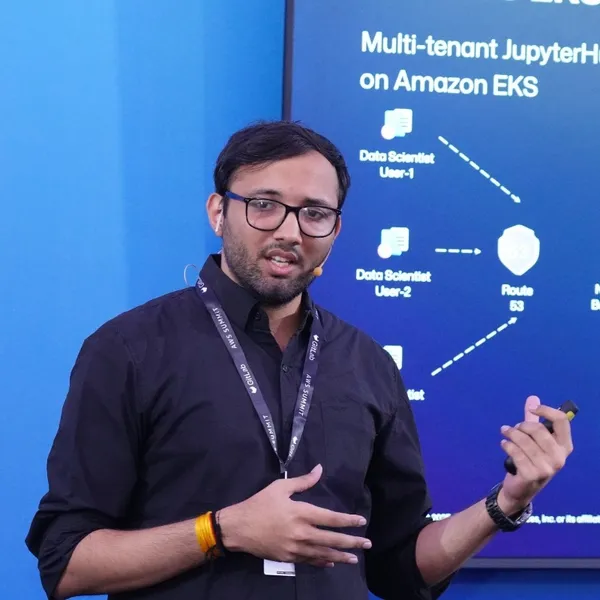
We kicked things off with a hands-on session designed for anyone new to Kiro or looking to go a level deeper. Vasu Bhimani and Madhav Gohel led the session, walking the community through Kiro Web, Powers, Kiro Crew, and the rest of the surface area not just what each of these is, but where each one actually fits depending on what you're trying to do. Thanks to Abhilasha Vyas for sharing her insights with the Community as well.

Thank you to Jeavio for partnering with us as the venue for this session.
A quick detour: the "which Kiro app" question
Around the same time, I read a blog post from Massimo Re Ferre on the Kiro team that ties in almost perfectly with what we covered at the meetup, so it's worth talking about here. The piece tackles a question a lot of people in the room were quietly asking: with Kiro now available as an IDE, a CLI, a web app, a mobile app, and Kiro Crew, which one are you actually supposed to use?
Massimo's answer is that this is the wrong question. Under the hood, Kiro has converged onto a single agent harness that sits behind every surface, and each app is simply a different way of consuming that same underlying agent. Earlier on, each surface actually ran its own separate agent, built in different languages, which meant every new capability had to be built three separate times and behaved a little differently depending on where you were. That's since been consolidated so that capabilities added to the core agent show up everywhere at once, and a working session can move from your laptop to the cloud to your phone without losing continuity.
What stuck with me most is the framing Massimo lands on: it's not about picking one app forever, it's about picking the right one for the task in front of you right now. The IDE is home base for writing code with AI woven in. The CLI is for people who live in the terminal or want Kiro running headless inside a CI/CD pipeline with no human in the loop at all. The web app is where you steer and review cloud agent sessions from one place, no matter where they were started. Mobile is for the quick, transactional touches — approve something, check on something, nudge a task along — when you're away from your desk. And Kiro Crew is the layer for full delegation: persistent memory, scheduled jobs, and multiple agents working asynchronously while you're in a meeting or asleep.
That mental model — same engine, different front doors depending on the moment — was a genuinely useful lens for our hackathon participants a week later, since several of them ended up moving between surfaces mid-build rather than committing to just one.
If you want the full piece, it's worth a read: Which Kiro app should I pick?
It set exactly the right foundation for what came next.
Meetup 2 — The Hackathon (August 15)
A week later, we turned theory into practice with a full in-person hackathon. Here's how the day actually came together, start to finish.
The format
Participants didn't just walk in and start building. We ran the day around three tracks, and every participant had to pick one before they could begin:
- 🤝 Community Tools — build something that helps a tech community run better: event operations, engagement, feedback, discovery, or similar challenges.
- 🎓 Learning & Student Enablement — build something that helps students or early-career builders learn cloud and AI faster.
- 🌐 Open Builder Tools — build a useful tool, workflow, or utility that any AWS builder could pick up and use.
Each track nudged people toward a different kind of problem, which meant that by the time the actual building started, the room was already covering a healthy spread of use cases instead of everyone converging on the same idea.
Once teams had picked a track, the next step was bringing an actual problem statement to the table — not a vague idea, but something specific enough to build against in the hours ahead. Teams then sat down with mentors to pressure-test their problem statements, sharpen scope, and figure out the right way to approach the build with Kiro before writing a single line of code. That conversation mattered more than it sounds — a good chunk of the strongest projects by the end of the day were the ones that had spent real time in this step rather than rushing past it.
From there, teams had the next few hours to actually build, with mentors circulating throughout to help unblock people, answer questions, and keep momentum going.
The judging
By the end of the building window, every team had a project to show, and judging was tough. Udit Parikh and Vishal Alhat went through every single project, and they didn't hold back — the feedback was direct and genuinely critical, exactly the kind that pushes participants to think harder about their build rather than just hearing "good job." Having judges willing to dig in properly instead of skimming for a quick winner made the whole exercise feel worth the effort teams had put in.
Udit also brought Kiro Credits to distribute across participants, and the distribution was handled really well — genuinely useful support that removed a real barrier for people trying to build with limited access. It's the kind of thing I'd love to see made available to other UG leaders running their own Kiro hackathons.

Here's how the prizes broke down:
🏆 Winner — AWS credits, a demo booth at AWS Community Day Vadodara 2026, and 2 tickets to attend.
🥈 Runners-up (first runner-up and two second runners-up — four teams in total) — AWS credits and a demo booth at AWS Community Day Vadodara 2026.
Congratulations to our winning team and to all four runner-up teams — the projects that came out on top reflected exactly the kind of sharp problem statements and solid execution the day was built around. Looking forward to seeing several of these show up as demo booths at AWS Community Day Vadodara 2026 next month.
Snacks and downtime
Through all of this, food and drinks were available for everyone throughout the day — small thing, but it matters when people are heads-down building for hours. No one had to step out or run low on energy mid-build.
The people who made it happen
None of this happens without the people working before, during, and after the event.
Udit Parikh and Vishal Alhat — thank you for spending your Saturday judging every project properly and pushing participants with real, critical feedback. And thank you again, Udit, for the Kiro Credits and how thoughtfully they were distributed.
Vishal Alhat stopped by in person — at the last minute, and it was much appreciated. Beyond just showing up, he spent time offering guidance to participants and helped shape parts of how the day played out. The kind of surprise that makes a hackathon better, not just longer.
Maria and Ridhima — thank you for consistently showing up for this community and helping make events like this possible.
Vasu and Madhav — thank you for leading Meetup 1 and setting the foundation the hackathon built on, and for all the help through the month.
Srujal, Malhar, Neel, Parth, and Rishit — thank you for all the help and support through the day, from setup to execution.
And the two people this entire month genuinely wouldn't have happened without: Nirmal and Jay. Their support tied the whole month together. Alongside them, the core team — Ravi, Vrajesh, Dhaval, Priyal, and Abhilasha — put in the work that doesn't always show up on stage but is exactly what keeps this community running.
The venues
Thank you to Jeavio for hosting Meetup 1, and to House of Progress for hosting the hackathon and giving the day a space that matched its energy.
That's a wrap on Kiro Month
Two events, one clear arc — learn Kiro first, then build with it under real constraints — and a community that showed up fully for both. Grateful to everyone who mentored, judged, organized, and built. Looking forward to what comes out of this next.
Up next: AWS Community Day Vadodara 2026, happening next month. book your tickets here: https://acd26.awsugvad.in/
Enjoyed reading this content? Let the author know!
Your likes, comments, shares, and saves help creators reach more builders.

Loading recommendations
Loading article