
Cross Cloud Amazon Bedrock AgentCore with Microsoft Foundry over A2A
Cross Cloud Proof of Concept connection Azure Foundry to Agentcore

Making the Impossible - Possible!
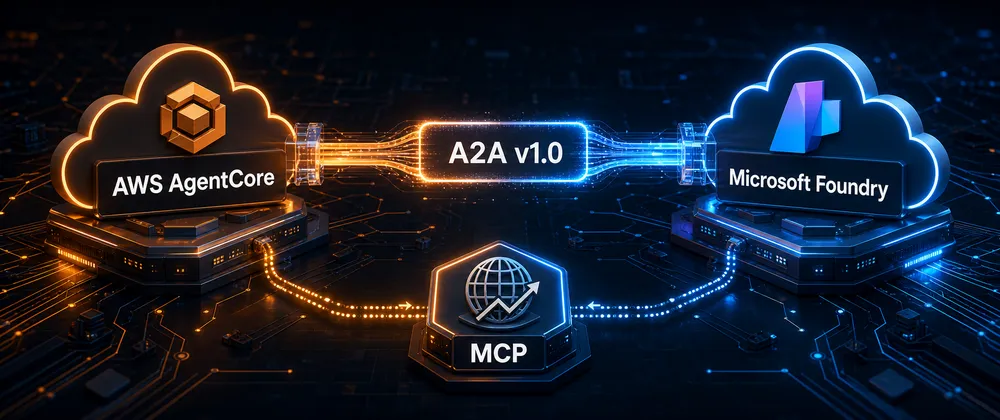
I wanted to test one specific path:
Amazon Bedrock AgentCore (AWS) | +-- MCP --> live exchange-rate tool | +-- A2A v1.0 --> Microsoft Foundry hosted agent (Azure)On July 29, 2026, that path worked end to end. An AgentCore-hosted Strands
coordinator called a Microsoft Foundry agent over A2A v1.0, authenticated with
Microsoft Entra, and compared the reply with an independent MCP conversion.
For the smoke case, both sides converted 100 USD to EUR using a rate of
0.87873 and returned 87.87300 . The deterministic comparator reported zero
relative difference and no warnings.This article shows how to run that demo and documents what failed on the way.
What the demo measures
This is not intended to be a currency chatbot. Currency conversion gives the
demo a small domain with exact arithmetic, a public data source, and answers
that are easy to compare.
The coordinator supports three modes:
Mode | Path |
|---|---|
mcp_only | AgentCore calls the exchange-rate MCP tool |
a2a_only | AgentCore delegates to the Foundry agent over A2A |
verified | Both calls run concurrently and deterministic code compares the results |
The LLM selects and explains the workflow. It does not calculate the
conversion or decide whether two amounts agree. Python
Decimal does that:difference = abs(primary.converted_amount - verifier.converted_amount)relative_difference = difference / abs(primary.converted_amount)agreed = relative_difference <= Decimal("0.005")If the two sources disagree, the coordinator returns both quotes. It never
asks a model which number looks better.
Architecture
CLI / test runner | | SigV4 vAmazon Bedrock AgentCore Runtime, us-east-1Strands Agents coordinator, Amazon Nova Micro | +-- MCP stdio | | | +-- Frankfurter daily reference rates | +-- AWS Secrets Manager | | | +-- Entra service-principal credential | +-- Entra OAuth client-credentials exchange | +-- A2A v1.0 JSON-RPC | vMicrosoft Foundry hosted agent, East US 2Microsoft Agent Framework, gpt-5-mini | +-- MCP stdio | +-- Frankfurter daily reference ratesThe two agents use the same rate provider deliberately. This smoke test is
about transport, authentication, tool use, and cross-framework agreement, not
about reconciling different market feeds.
Prerequisites
You need:
- Python 3.11 or later
- Node.js 20 or later
- AWS CLI v2, authenticated to the target account
- Azure CLI 2.80 or later
- Azure Developer CLI (
azd) with the Foundry agent extension
- permission to deploy AgentCore resources in AWS
- permission to create a Foundry project and hosted agent in Azure
Install the AgentCore CLI and authenticate:
npm install -g @aws/agentcore
aws sts get-caller-identityaz loginazd auth login
The Azure identity performing the deployment needs
Foundry Project Manager
on the Foundry project. Azure management-plane Owner or Contributor alone
does not grant the data-plane agents/write action.Run the credential-free local checks
Clone the repository and install into the current user's Python environment.
The related benchmark repositories expose the same console-script names, so
invoking modules from the intended checkout avoids accidentally running a
sibling clone.
git clone https://github.com/xbill9/bedrock-foundry-a2a-currency.gitcd bedrock-foundry-a2a-currency
pip3 install --user --break-system-packages -e ".[dev]"pip3 install --user --break-system-packages -r requirements.txt
PYTHONPATH=. python3 -m pytest -q
The July 29 build passed 66 tests. These cover the
Decimal domain logic,
MCP subprocess transport, failure policies, Entra credential parsing, and a
Foundry-shaped authenticated A2A v1.0 server.Try the three modes with deterministic fixture rates:
PYTHONPATH=. python3 -m coordinator.cli \  100 USD EUR --mode mcp_only
PYTHONPATH=. python3 -m coordinator.cli \  100 USD EUR --mode a2a_only
PYTHONPATH=. python3 -m coordinator.cli \  100 USD EUR --mode verified --transport mcp-stdio --json
Fixture results prove orchestration and protocol behavior. They are not
financial quotes.
Deploy the Microsoft Foundry peer
The repository's deployment script packages the Foundry agent, provisions the
project and
gpt-5-mini model deployment, deploys the hosted agent, enables
incoming A2A, and reads back the authenticated v1.0 agent card:./infra/deploy_foundry_peer.shThe script prints an endpoint shaped like:
https://<account>.services.ai.azure.com/api/projects/<project>/agents/currency-a2a-agent/endpoint/protocols/a2aSave it for the next steps:
export CURRENCY_FOUNDRY_A2A_ENDPOINT="https://<account>.services.ai.azure.com/api/projects/<project>/agents/currency-a2a-agent/endpoint/protocols/a2a"The card is not public. Foundry serves it at
agentCard/v1.0 , and it requires an Entra bearer token just like the message
endpoint.Before involving AWS, test the real Foundry peer from the local coordinator.
The local path uses your ambient Azure CLI credential:
CURRENCY_RATE_PROVIDER=frankfurter \CURRENCY_FOUNDRY_A2A_ENDPOINT="$CURRENCY_FOUNDRY_A2A_ENDPOINT" \PYTHONPATH=. python3 -m coordinator.cli \ 100 USD EUR \ --mode verified \ --transport mcp-stdio \ --a2a-peer foundry \ --timeout-seconds 90 \ --jsonExpect
mcp-stdio:frankfurter-live as the primary source and
hosted-foundry-a2a as the verifier.Give the AWS runtime an Azure identity
An AgentCore runtime has an AWS IAM role, but it has no Azure identity.
Foundry does not accept an API key for incoming A2A. The demo uses a dedicated
Entra service principal with
Foundry Agent Consumer on only the Foundry
project.Create that identity using your organization's normal process, grant the
project role, and place the client secret in a protected local file. Then run:
export AZURE_TENANT_ID="<tenant-id>"export AZURE_CLIENT_ID="<application-client-id>"export AZURE_CLIENT_SECRET_FILE="/secure/path/to/client-secret"export CURRENCY_AZURE_SECRET_ID="bedrock-foundry-a2a/azure-service-principal"
./infra/configure_azure_secret.sh
That script stores a JSON credential in AWS Secrets Manager without putting
the secret on the command line. It also prints the narrow IAM policy needed
by the generated AgentCore execution role:
{ "Effect": "Allow", "Action": "secretsmanager:GetSecretValue", "Resource": "<the-one-secret-arn>"}Do not place the client secret in
agentcore.json . Runtime environment
variables are visible through the control plane.Deploy the AgentCore coordinator
Configure the AWS target and deploy once:
./infra/configure_aws_target.sh./infra/sync_app.shagentcore deploy -yagentcore statusGrant the generated execution role the one-secret policy printed by
configure_azure_secret.sh .Now point the runtime at Foundry and redeploy:
export CURRENCY_AZURE_SECRET_ID="bedrock-foundry-a2a/azure-service-principal"export CURRENCY_FOUNDRY_A2A_ENDPOINT="https://<account>.services.ai.azure.com/api/projects/<project>/agents/currency-a2a-agent/endpoint/protocols/a2a"
./infra/point_coordinator_at_foundry.sh
The script updates the local, account-specific runtime configuration, syncs
the bundle, deploys it, checks status, and runs a smoke request. Keep the
generated endpoint and account configuration out of Git.
Run each hosted mode explicitly:
agentcore invoke "Convert 100 USD to EUR in mcp_only mode."agentcore invoke "Convert 100 USD to EUR in a2a_only mode."agentcore invoke "Convert 100 USD to EUR in verified mode."Observed results
These are the hosted smoke observations from July 29, 2026. They are not a
latency distribution and should not be read as a platform benchmark.
Mode | Observed source | Result | Observed tool latency |
|---|---|---|---|
mcp_only | mcp-stdio:frankfurter-live | rate 0.87873 , amount 87.87300 | about 4.2 s |
a2a_only | hosted-foundry-a2a | rate 0.87873 , amount 87.87300 | about 18.8 s |
verified | both sources | zero relative difference, no warnings | MCP about 3.1 s; A2A about 18.1 s |
The verified path runs both legs concurrently, so its tool time is dominated
by the slower Foundry call rather than the sum of both calls.
The important result is functional: AWS SigV4 invocation, Bedrock tool use,
MCP stdio, AWS Secrets Manager, an Entra client-credentials exchange, Foundry
agent-card discovery, and A2A v1.0 JSON-RPC all completed in one request.
The full 38-case AWS-to-Foundry matrix, repeated warm/cold distributions,
token use, and cloud cost have not been measured yet.
Failures found while building it
Foundry deployment returned 403
The Azure resource deployment succeeded, but hosted-agent creation failed
with:
Identity does not have permissions forMicrosoft.CognitiveServices/accounts/AIServices/agents/writeAssigning
Foundry Project Manager at the project scope fixed it. Azure
Owner did not imply this Foundry data-plane permission.The Foundry container never became ready
The manifest passed an unset
AZURE_AI_MODEL_DEPLOYMENT_NAME template value.
The container exited with:ValueError: Model is requiredThe model deployment is owned by the same manifest, so the fix was to set its
known deployment name,
gpt-5-mini , explicitly.The AgentCore A2A leg lacked aiohttp
azure.identity.aio uses Azure Core's optional aiohttp transport. The first
hosted invocation failed before token acquisition because aiohttp was not
declared in the CodeZip application's own dependency manifest.Adding and locking
aiohttp==3.13.3 in
app/CurrencyCoordinator/pyproject.toml fixed the deployed runtime. Adding it
only to the repository-root requirements file was not enough; CodeZip resolves
the application bundle independently.Each of these interoperability failures now has a regression test or a
manifest assertion.
What A2A added
For this small conversion, MCP alone was faster and sufficient. A2A added an
independently hosted implementation, a separate model and framework, another
tool invocation, and a distinct failure boundary.
It also added real engineering work:
- cross-cloud identity and least-privilege role assignment
- authenticated agent-card discovery
- protocol-version pinning
- another cold-start boundary
- more dependency and deployment surfaces
That overhead is worthwhile only if independent execution, failover, or
cross-framework portability matters to the application. The demo now gives us
a reproducible way to measure that tradeoff instead of treating an HTTP 200 as
proof of interoperability.
Enjoyed reading this content? Let the author know!
Your likes, comments, shares, and saves help creators reach more builders.

Loading recommendations
Loading article