
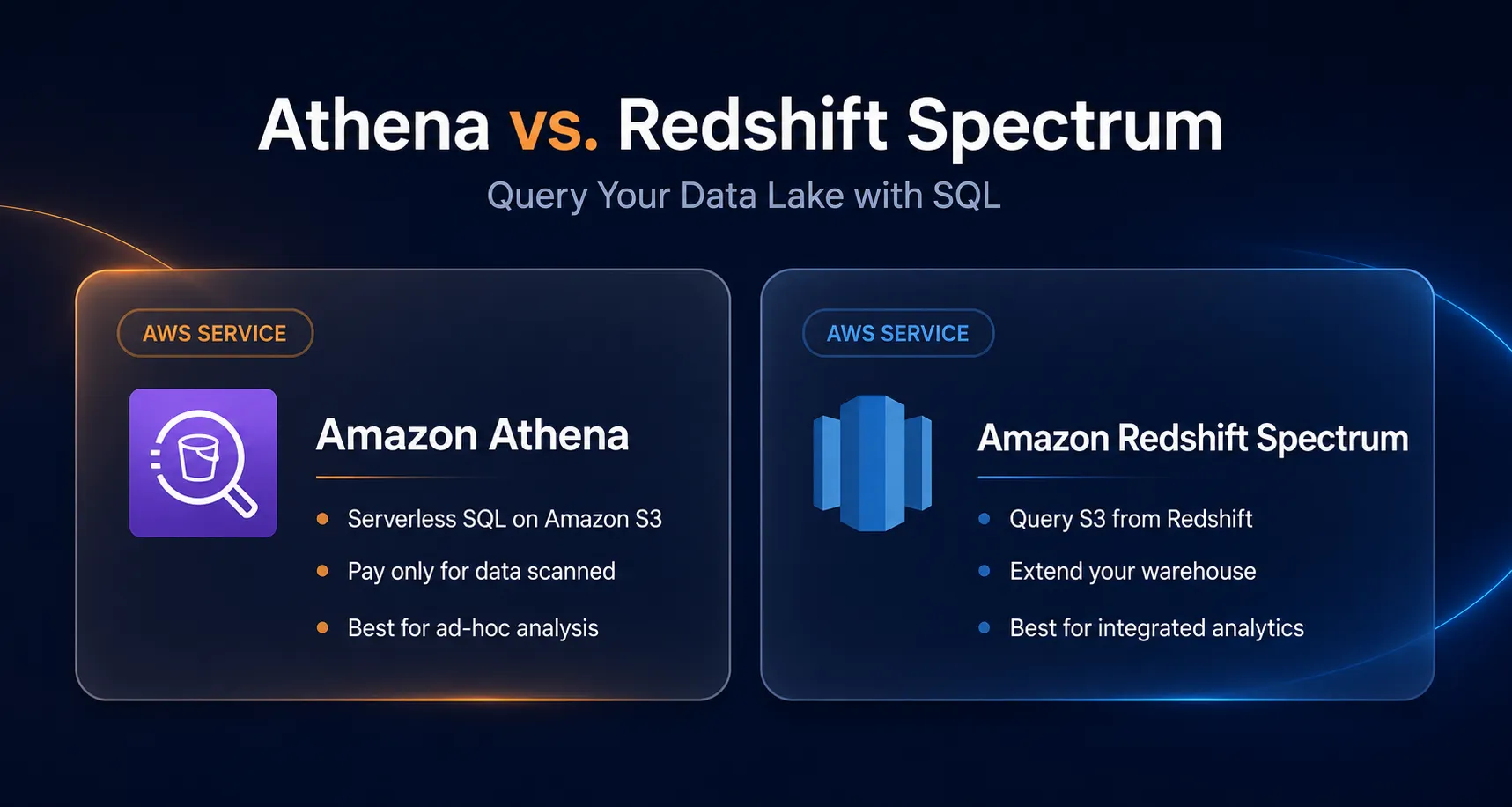
Athena vs. Redshift Spectrum: Querying Your Data Lake
Athena or Redshift Spectrum — which one should you use to query your S3 data lake? This blog breaks down both tools in simple terms, compares them side by side, and shows a real-world example of when each one makes sense, so you can choose the right fit for your project.

Business & Data Analyst |Graphics |Learning, gaining, and sharing knowledge through data and design.
If you're storing data in Amazon S3 — logs, exported files, reports, raw data from an app — at some point you'll want to explore that data using SQL, without first loading it into a database. AWS gives you two ways to do this: Amazon Athena and Redshift Spectrum.
They both let you "ask questions" of your data using SQL while it sits untouched in S3. But they come from different starting points, and knowing the difference will save you time, money, and confusion when you're deciding which one to use. This post breaks both down in simple terms.
The Problem They're Both Solving
Imagine your data is stored in S3 like files in folders — maybe sales records, customer activity, or app logs, organized by date. Normally, to run SQL queries on data like this, you'd need to load it into a database first. That takes time, costs money to store twice, and means your "database copy" can go stale.
Athena and Redshift Spectrum solve this by letting you query the data directly where it lives, in S3 — no copying, no separate database needed. You write a SQL question, and the data is read in place to answer it.
The real difference between the two comes down to what you need to already have in place to use them.
Amazon Athena: Simple and Self-Contained
In one line: Athena is a serverless query service that lets you run SQL directly on data stored in S3, without setting up any infrastructure.
Picture Athena as a helpful assistant who shows up only when you call, answers your question, and then quietly disappears again — no office to rent, no team to manage, nothing sitting around costing you money while it waits. That's the spirit of how Athena works.
Getting started is refreshingly simple:
- First, you tell AWS where your data lives in S3 and roughly what it looks like — how it's organized, what kind of information is in it. Most of the time, a tool called AWS Glue does this step for you automatically, scanning your files and mapping out their structure so you don't have to do it by hand.
- Next, you write your question in SQL — a plain, widely-used way of asking things like "show me total sales by region."
- Athena then goes and reads through the relevant files sitting in S3, and hands you back the answer.
There's no server humming in the background, no system to maintain day to day. Athena only springs into action the moment you ask it something, and you're only charged for the amount of data it had to look through to answer that one question. Ask nothing, and you pay nothing — there's no idle cost ticking away in the background.
This makes Athena a genuinely friendly starting point if you're new to working with a data lake. There's very little to set up, almost nothing to break, and you can be running your first query within minutes.
Redshift Spectrum: An Extension of an Existing Warehouse
In one line: Redshift Spectrum is a feature of Amazon Redshift that lets an existing warehouse query and combine data stored in S3, without moving that data in first.
Redshift Spectrum tells a different kind of story. Rather than being its own independent tool, it's a built-in feature of Amazon Redshift, AWS's data warehouse service. Think of a data warehouse as a well-organized library — data that's already been cleaned up, structured, and shelved neatly, ready to be pulled out and used for reports and analysis at a moment's notice.
If your company already has that "library" — an existing Redshift warehouse — Spectrum acts like a bridge that lets it reach beyond its own shelves and read data still sitting out in S3, almost as if that S3 data had been shelved in the library all along.
Where this really shines is when you want to bring two different worlds together in a single question: the well-organized, frequently used data already living inside your warehouse, and the older or less-frequently-touched data still sitting out in S3. Rather than first hauling that S3 data into the warehouse before you can use it, Spectrum lets you reach across and combine both at once, in one single query.
The catch is that Spectrum doesn't work on its own — it needs that Redshift warehouse to already exist and be running. So unlike Athena, which you can start using cold, Spectrum only makes sense once you already have a warehouse in place.
The Simple Difference
| Athena | Redshift Spectrum |
|---|---|---|
Do you need anything extra set up first? | No — works on its own | Yes — you need an existing Redshift warehouse |
How does it charge you? | Only for what you query, nothing if idle | You pay for the warehouse whether you use Spectrum or not |
What's it best for? | Simply exploring or analyzing data in S3 | Combining warehouse data with S3 data in one question |
How easy is it to start? | Very easy — minimal setup | Only useful if you already run Redshift |
Who tends to use it? | Beginners, analysts without a warehouse, quick exploration | Teams already using Redshift who need to blend both types of data |
Both tools, behind the scenes, can actually look at the same data catalog (the "map" that describes where your S3 data is and what it looks like). So starting with one doesn't lock you out of using the other later.
How to Decide Which One to Use
Ask yourself one simple question: do you already have a Redshift warehouse set up?
- No → Start with Athena. It's the simplest way to begin exploring data in S3, with almost nothing to set up and no ongoing cost when you're not using it.
- Yes, and you want to bring together warehouse data with S3 data → Use Redshift Spectrum. That's exactly the situation it's designed for.
- Yes, but your question only involves data sitting in S3 → Athena still works perfectly fine, even if you also have Redshift. You don't have to use Spectrum just because you have a warehouse available.
In practice, it's common for teams to use both — Athena for quick, everyday exploration, and Spectrum for the moments they specifically need to connect S3 data with what's already inside their warehouse.
A Real-World Example
To make this less abstract, imagine you work at an online retail company.
Your team keeps five years of order history sitting in S3 — far too much to keep loaded in an expensive warehouse all the time, but still valuable when someone wants to look back at long-term trends. Alongside that, the company runs Amazon Redshift as its main data warehouse, holding the current year's orders, customer profiles, and inventory — the data your BI dashboards and daily reports depend on.
Here's where each tool naturally fits in:
A data analyst wants to check something quick — say, how sales in the older archived years looked for a particular product category, just for a one-off comparison. There's no need to touch the warehouse for this. They open Athena, point it at the S3 archive, run their question, and get an answer in a few seconds. No setup, no cost beyond that single query, and nothing added to the warehouse's workload.
Later, the marketing team wants a report that shows each customer's full purchase history — both their recent orders (sitting in Redshift) and their older orders from years ago (sitting out in the S3 archive) — combined into one view, to understand long-term buying patterns. This is where Redshift Spectrum comes in. Since the company already has Redshift running, Spectrum lets that single report pull in both the recent warehouse data and the older S3 data together, without anyone having to first copy the archive into the warehouse.
In this one company, both tools end up being useful at the same time — Athena for quick, independent digging into the archive, and Spectrum for polished reports that need to blend fresh warehouse data with older historical data. Neither one replaces the other; they simply get used in the moments that fit each one best.
Bottom Line
Both Athena and Redshift Spectrum let you explore data sitting in S3 using simple SQL questions, without moving or duplicating anything. Athena is the easier starting point if you're working with S3 data on its own. Redshift Spectrum comes into play once you already have a Redshift warehouse and want to connect that warehouse to your S3 data. The right one for you really just depends on what you already have in place.
Enjoyed reading this content? Let the author know!
Your likes, comments, shares, and saves help creators reach more builders.

Loading recommendations
Loading article