
Kiro Powers Explained: How AWS Brings Domain Expertise to AI-Assisted Software Development
Discover how AWS Kiro Powers bring domain-specific expertise into AI-assisted software development through just-in-time context activation. Learn how they reduce context overload, optimize token usage, and help developers make better architectural and engineering decisions.

Over the past two years, the conversation around AI-assisted software development has largely focused on code generation. New tools continue to improve their ability to create APIs, write tests, generate documentation, and accelerate development workflows.
As these capabilities mature, however, a different challenge is becoming increasingly visible.
The problem is no longer generating code.
The problem is ensuring that AI systems have access to the right expertise, context, and best practices when helping developers make architectural, security, modernization, database, and operational decisions.
A developer designing an Amazon Aurora database, modernizing a Java application, implementing a serverless architecture, or performing a security review often needs far more than code suggestions. They need guidance that reflects domain-specific knowledge and real-world engineering practices.
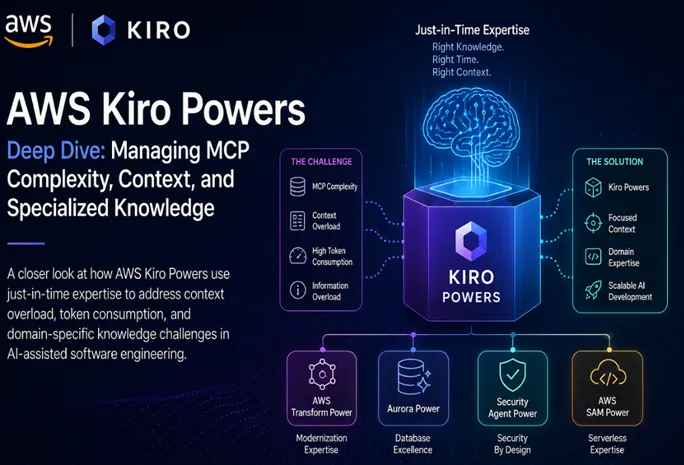
One common approach has been to connect AI assistants to additional MCP servers, tools, documentation repositories, and knowledge sources. While this expands what AI can access, it also introduces challenges around context management, token consumption, and information overload.
This is the problem space that Kiro Powers attempt to address.
Rather than viewing Powers as simply another plugin mechanism, it is more useful to look at them as AWS’s approach to managing expertise and context in AI-assisted software engineering.
This is the problem space that Kiro Powers attempt to address.
Rather than viewing Powers as simply another plugin mechanism, it is more useful to look at them as AWS’s approach to managing expertise and context in AI-assisted software engineering..
The Hidden Problem with AI-Assisted Development
Over the last two years, AI coding assistants have evolved from autocomplete tools into capable engineering companions. They can generate APIs, write tests, explain complex code, and even scaffold complete applications.
Yet many development teams have discovered that code generation is only a small part of software engineering.
The real challenge begins after the code is generated.
Developers still spend time validating recommendations, reviewing documentation, understanding service-specific best practices, and making architectural decisions. The AI may know how to use an API, but it often lacks the deep context needed to make production-grade decisions.
Consider a few common scenarios
Building a payment integration with StripeDesigning a highly scalable Aurora databaseModernizing a legacy Java applicationSecuring a customer-facing platformBuilding an event-driven serverless architecture
In each case, writing code is relatively easy. Knowing how to implement the solution correctly is much harder.
This expertise gap becomes even more apparent in enterprise environments where architectural consistency, security requirements, operational excellence, and modernization strategies matter just as much as the code itself.
Why More MCP Servers Are Not the Answer
Many organizations attempt to solve this problem by connecting more tools to their AI assistants.
The logic seems reasonable
If the AI needs more knowledge, give it more knowledge.
This often results in additional
MCP serversDocumentation repositoriesAPIsInternal knowledge basesFramework-specific instructions****Custom rule files
Initially, this improves capabilities. Eventually, however, it introduces a different problem. Every connected tool adds more context that the AI must process before it can provide useful answers
Over time this becomes problems like
Response times increaseToken consumption growsContext windows become crowdedRelevant information becomes harder to identify
The more tools organizations add, the more difficult it becomes for the AI to determine which information actually matters.
This is one of the most overlooked challenges in AI-assisted software engineering today.
AWS Took a Different Approach
Kiro Powers are AWS’s answer to this problem.
Instead of loading every tool, every instruction, and every document into the model from the beginning, Kiro activates expertise only when it becomes relevant to the task being performed.
Think about how organizations operate. When a company starts a modernization initiative, it does not invite every security engineer, database architect, platform engineer, and cloud specialist into every meeting. Experts join when their expertise is required.
Kiro Powers follow the same philosophy. The AI gains specialized knowledge dynamically based on the problem being solved.
That sounds like a small architectural decision, but it fundamentally changes how AI agents scale.
The Difference Between Tools and Expertise
Many articles describe Powers as bundles of MCP configurations, instructions, documentation, and workflows.
Technically, that description is correct. But it misses the bigger picture. The real value of a Power is not the tooling. The real value is packaged expertise.
For example, an Aurora Power is not simply a shortcut to Aurora APIs.
It represents accumulated knowledge about
- Schema design
- Query optimization
- Performance tuning
- Security best practices
- Operational patterns
- Scalability considerations
Similarly, AWS Transform Power is not just a migration utility. It brings modernization expertise directly into the development workflow. Organizations rarely struggle with access to tools. They struggle with access to expertise.
That distinction is what makes Kiro Powers interesting.
AWS Transform Power: Modernization Expertise Without Months of Discovery
Application modernization remains one of the most challenging initiatives for enterprises. Before organizations can migrate, upgrade, or transform applications, they must first understand what they are working with.
Teams need answers to questions such as
Which technologies are being used?What dependencies exist?What upgrade blockers are present?Which applications are modernization candidates?What risks need to be addressed?
Traditionally, this assessment phase requires extensive manual effort and involvement from experienced architects and modernization specialists.
AWS Transform Power brings that expertise directly into Kiro.
Instead of manually reviewing thousands of files, teams can leverage modernization intelligence inside their development workflow to identify issues, evaluate migration paths, and accelerate planning activities.
Imagine an organization upgrading hundreds of Java applications while simultaneously reducing technical debt. Rather than spending weeks gathering information and producing assessment reports, teams can begin understanding modernization challenges immediately from within the IDE.
The biggest value is not automated code changes. The biggest value is reducing the time spent figuring out what needs to change in the first place.
Aurora Power: From Generic SQL to Production-Aware Database Design
Most AI coding assistants can generate SQL statements.
That is no longer impressive. The real challenge begins when teams need to make database decisions that affect performance, scalability, security, and operational costs. Consider a travel platform building a flight reservation system. A generic AI assistant can generate tables for bookings, passengers, schedules, and payments. However, it may not understand Aurora-specific considerations such as indexing strategies, connection management, query optimization patterns, or high-availability design.
With Aurora Power, Kiro gains access to specialized Aurora expertise only when database-related tasks are being discussed.
Instead of generating isolated SQL scripts, it can provide recommendations aligned with Aurora best practices, helping teams design systems that are easier to operate and scale in production.
The conversation shifts from Generate a table to Help me design a database architecture that can support millions of reservations
That is the difference between code generation and engineering guidance.
Security Agent Power: Bringing Security Expertise Closer to Developers
Security reviews often occur late in the development lifecycle.
A feature gets built. The architecture is reviewed. Security concerns are identified. Rework follows.
This process is common across organizations and often becomes a bottleneck for delivery teams.
The Security Agent Power helps shift security expertise earlier into the development process.
Rather than waiting until implementation is complete, developers can incorporate security considerations while designing and building solutions.
Whether it involves threat modeling, secure coding practices, architectural reviews, or vulnerability analysis, the goal is the same: identify issues sooner, when they are easier and less expensive to address.
The benefit is not simply finding vulnerabilities.
It is reducing the friction that often exists between development and security teams.
AWS SAM Power: Making Serverless Development Less Complex
Serverless architectures provide tremendous flexibility, but they also introduce complexity.
A typical serverless application may involve
- Lambda functions
- EventBridge rules
- SQS queues
- DynamoDB streams
- IAM permissions
- Deployment pipelines
- Observability configurations
Developers frequently move between documentation, architecture diagrams, and deployment templates to ensure everything is configured correctly.
AWS SAM Power helps bring those best practices directly into Kiro.
Instead of piecing together multiple sources of information, teams can leverage serverless-specific expertise throughout the development lifecycle.
The result is not simply faster development.
It is greater confidence that applications are being built using proven serverless patterns from the start.
Why Kiro Powers Matter Beyond Individual Use Cases
While each Power provides value within its own domain, the bigger story is the architectural approach AWS has taken to solving some of the most persistent challenges in AI-assisted software engineering.
Reducing Context Overload
Many AI development environments continuously load MCP servers, instructions, documentation, and tool definitions regardless of whether they are needed.
As more tools are added, models spend increasing amounts of time processing context rather than solving problems.
Kiro Powers introduce a just-in-time model where expertise is activated only when relevant.
This allows the AI to focus on the task at hand instead of navigating a large collection of unrelated tools and instructions.
Reducing Token Consumption
Large context windows are valuable, but they are also finite.
Loading every tool and every instruction into the model can consume significant portions of available context before meaningful work even begins.
By activating expertise dynamically, Kiro avoids spending tokens on information that has no relevance to the current task.
This creates more room for actual problem solving and can improve response quality as projects become larger and more complex.
Closing the Domain Expertise Gap
Perhaps the most important benefit is the ability to bring specialized knowledge directly into the development workflow.
Most developers are not database architects.
Most architects are not security specialists.
Most security specialists are not modernization experts.
Organizations rely on specialists because expertise matters.
Kiro Powers create a mechanism for making that expertise available precisely when it is needed.
Where the Kiro IDE Fits In
This does not diminish the importance of the Kiro IDE itself.
The IDE provides the foundation through capabilities such as
- Spec-driven development
- Requirements generation
- Design documentation
- Task planning
- Test generation
- AI-assisted implementation
These features help teams move from an idea to a working solution.
However, without Powers, Kiro would still function primarily as a highly capable general-purpose development assistant.
The real differentiation emerges when domain expertise is layered on top of those capabilities.
Together they create a workflow that spans:
Requirements → Design → Implementation → Validation → Deployment
with specialized knowledge embedded throughout the process.
Final Thoughts
Most discussions about Kiro focus on the IDE because it is the most visible part of the product. It is what developers interact with every day.
But the longer-term strategic story is Kiro Powers. The software industry already has plenty of tools that can generate code. What organizations increasingly need are tools that can provide expertise at scale. That is what makes Kiro Powers interesting.
They are not simply another plugin mechanism, nor are they just a collection of MCP integrations packaged together.
They represent AWS’s attempt to make specialized engineering knowledge available exactly when it is needed, without overwhelming either developers or AI models with unnecessary complexity.
Enjoyed reading this content? Let the author know!
Your likes, comments, shares, and saves help creators reach more builders.

Loading recommendations
Loading article