
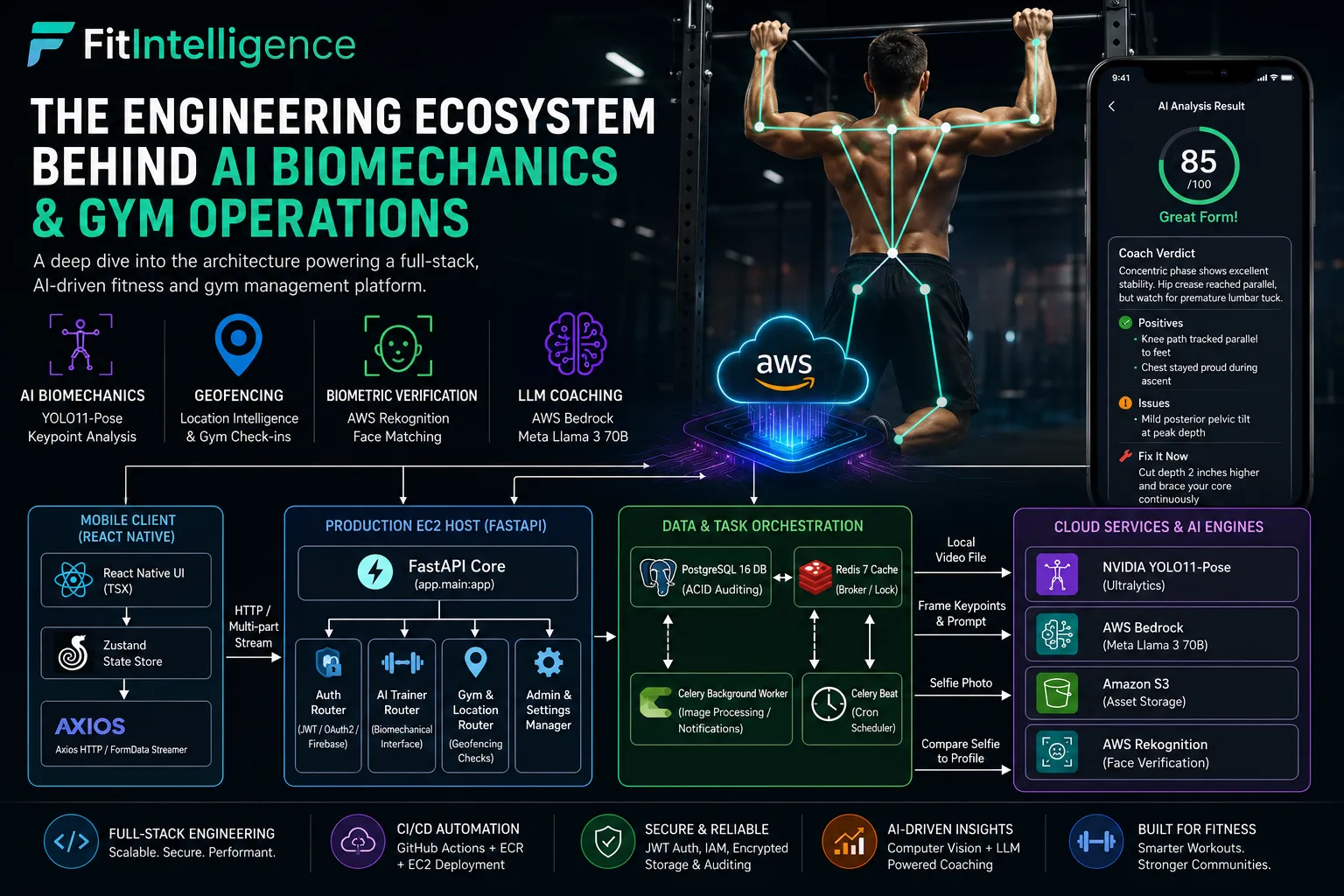
Fitelligence: The Engineering Ecosystem behind AI Biomechanics & Gym Operations
A deep dive into the architecture powering a full-stack, AI-driven fitness and gym management platform.

This technical blog post breaks down the complete engineering architecture of FitIntelligence, a premium, full-stack fitness and gym management application. By merging real-time computer vision, large language model (LLM) reasoning, geofenced location intelligence, and automated CI/CD deployment pipelines, FitIntelligence bridges the gap between hardware tracking and digital coaching.
1. System Architecture Topology
The diagram below illustrates the end-to-end data flow, API gateways, background processing jobs, and AI/ML model integrations within the FitIntelligence platform.

2. In-Depth Service Analysis
A. Mobile Client (React Native, TypeScript, Zustand)
The FitIntelligence mobile app is engineered for smooth interactive experiences, combining a custom glassmorphic dark-theme UI with low-latency client logic:
- Zustand State Manager: Avoids the heavy re-rendering of Redux by managing separate stores (
useStoreanduseAdminStore) for local auth, theme tokens, gym checklists, and current calendar entries.
- FormData Video Streaming: Video files picked from the library are sent to the
/trainer/ai/analyze-videoendpoint as a multi-part form payload.
- Path Prefix Stability: The client retains the native file scheme (
file://orcontent://) depending on the OS platform to allow React Native's underlying network client (OkHttp / RCTNetworking) to stream files without raising silentNetwork Errorread crashes.
B. FastAPI Gateway (FastAPI, Uvicorn, SQLAlchemy)
The backend service acts as the operational orchestrator. Built using FastAPI for asynchronous routing:
- Uvicorn Gateway: Runs the API gateway on port
8000. By configuring large request body limits and optimizing Uvicorn keep-alive timeouts, the backend handles concurrent high-bandwidth video uploads smoothly.
- Security & Auth: Leverages JWT tokens and OAuth2 interfaces to handle user registrations, admin privileges, and secure token refresh cycles.
- SQLAlchemy & Alembic ORM: Handles connection pooling to PostgreSQL. Database updates are managed through programmatic migration scripts (
alembic upgrade head) executed automatically during production updates.
C. Computer Vision Engine (NVIDIA YOLO11-Pose)
When a video is received, the backend saves the payload to a secure temporary path and processes it using the YOLO11-Pose keypoint extraction library:
- Joint Coordinates Extraction: Frame-by-frame, the model isolates human silhouettes and computes the coordinates of 17 key joints (shoulders, elbows, hips, knees, ankles, etc.) relative to the frame dimensions.
- Angle Calculation: Using vector mathematics, joint flexions are tracked dynamically. The angle θ\theta θ at a joint (e.g. elbow) formed by points AA A (shoulder), BB B (elbow), and CC C (wrist) is calculated using the dot product:

- Range of Motion (ROM) Computation: The minimum and maximum extension angles across the entire clip are calculated to determine if the user has reached full extension (e.g., deadhang in pull-ups) and full flexion.
D. Biomechanical Reasoning (AWS Bedrock & Meta Llama 3 70B)
Raw numerical angles do not help an everyday athlete. To make this data actionable, the calculated angles and exercise metrics are sent to AWS Bedrock using Meta Llama 3 70B as the core reasoning model.
- Biomechanics Prompting: The LLM is instructed to evaluate the joint angles like a kinesiologist. It verifies target muscle activation, spine angle consistency, and depth limits.
- Structured Outputs: The prompt enforces a strict JSON schema return so that the frontend can read the response reliably without parsing issues:
json
JSON
{"score": 85,"coach_verdict": "Concentric phase shows excellent stability. Hip crease reached parallel, but watch for premature lumbar tuck.","injury_risk": "Spine flexion under load at bottom depth increases shear force on L5-S1 lumbar joints.","positives": ["Knee path tracked parallel to feet", "Chest stayed proud during ascent"],"issues": ["Mild posterior pelvic tilt at peak depth"],"fix_it_now": ["Cut depth 2 inches higher and brace your core continuously"],"what_to_do_next": ["Incorporate plank-to-squat transitions", "Perform goblet squats with paused depth checks"]}
3. Gym & Location Services (Geofencing & Biometrics)
Ensures accountability for gym check-ins through dual-factor verification:
- Haversine Geofencing: When a user checks in, the backend computes the distance between their current GPS coordinates and the gym's registered coordinates using the Haversine formula:

If the computed distance dd d is less than the geofence radius (e.g., 100 meters), the user passes the first boundary step.
- AWS Rekognition Face Comparison: The user takes a live check-in selfie, which is uploaded to an Amazon S3 bucket. The backend calls
compare_faceson AWS Rekognition to match the selfie against their registered profile picture. If the match confidence exceeds 90%, the check-in is approved.
4. Cache & Task Queue (Redis 7 & Celery)
Handles background computations and notifications without delaying HTTP responses:
- Celery Workers: Run background jobs such as processing image assets, calculating stats, and dispatching push alerts.
- Celery Beat: A scheduler that triggers daily membership health checks. It flags accounts whose memberships expire in 3 days or less, and queues push warning tasks.
5. AWS Infrastructure Setup
FitIntelligence runs on a production environment hosted on AWS (us-east-1):
- EC2 Host Instance: Orchestrates backend services inside a multi-container Docker environment.
- Amazon ECR (Elastic Container Registry): Serves as the repository for backend Docker images.
- Amazon S3: Serves as the media storage vault for user selfies and profile images.
- AWS Rekognition: Handles anti-proxy validation checks.
- AWS Bedrock: Processes text prompts and biomechanical angle critiques using the Llama 3 model family.
- IAM Instance Profile: Provides the EC2 host with secure access to S3, Rekognition, and Bedrock without hardcoding access keys in the code.
6. The CI/CD Pipelines
FitIntelligence uses GitHub Actions workflows to automate building, testing, security checks, and production deployments.
A. The CI Pipeline ( ci.yml )
Runs on every push to the
main and develop branches:- Linting and Quality Check: Validates imports and formats using
ruff,black, andisort.
- Database Integration Testing: Spins up dynamic PostgreSQL 16 and Redis 7 Docker containers within the GitHub Runner.
- Pytest Suite: Runs integration tests to verify auth endpoints, location calculations, and database models.
- ECR Image Compilation: Authenticates with AWS, builds the production-ready backend Docker container, tags it with the unique git commit SHA, and pushes it to Amazon ECR.
B. The CD Pipeline ( cd.yml )
Triggers automatically once the CI pipeline completes successfully on the
main branch:- SSH Key Injection: Securely logs in to the production EC2 instance.
- Code Synchronization: Synchronizes workspace updates (excluding frontend files) directly to
/home/ubuntu/app/usingrsync.
- Docker Compose Hot-Reload: Pulls the new container image from Amazon ECR and restarts the services (
docker compose up -d).
- Database Auto-Migration: Runs Alembic database migrations (
docker compose exec -T api alembic upgrade head) to update tables without losing data.
- Health Checks: Executes a retry loop using curl to verify the API returns a
200 OKstatus.
7. Summary of Recent Optimizations
To ensure the app feels elite, stable, and polished, we recently rolled out several optimizations:
- Emoji-Free Design System: Replaced casual, unpolished emojis in result cards with professional FontAwesome vector icons (e.g.
check-circlefor strong points,exclamation-circlefor corrections) to align with a scientific sports aesthetic.
- No-Crash API Handler: Wrapped the backend video processing logic in a fallback try/except framework to ensure it always returns a structured JSON payload even in case of exceptions.
- Path Prefix Fix: Kept the
file://structure intact on iOS during uploads to resolve native networking issues, restoring the video upload flow.
Closing Thoughts
FitIntelligence is a good example of what it takes to turn a phone camera into a credible fitness coach: a pose-estimation model doing the geometry, an LLM translating angles into coaching language, and a boring-but-solid layer of geofencing, background jobs, and CI/CD holding it all together in production. None of the individual pieces are exotic — the value is in how cleanly they're wired together and how much failure-mode handling sits underneath the polish.
Enjoyed reading this content? Let the author know!
Your likes, comments, shares, and saves help creators reach more builders.

Loading recommendations
Loading article