
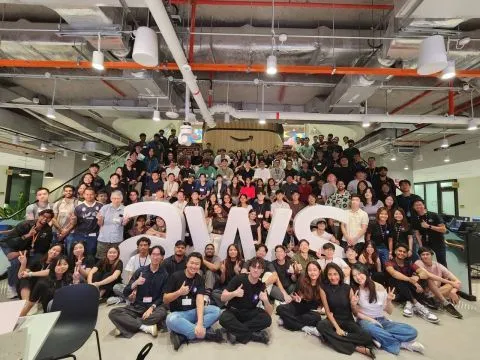
Bringing Singapore’s Student Builders Together for the First AWS Kiro Workshop
Students from across Singapore came together for the first AWS Kiro Workshop with AWS Student Builder Groups to explore spec-driven development, AI-assisted workflows, and building with Kiro.
Series: Community Events (4 articles)
- …
- 4Bringing Singapore’s Student Builders Together for the First AWS Kiro Workshop This article

Bringing Singapore’s Student Builders Together for the First AWS Kiro Workshop
What started as an idea for a student-focused workshop became an evening of learning, building, networking, and collaboration across universities.
Together with AWS and AWS Student Builder Groups from different schools, we organised our first AWS Kiro Workshop for students in Singapore.
The goal was not only to introduce another AI development tool. We wanted students to understand how Kiro supports a more structured approach to building software through spec-driven development.
Why We Organised the Workshop
AI-assisted development is changing how developers approach software projects.
Developers can now use AI to generate code, understand unfamiliar codebases, debug problems, create documentation, and automate repetitive tasks. However, generating code quickly does not always mean building the right solution.
Students still need to think carefully about:
- What problem they are solving
- What requirements the project must meet
- How the system should be designed
- How work should be divided into manageable tasks
- How generated code should be reviewed and tested
This was why Kiro and spec-driven development were central to the workshop.
Instead of immediately asking an AI assistant to generate an application, students learned how to begin with clear requirements, develop a design, and break the implementation into structured tasks.
Exploring Spec-Driven Development with Kiro
During the workshop, participants explored how Kiro can support the different stages of a software development workflow.
A typical spec-driven workflow begins with three important components:
Requirements
The requirements define what the application should do, who it is being built for, and what conditions the final solution must satisfy.
Writing clear requirements helps both developers and AI assistants understand the intended outcome.
Design
The design describes how the system should be structured.
This can include the application architecture, components, data flow, interfaces, technology choices, and important technical decisions.
Tasks
The tasks convert the requirements and design into smaller implementation steps.
This makes the project easier to manage and gives developers a clearer view of what has already been completed and what still needs to be built.
By working through these stages, students could see that AI-assisted development is not only about prompting an agent to write code. It is also about giving the agent sufficient context and direction.
Building Across University Communities
One of the most meaningful parts of this event was seeing students from different universities come together in the same space.
The workshop was supported by Student Builders and core teams from:
- Singapore Institute of Technology
- Singapore Management University
- Singapore Institute of Management
- Nanyang Technological University
- Singapore University of Social Sciences
Additional outreach also helped us connect with students from other institutions.
Each university community contributed by sharing the event, supporting participants, coordinating logistics, and helping create a welcoming environment.
The collaboration demonstrated what student communities can accomplish when they work together instead of operating separately.
Learning Beyond the Workshop
The workshop was also connected to Kiro BuildFest 2026.
After learning the fundamentals of Kiro, students were encouraged to apply what they had learned by developing their own projects.
This gave participants an opportunity to move beyond following a demonstration. They could identify a problem, prepare their specifications, experiment with Kiro’s capabilities, and create something of their own.
Hackathons and build challenges are valuable because they turn learning into practical experience. Students encounter real problems, make technical decisions, manage limited time, and learn from unexpected errors.
Even when a project is incomplete, the process of building it can teach more than simply watching another tutorial.
More Than a Technical Event
Although Kiro and AI-assisted development were the main topics, the event was also about community.
Students had opportunities to:
- Meet builders from other universities
- Ask questions about Kiro and software development
- Share the projects they were interested in building
- Connect with AWS professionals and community members
- Find potential teammates for future projects
These conversations are an important part of student technology events.
A student may arrive to learn about a development tool but leave with a new collaborator, project idea, mentor, or community connection.
What I Learned from Organising the Workshop
Organising a cross-university event taught me that the participant experience depends heavily on the work completed before the event begins.
Some of the most important lessons were:
Start collaboration early
Coordinating several university communities requires clear communication and sufficient preparation time.
Each school has its own schedules, communication channels, and student audience.
Give every team a clear responsibility
It becomes easier to organise a large event when responsibilities such as outreach, registration, logistics, participant support, and communications are clearly assigned.
Design the event for different experience levels
Some participants may already use AI development tools regularly, while others may be trying them for the first time.
The content should provide beginners with a clear starting point while still offering useful insights to more experienced builders.
Create a path for participants to continue building
A workshop should not end when the final presentation finishes.
Providing a hackathon, project challenge, community group, resource page, or follow-up activity gives participants a reason to continue applying what they learned.
Thank You to Everyone Who Made It Possible
A huge thank you to all the Student Builders and core teams from SIT, SMU, SIM, NTU, and SUSS who collaborated to organise and support the workshop.
Thank you as well to the students and community members who helped with outreach and invited builders from their respective schools.
I am especially grateful to Huei Chin Yap for leading the AWS side of the planning and helping make the event possible.
Thank you also to Isaac Ibrahim, Utkarsh Pundir, Myo Min Tun, Han Li, Chai Yinn, Chantelle L., and the wider AWS team for supporting the planning, food, swag, credits, and the many behind-the-scenes details required to run the event.
Finally, thank you to every participant who attended, asked questions, met other builders, and began developing a project.
What Comes Next
This workshop showed how powerful the student builder community can be when universities, industry professionals, and community leaders work together.
I hope this becomes the beginning of more cross-university workshops, hackathons, technical sessions, and opportunities for students to build with AWS and modern developer tools.
The technology will continue to change, but the most important part remains the same: bringing curious people together to learn, experiment, and build.
Connect. Learn. Build.
Series: Community Events (4 articles)
- …
- 4Bringing Singapore’s Student Builders Together for the First AWS Kiro Workshop This article
Enjoyed reading this content? Let the author know!
Your likes, comments, shares, and saves help creators reach more builders.

Loading recommendations
Loading article