
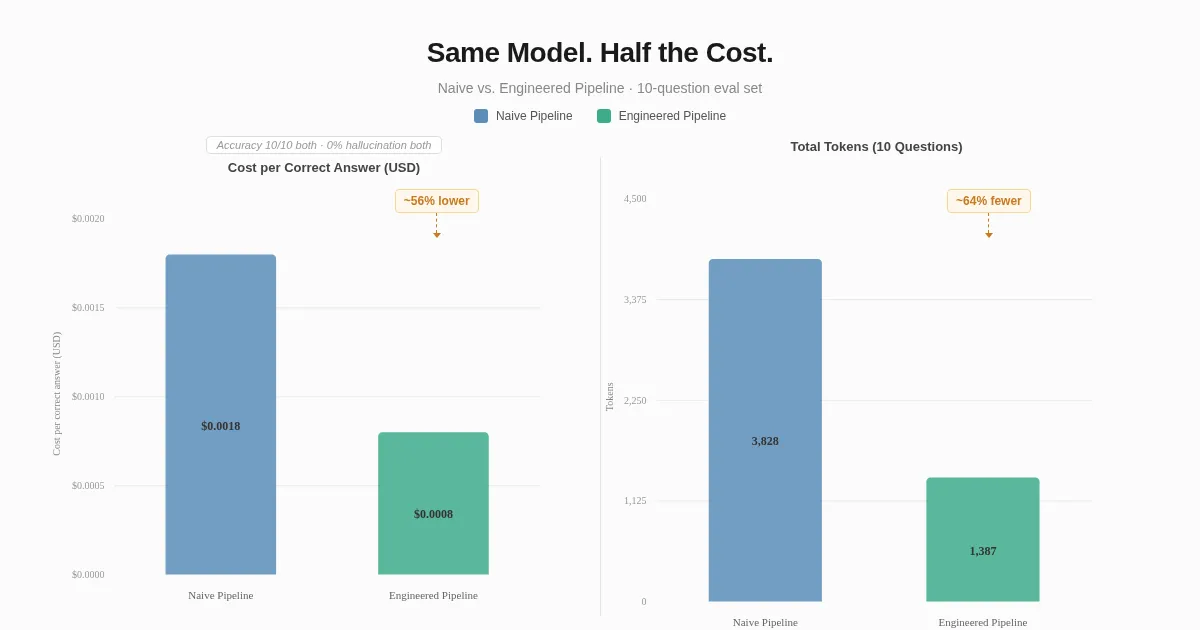
AI tokenomics, demonstrated: same model, ~56% lower cost per correct answer from the data platform alone
A reproducible experiment in AI tokenomics, not a production case study. I hold the model constant and change only the data pipeline to show what's possible, the levers behind it, and the evaluation traps that hide real regressions.

The term everyone's using, that almost no one is measuring
There's a phrase moving through every AI keynote and vendor deck right now: tokenomics. The framing is that as enterprises move from AI pilots to production, the unit that matters is the token. Every prompt, retrieval, reasoning step, and agent action consumes or produces them, and success is the economics of those tokens: the value you get per token versus the cost you pay per token. The accompanying argument, made well in Forbes by Dell Technologies, is that the thing which moves those economics is not the model but the AI data platform that feeds it , positioned as a "token optimization engine."
I think that thesis is right. But it's also, at this point, asserted far more than it's measured. So I did the boring, useful thing: I built a small, self-contained harness to test it under controlled conditions, and I report what held up, including the part where my own measurement nearly told me the wrong story.
In concrete terms, tokenomics reduces to one number you can actually put on a dashboard:
Cost per correct answer: what you pay for each answer that is actually right.
Everything below runs on that metric.
The result (the short version)
I ran an identical workload through two pipelines that share the same model, the same embeddings, and the same dataset (questions and corpus). The only thing that differs is the data platform layer wrapped around the model:
- a naive data pipeline, a realistic first cut: fixed-size chunking, top-k retrieval, no reranking, no cache, no governance; and
- an engineered data pipeline: cleaning, deduplication, contextual semantic chunking, metadata pre-filtering, reranking, caching, and governance.
Holding the model constant, on a real model (Anthropic Claude Sonnet, model id
us.anthropic.claude-sonnet-4-6) with real semantic embeddings (Amazon Titan Text Embeddings v2):| Metric | Naive data pipeline | Engineered data pipeline |
|---|---|---|
| Accuracy | 10/10 | 10/10 |
| Hallucination rate (LLM-judged) | 0% | 0% |
| Cache hit rate | 0% | 20% |
| Governance blocks | 0 | 2 |
| Cost per correct answer | $0.0018 | $0.0008 (~56% lower) |
| Aggregate tokens | 3,828 | 1,387 (~64% fewer) |
Same answers, same quality, at roughly half the cost per correct answer and nearly two-thirds fewer tokens, attributable entirely to the data platform because, in this controlled comparison, nothing else changed.
The one decision this implies: before you reach for a bigger or pricier model to fix cost or quality, look at the data pipeline first. That's usually where the token bill is actually being set.
Reading these numbers: this is a reproducible demonstration of the mechanism, not a production deployment or a saved invoice. The lever exists and is large; your numbers will differ. Also: tokens fell ~64% but cost only ~56%, because a token count weights input and output equally while pricing does not. On Bedrock, output tokens cost roughly 5x input tokens (for Claude Sonnet), and these optimizations mostly trim the input (the retrieved context). The answer itself stays about the same length on both pipelines, so the pricier, unchanged output dilutes the dollar savings. Cost is the more honest metric: not all tokens cost the same.The cache and governance rows show the other two levers firing: the answer cache served the repeated questions (20% hit rate) with no model call, and governance blocked the one restricted "poisoned" record from the engineered pipeline's context (2 blocks). Governance is a trust lever here, not a driver of the cost number, which comes mostly from chunking, deduplication, and reranking.The corpus is real public-domain text: geography excerpts from the 1990 CIA World Factbook, not authored to favor either pipeline.
Why it's cheaper (the mechanism)
The engineered pipeline isn't doing anything exotic. It's applying well-understood data-platform techniques, each of which has a direct token-cost consequence:
| Data-platform lever | What it does | Why the bill drops |
|---|---|---|
| Semantic + contextual chunking, rerank, dedup | smaller, cleaner, on-topic context | fewer tokens per answer |
| Answer cache | repeated questions skip the model | you stop paying twice for the same question |
| Governance on retrieval | policy-filtered context | unauthorized or "poisoned" data kept out of answers (trust, not just cost) |
(The model, tokenizer, and dataset are held identical for both pipelines. That's the experimental control, not a lever: it's what lets us attribute every difference above to the data platform rather than to model choice.)
The naive pipeline pays for tokens it doesn't need: it pulls near-duplicate and off-topic chunks into every prompt, re-asks the model for questions it already answered, and lets low-trust records into context. The engineered pipeline spends tokens only where they buy value. That gap is tokenomics.
A note on the baseline, so this stays a fair fight. Fixed chunk-size splitting is the common starting point in leading RAG stacks. The go-to splitters in LangChain (
RecursiveCharacterTextSplitter) and LlamaIndex (SentenceSplitter) enforce a token ceiling but are boundary-aware (they prefer paragraph or sentence breaks) and apply overlap by default, and Amazon Bedrock Knowledge Bases' default chunking targets roughly 300 tokens while honoring sentence boundaries (its separate fixed-size option adds a configurable overlap). So "naive" reflects what a lot of teams ship first, not a strawman. The honest caveat is that this demo's baseline is plainer than those tuned defaults: fixed-size windows with no overlap and no boundary preference. And the engineered path isn't exotic: semantic chunking is offered by all three stacks as the next step up, and the subject-prefixing is a lightweight version of Anthropic's published "contextual retrieval" technique.The part nobody writes about: measuring "quality held equal" is the hard bit
Cost is the easy half: token counts times price. The hard half is the claim hiding in the headline, that quality held equal, and that is where I went wrong three times before I got it right. Each failure is a trap you'll hit too.
Trap 1: lexical overlap rewards verbosity. My first "hallucination" metric scored an answer as grounded if enough of its words appeared in the source corpus. A real model writes fluent, padded sentences, so almost everything scored as grounded, and a wordier answer scored better. The metric measured eloquence, not faithfulness.
Trap 2: whole-corpus scoring can't tell the pipelines apart. When I scored groundedness against the entire corpus, both pipelines looked identical, because the right facts existed somewhere in the corpus regardless of what each pipeline actually retrieved. Faithfulness has to be judged against the context the model actually saw for that query, not the library it could have seen.
Trap 3: an LLM-as-judge rewards over-retrieval. So I switched to an LLM judge (the approach managed eval tools use), scoring each answer against its own retrieved context. Now the metric had teeth, and it immediately flagged the engineered pipeline as less faithful on one question. The naive pipeline scored perfectly. Read naively, that says optimization hurt quality.
It didn't. The judge had surfaced a real defect, but in my pipeline, not in the idea.
The finding: optimization can quietly strip context
I made the judge show its reasoning and the exact chunks it saw. The flagged question was "Which country is the largest West European nation?" The engineered pipeline had retrieved a chunk that read, in full:
note: largest west european nation.
My semantic chunker had split each record into one chunk per sentence, and in doing so had severed that fact from its subject. The chunk no longer said France. Retrieved on its own, it asserts that something is the largest West European nation, with no way to know what. The judge was right to flag it. The naive pipeline only "passed" by accident: its blunt fixed-size chunks happened to keep "France" glued to the claim.
The fix is a known technique, contextual chunking (prepend each chunk's subject so it's self-contained), and it's a genuine retrieval improvement, not a metric tweak. After it, the chunk reads:
france. note: largest west european nation.
The judge then marked it grounded, and the faithfulness scores tied at 0% for both pipelines: the clean "equal quality, far lower cost" result in the table above.
The lesson, in both languages:
- For practitioners: faithfulness must be judged against per-query retrieved context, an LLM judge rewards coverage (so over-retrieval looks "safer"), and aggressive chunking can silently drop a fact's subject. Show the judge's reasoning; it's how I found this.
- For decision-makers: a careless quality metric made the better system look worse. If you don't measure value-per-token honestly, you will make the wrong build-vs-buy call.
Reproduce it on your own workload
The whole thing runs offline and deterministically by default (standard library only), and against real models when you want ground-truth numbers:
1
2
3
4
5
6
7
8
9
git clone https://github.com/akomandooru/tokenomics-lab.git
cd tokenomics-lab

# Offline, deterministic: proves the mechanics, zero dependencies
python -m tokenomics_lab

# Real model + real embeddings + LLM-judged faithfulness
# Needs: pip install boto3, AWS credentials
python -m tokenomics_lab --llm bedrock --embeddings bedrock --region us-east-1 --faithfulness llm --per-query
--per-query prints, for each question, the retrieved chunk text and the judge's reasoning. That is exactly the visibility that turned "the optimized pipeline looks worse" into "here's the chunking bug." Swap in your own corpus and questions to measure your cost per correct answer.Where the lever compounds: agentic workloads
A single RAG call is the simple case. Agentic workloads are where tokenomics gets serious, because the saving is not one-time: it recurs on every step. If one retrieval-augmented call is ~56% cheaper per correct answer, an agent that retrieves and reasons over N steps re-incurs that context cost N times. The per-step saving is at least constant, and likely grows: agent context windows tend to accumulate history across steps, so the input token count rises each turn and a proportional saving on a larger number is a larger dollar amount. That is the multiplication: the same discipline that trims a single prompt compounds across an agent's loop.
Agents also introduce token-cost levers that single-shot RAG does not have. The same "spend tokens only where they buy value" principle shows up in new places:
- Step and orchestration budgeting. Cap reasoning and tool steps, stop early on a confident answer, and avoid runaway loops. Step count is a token multiplier unique to agents.
- Tool-result management. Tool and MCP responses (search hits, API payloads, file contents) can be large and get appended to context every turn. Truncate, summarize, or store them out of context and reference them, rather than carrying raw outputs forward.
- Per-step model routing. Use a cheap model for triage and routing, and the expensive model only for the hard step. Tokenomics is also which model runs which step.
To be clear about scope: these are the agentic extensions of the same thesis, not things this harness measured. The numbers above are single-step RAG. I list them because the question a practitioner asks next is "what changes when this becomes an agent?", and the answer is that the lever gets bigger and moves into orchestration and tool I/O.
Limits
This is a teaching harness, not a benchmark. The corpus is small (ten questions, a handful of public-domain records), the real-model figures come from single non-deterministic runs, and I tested one model family. I also did not isolate each lever's individual contribution; the numbers are the combined effect of the engineered pipeline, not a per-lever attribution of how much came from chunking versus cache versus dedup. Treat the percentages as illustrative of the mechanism, not as universal constants. The transferable part isn't "56%". It's the method (hold the model constant, measure cost per correct answer, judge faithfulness against retrieved context) and the traps to avoid while doing it.
Back to AI tokenomics
The industry is right that the AI data platform is where token economics is won or lost. What's missing from the conversation isn't the thesis. It's a way to measure it without fooling yourself. Cost is easy; "did quality hold?" is where the real work is, and where a naive metric will hand you a confident, wrong answer.
So if you take two things from this:
- Tune the data pipeline before you tune the model. It's usually the cheaper, larger lever on cost per correct answer.
- Measure value per token as carefully as you measure cost per token. Judge faithfulness against what the model actually retrieved, and make your evaluator show its work.
That's AI tokenomics in practice: not generating the most tokens, but generating the most value per token, and being able to prove it.
Appendix: AI tokenomics pipeline audit
The goal of this checklist is visibility, not optimization. One question per lever: "do I know what this is doing in my pipeline?" You can't fix what you can't see.
Start here: the meta-check
- [ ] If your optimized pipeline scores worse on a quality metric than your naive one, have you looked at the evaluator's reasoning, not just its verdict? A score can be technically correct and still be measuring the wrong thing. In this project, an LLM judge flagged the optimized pipeline as less faithful, because semantic chunking had stripped a claim from its subject, producing a context note that said "largest West European nation" without saying which country. The score was right; the interpretation ("the pipeline is worse") was wrong. Show your evaluator's work before you act on its output.
Retrieval and context
- [ ] Do you know your average context size in tokens per query? Is it growing over time?
- [ ] Are your chunks self-contained? Can any chunk be understood without the one before it? (Subject-stripping, where a fact is severed from the entity it describes, lives here.)
- [ ] Do you have near-duplicate chunks in your index?
- [ ] Is your faithfulness metric judged against what the model actually retrieved for each query, or against the whole corpus? Whole-corpus scoring makes both pipelines look identical and cannot tell them apart.
- [ ] Do you have a governance policy on what enters model context? Do you know how many candidates it blocks per run?
Cost measurement
- [ ] Can you compute cost per correct answer, not just aggregate token counts?
- [ ] Are you tracking input and output tokens separately? They are not the same price on most providers, and optimizations almost always affect input more than output.
- [ ] Are embedding costs tracked separately from generation costs?
Caching
- [ ] Do you have an answer cache? What is your cache hit rate?
- [ ] Are you paying for the same question twice? Repeat and FAQ traffic costs nothing on the second call with a cache in place.
- [ ] Are you using provider prompt caching for static content like system prompts and tool schemas that repeat every turn?
Agents (if applicable)
- [ ] Do you know your average step count per agent run? Is it bounded or can it grow unbounded?
- [ ] Are tool and MCP responses carried forward raw into every subsequent prompt, or are they summarized or stored out of context after use?
- [ ] Is your agent using the same model for triage, routing, and reasoning? Cheap tasks routed to a cheap model is a direct per-step cost lever.
- [ ] Is context accumulating across steps, or is there a rolling or summarized window? Unbounded context growth means the token cost of every step rises as the loop runs.
The items above are about visibility not specific thresholds. Framework defaults and provider pricing change; whether you can answer each question does not.
Enjoyed reading this content? Let the author know!
Your likes, comments, shares, and saves help creators reach more builders.

Loading recommendations
Loading article