
Sometimes All It Takes Is One Message: Our 48 Hours Building Seeley at the AWS YouthTech AI-DLC Hackathon
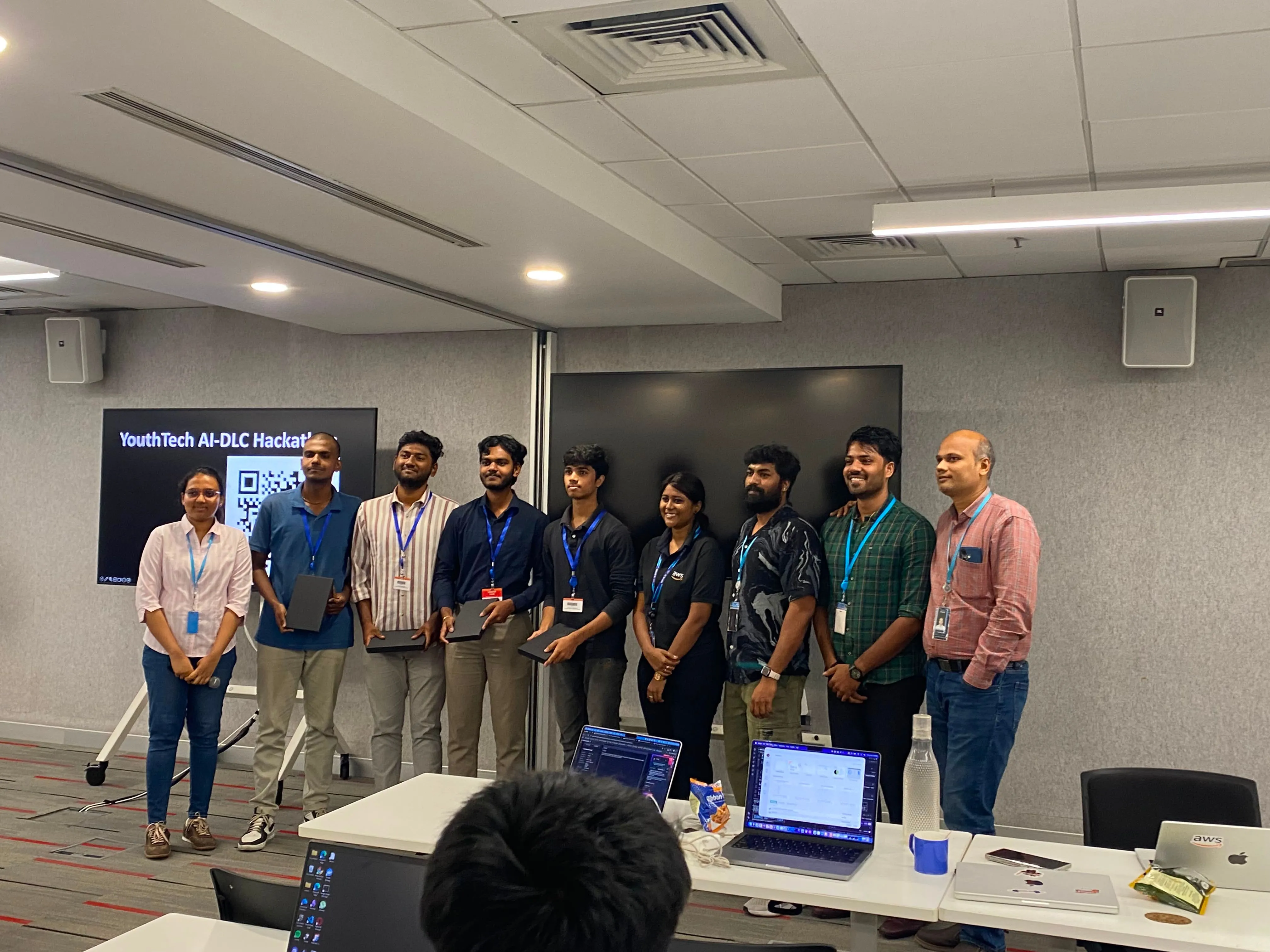
We almost didn't make it into the Youthtech AI-DLC Hackathon at the AWS Chennai office. Forty eight hours later, Team CyberPhantoms walked out with first place and a platform called Seeley that neither existed nor had a name before that weekend. This is the version of those two days nobody saw from the outside - the debates that ate our first day, the night we built through, the laptop that shut off right before our turn, and everything we picked up along the way.
I had almost missed the YouthTech AI-DLC Hackathon entirely. I saw the message late, reached out, got in, and before I knew it, Team CyberPhantoms (Thirumurugan Kandan, Kabelan G K, Jaiyantan S) was walking into the AWS Chennai office. We had no real idea what to expect. Looking back now, it honestly feels like one of those things that was meant to happen.

Day 1: Before a Single Line of Code
We all carry this image of a Solutions Architect as someone who knows every AWS service by heart, deep in tech, end to end. One session by Medha Aiyah completely changed that picture for me. She didn't talk about services or tools at all. She spoke about customers, about understanding business problems before anything else, about leadership principles, and about the Working Backwards approach.
That last one was probably my biggest takeaway from the entire two days. I usually start with "this would be cool to build." Amazon's approach is closer to "would anyone actually use this?" You write the press release before the product exists. You force yourself to answer every hard question before you write a single line of code. It sounds obvious once you hear it, but it is a genuinely good question to sit with before spending days building something that just ends up sitting unused in a GitHub repo.

Once the sessions wrapped up, the real fun began. We were introduced to the AI-Driven Development Lifecycle, explored AWS's GenAI stack, and got hands-on with Kiro. We received our AWS and Kiro credits to build our solution, and we did not let them sit idle. We pushed them hard, experimented with a bunch of different ideas, broke a few things along the way, and tried more models than we probably needed to.
By the afternoon, the hackathon officially began.
The Hours Before We Built Anything
Here is the part that does not usually make it into hackathon recaps. While it felt like other teams had already locked in their direction and started building, we were still going back and forth. Feasibility. Scalability. What would actually have an X-factor worth presenting. It was a real debate, the kind that does not resolve quickly just because there is a clock running.
We went home that evening with nothing decided.

Later that night, we got on a Google Meet call and kept at it. Somewhere between whiteboards, screen shares, and one too many "okay, one last change," it clicked. By around 12:00 PM the next day, we finally said it out loud: okay, this is it, we are going all in.
Building Seeley
Seeley (சீலே) is an AI-assisted interior design platform. You drop in one photo of a room, and it gives you back a personalized 3D layout, an AR preview, furniture matches suited to your space, and a photorealistic render.
GitHub Link: https://github.com/JoseScript7/Seeley
The flow, roughly, looks like this:
Photo uploaded → Amazon Bedrock (Claude) reads the room → 3D layout generated → AR preview rendered → furniture matched to your space and style → photorealistic render delivered back to you
It is built on Amazon Bedrock (Claude), Three.js, FastAPI, and a full AWS serverless stack, all put together with Kiro in the hours we had left.

We worked through the night. Kiro running alongside us, services slowly coming together, infrastructure getting stitched piece by piece. We slept for maybe an hour, maybe two, somewhere in between. We came back the next morning running on exactly that, and whatever adrenaline was left over from the day before.
Day 2: The Day Everything Was Supposed to Go Right
The morning was spent refining the product, fixing things that had quietly broken overnight, and getting ready for the final presentation. By the time we were called up, we were running on fumes, but Seeley was standing.
Then, right before our turn, I accidentally closed my laptop.
Every service we had went offline.
Here is what actually happened, in plain terms. Our application had already been deployed, but some of our backend services were still running as active processes from the terminal session itself. The moment that session ended, those processes stopped with it. There was no detached process keeping things alive independently. We had to restart everything from scratch and sit through the full initialization and cooldown before Bedrock, the FastAPI server, and the frontend were all live again. Those few minutes were, without question, the longest of the entire two days.
We made it back online just in time. We walked up, spoke about Seeley, and meant every word of it.
The Result
Third place. Not us.
Second place. Still not us.
And then we heard it: Team CyberPhantoms.

That moment was genuinely the cherry on top. The real reward was everything those 48 hours had already taught us, long before the results were announced.
What This Taught Me
If your demo only lives on your machine, it dies the moment your machine does. Always deploy to something that persists independently of whatever terminal or session you happen to be running it from. I learned that one the hard way, and it is not leaving my head anytime soon.
And the hours we spent debating before we touched a single line of code were not wasted time. That was the actual work. Understanding a problem deeply enough before you start building is what shows up in the room later, whether or not things go wrong on stage right before you present.
Gratitude
Huge thanks to Medha Aiyah , Nihitha Vemulapalli , Sangeetha Priya , and Naresh Jawahar for every conversation, every piece of guidance, and for showing us what building on AWS actually feels like.
Thank you to Lindsay Hair and Lisa Bagley for making sure this opportunity even reached us in the first place, and to the entire organizing team for running an event this well put together.
Thank you to Amazon Web Services for this opportunity, and to Saveetha Engineering College and the AWS Student Builder Group at Saveetha Engineering College for consistently putting us in places where we get to learn, build, and grow.
Arigato. We built a platform that turns a single photo into a vision. Looking back, these two days did something fairly similar to all of us.
#AWS #AmazonBedrock #Kiro #AIDLC #CyberPhantoms #BuildOnAWS #AWSYouthTech #Hackathon #CloudComputing #AWSCommunity #StudentDevelopers #AI #AmazonWebServices #Builders
Enjoyed reading this content? Let the author know!
Your likes, comments, shares, and saves help creators reach more builders.

Loading recommendations
Loading article