
How I Built DisasterTrain360 AI: Using AWS and Generative AI to Improve Disaster Preparedness
Disaster preparedness programs often rely on manual processes and scattered records. In this article, I share how I built DisasterTrain360 AI using AWS services and generative AI to create a secure, scalable, and intelligent disaster training platform.

How I Built DisasterTrain360 AI: Using AWS and Generative AI to Improve Disaster Preparedness
Introduction
Disaster preparedness training plays an important role in saving lives. Across different states and districts, government agencies and training organizations conduct thousands of disaster awareness programs every year. However, many of these programs still rely on manual records, spreadsheets, emails, and paper-based reporting.
While working on this problem, I realized that training programs often face challenges such as delayed approvals, scattered data, lack of centralized monitoring, and limited visibility into preparedness levels.
This motivated me to build DisasterTrain360 AI, a cloud-native platform that manages the complete lifecycle of disaster preparedness training programs while also generating AI-powered insights using AWS services.
Understanding the Problem
Training providers conduct sessions in different regions, citizens enroll in programs, and administrators need to monitor activities at a national level.
Some common challenges include:
- Training records are stored in different places.
- Evidence submission and verification take time.
- Administrators have limited visibility into district-level activities.
- There is no easy way to measure preparedness.
- Reports are often generated manually.
I wanted to create a system that could simplify these processes and provide meaningful insights.
The Idea Behind DisasterTrain360 AI
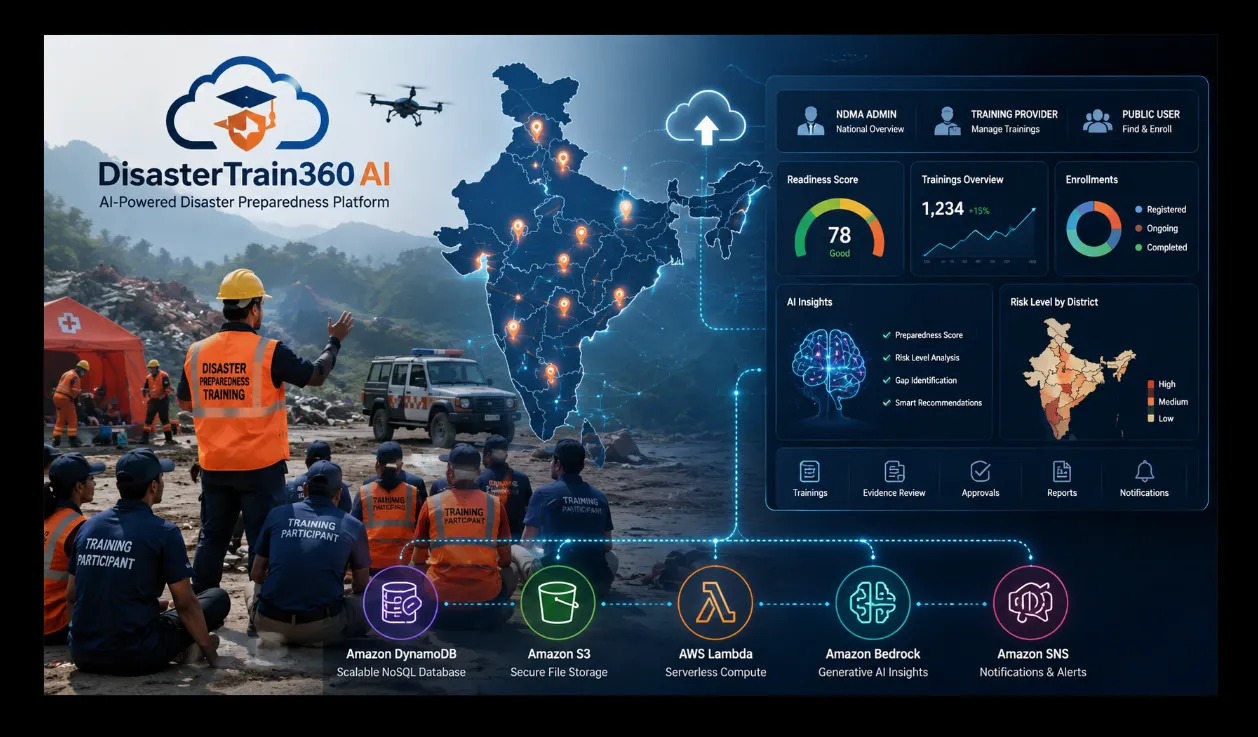
The platform supports three different users:
NDMA Administrators
Administrators can monitor training activities, review evidence, approve completions, and analyze preparedness insights.
Training Providers
Organizations can create training programs, manage sessions, and upload completion evidence.
Public Users
Citizens can discover training programs, enroll in sessions, and download certificates after completion.
This creates a single digital platform for all stakeholders.
Choosing AWS Services
One of my goals was to build a scalable and secure application using managed AWS services.
Amazon DynamoDB
I used DynamoDB to store:
- Users
- Trainings
- Enrollments
- AI insights
- Notifications
- Reports
Since DynamoDB is fully managed and highly scalable, it fits well for applications that may eventually serve multiple states or districts.
Amazon S3
Training photos, evidence documents, certificates, and reports are stored in Amazon S3.
Instead of making files public, I used presigned URLs so authorized users can access files securely for a limited time.
AWS Lambda
Whenever a new training is created, a Lambda function runs asynchronously.
This keeps the application responsive and allows background processing without managing additional servers.
Amazon Bedrock
I wanted the platform to do more than just store data.
Using Amazon Bedrock, the system analyzes training information and generates:
- Preparedness scores
- Risk levels
- Recommendations
- Gap analysis
These insights can help administrators understand areas that may require additional training efforts.
Amazon SNS
SNS helps deliver notifications for important events such as approvals and updates.
Application Architecture
The frontend is built using React and communicates with a Spring Boot backend through REST APIs.
The backend integrates with various AWS services:
- DynamoDB for data storage
- S3 for file storage
- Lambda for background processing
- Bedrock for AI insights
- SNS for notifications
This architecture allows the application to remain scalable and easy to maintain.
Security Considerations
Security was an important part of the project.
Some measures implemented include:
- JWT authentication
- Role-based access control
- Private S3 buckets
- Presigned URLs
- Environment variables for secrets
- Restricted CORS policies
These practices help protect both user data and training evidence.
Challenges During Development
Building DisasterTrain360 AI involved several challenges.
- Designing role-based access control.
- Managing secure file access.
- Integrating multiple AWS services.
- Handling asynchronous workflows.
- Generating meaningful AI insights.
Each challenge provided an opportunity to learn more about AWS services and cloud-native application design.
What I Learned
This project taught me that cloud services become most valuable when they work together.
Instead of using AWS only for hosting, I learned how managed services such as DynamoDB, S3, Lambda, SNS, and Bedrock can solve real-world problems while reducing operational complexity.
I also gained experience in designing event-driven architectures and integrating generative AI into practical applications.
Future Improvements
Some ideas for future development include:
- Real-time GIS monitoring
- Mobile applications
- Multi-language support
- Predictive analytics
- Advanced dashboards
Conclusion
DisasterTrain360 AI started as an idea to improve disaster preparedness training management. By combining AWS services with generative AI, the platform evolved into a secure, scalable, and intelligent solution.
This project demonstrated how cloud technologies can help solve real-world challenges and improve the way preparedness programs are managed and monitored.
Building this application was a valuable learning experience, and it showed me how AWS services can be combined to create impactful solutions.
Enjoyed reading this content? Let the author know!
Your likes, comments, shares, and saves help creators reach more builders.

Loading recommendations
Loading article