
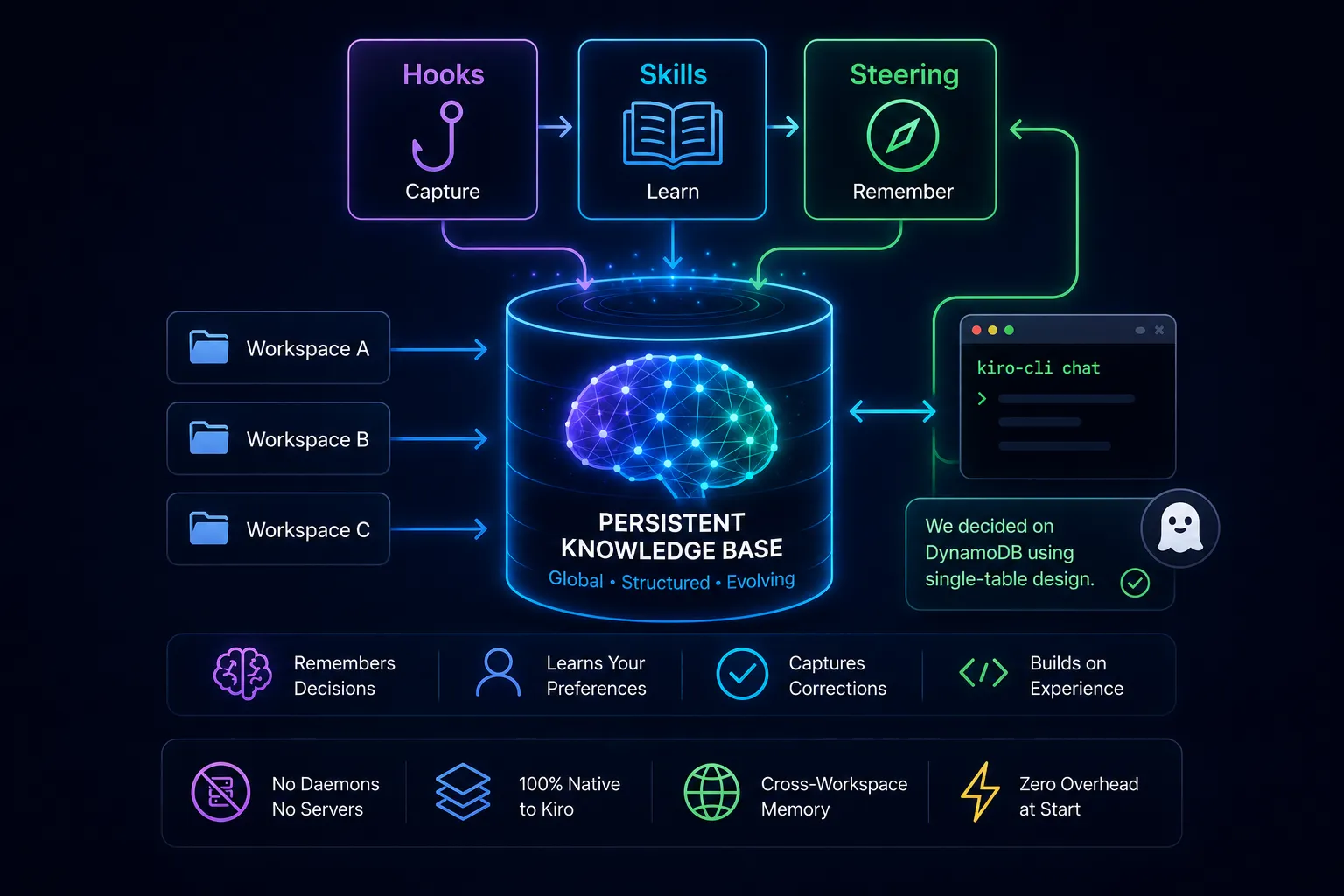
Building Persistent Memory for Kiro CLI
Cross-Workspace Knowledge Using Hooks, Skills, and Steering

Every AI coding assistant has the same weakness—it forgets.
Yesterday it learned your team's architecture decisions. Today it asks the same questions again. It forgets your preferred coding style, repeats mistakes you've already corrected, and loses valuable context every time a new session begins.
While context windows continue to grow, conversation history is not the same as memory. Useful memory means retaining the decisions, preferences, patterns, and lessons that make future interactions better.
I wanted an agent that continuously learns from experience without introducing additional infrastructure, background services, or complex setup.
This article explores the architecture behind a persistent memory system for Kiro CLI, built entirely using Kiro's own capabilities: Hooks, Skills, and Steering.
The Problem
Most AI coding assistants are effectively stateless between sessions.
They may remember the current conversation, but they rarely retain knowledge such as:
- Architecture decisions
- User preferences
- Previous corrections
- Domain-specific conventions
- Successful implementation patterns
This often leads to repetitive conversations where the same decisions need to be explained again and again.
Several community projects have explored solving this problem by introducing external memory systems. While these approaches are effective, they typically rely on additional infrastructure such as background daemons, MCP servers, or external synchronization processes.
Those solutions work—but they also introduce operational overhead that has to be installed, configured, monitored, and maintained.
That led to a different question:
Can persistent memory be implemented using only Kiro's native building blocks?
The Design Goal
Rather than building another memory service, the objective was to treat Kiro itself as the platform.
The design was guided by five principles:
- Native before external
- Zero operational overhead
- Cross-project knowledge sharing
- Incremental learning instead of replaying history
- Structured knowledge instead of raw conversations
The result is a lightweight architecture that continuously improves over time while remaining completely native to Kiro.
Architecture
Kiro already provides the primitives required to build long-lived intelligent agents:
- Hooks perform deterministic lifecycle operations.
- Skills provide structured workflows for knowledge extraction.
- Steering ensures learning continues throughout the session.
- Agents orchestrate the complete learning process.
Rather than layering another runtime alongside Kiro, the memory system is composed entirely from Kiro's own primitives.
The overall architecture follows three logical phases.

Phase 1 — Capture
When a new Kiro CLI session starts, a native Hook performs lightweight preprocessing.
Instead of replaying every historical conversation, it incrementally processes only newly created session data and prepares compact summaries for later analysis.
This phase performs no model inference. The entire capture phase runs as deterministic code, consumes zero LLM credits, and typically completes in under two seconds.
Phase 2 — Learn
Once the conversation begins, the agent reviews the prepared summaries using a dedicated Skill.
Rather than storing entire conversations, it extracts structured knowledge.
The extracted knowledge includes:
| Conversation Signal | Stored Knowledge |
|---|---|
| Architecture decisions | Architecture Decision Records (ADRs) |
| User corrections | Corrections |
| Coding preferences | User Preferences |
| Recurring implementation approaches | Patterns |
| Project-specific information | Domain Knowledge |
The objective is to preserve information that improves future reasoning rather than archive every interaction.
Phase 3 — Remember
Learning doesn't stop after startup.
Steering continuously guides the agent to recognize new knowledge during active conversations.
Whenever meaningful information emerges—whether it's a new decision, a correction, or a user preference—it immediately becomes part of the persistent knowledge base.
This creates a continuous reinforcement loop. Corrections improve future reasoning, preferences shape recommendations, and recurring patterns reduce repeated explanations. The agent doesn't simply accumulate facts—it continuously learns from experience.
Because the knowledge base is global rather than project-scoped, insights gained in one workspace immediately benefit every other workspace. Over time, the agent develops a richer understanding of both the user and the projects it works on.
Key Architectural Decisions
Rather than focusing on implementation details, this project is built around a few deliberate architectural choices.
Native Extensibility
Instead of introducing external infrastructure, the solution leverages Kiro's own lifecycle primitives—Hooks, Skills, Steering, and Agents—as first-class extension points.
This keeps the architecture lightweight, reduces operational complexity, and remains aligned with Kiro's design philosophy.
Incremental Processing
Only newly created session data is processed.
This avoids repeatedly scanning historical conversations, minimizes startup latency, and keeps processing efficient as the knowledge base grows.
Structured Memory Over Conversation History
Not every conversation deserves to become memory.
The agent extracts only long-lived knowledge that improves future interactions:
- Architecture decisions
- User preferences
- Corrections
- Reusable implementation patterns
- Domain knowledge
The goal is to retain what matters, not everything that happened.
Global Knowledge
Instead of maintaining isolated, project-specific memories, knowledge is shared across projects.
This allows the agent to continuously improve as it gains experience, bringing relevant architectural decisions and user preferences into future conversations regardless of the workspace.
The Result
The outcome is a self-learning agent that becomes more valuable over time.
- Session 1: The agent starts with no prior knowledge.
- Session 5: It remembers your preferred technologies and several key architectural decisions.
- Session 20: It has accumulated meaningful patterns, preferences, corrections, and domain knowledge that improve every subsequent interaction.
Rather than simply having a larger conversation history, the agent develops a persistent knowledge base that grows with experience—and because that knowledge base is global, insights from one project improve the agent's reasoning in every other project.
GitHub Repository
If you're interested in exploring the implementation, installation steps, or contributing to the project, the complete source code is available on GitHub.
GitHub: https://github.com/manojaiconf26/kiro-self-learn
Looking Ahead
This implementation establishes a foundation for persistent memory in Kiro, currently targeting Kiro CLI, where Hooks, Skills, and Steering provide the necessary primitives.
The architectural approach is intentionally platform-oriented rather than CLI-specific. As Kiro continues to evolve, I plan to explore extending the same concepts to the Kiro IDE, enabling a consistent self-learning experience across both CLI and IDE workflows.
Potential future enhancements include:
- Semantic memory retrieval
- Knowledge confidence scoring
- Automatic memory pruning
- Shared team knowledge bases
- Native support for Kiro IDE
The objective isn't to build another memory service—it is to demonstrate how Kiro's native primitives can be composed to create long-lived, continuously learning AI agents.
Final Thoughts
Persistent memory shouldn't require additional infrastructure.
By combining Kiro's native Hooks, Skills, and Steering, it's possible to build agents that continuously learn from experience while remaining lightweight, maintainable, and aligned with the platform itself.
This project is an exploration of that idea, implemented today for Kiro CLI, with an architecture designed to evolve alongside the broader Kiro ecosystem.
After all, the most useful AI assistants aren't the ones with the largest context windows—they're the ones that remember what actually matters.
Enjoyed reading this content? Let the author know!
Your likes, comments, shares, and saves help creators reach more builders.

Loading recommendations
Loading article