
When the Live Demo Fails: What I Learned About Building Reliable AI Voice Agents
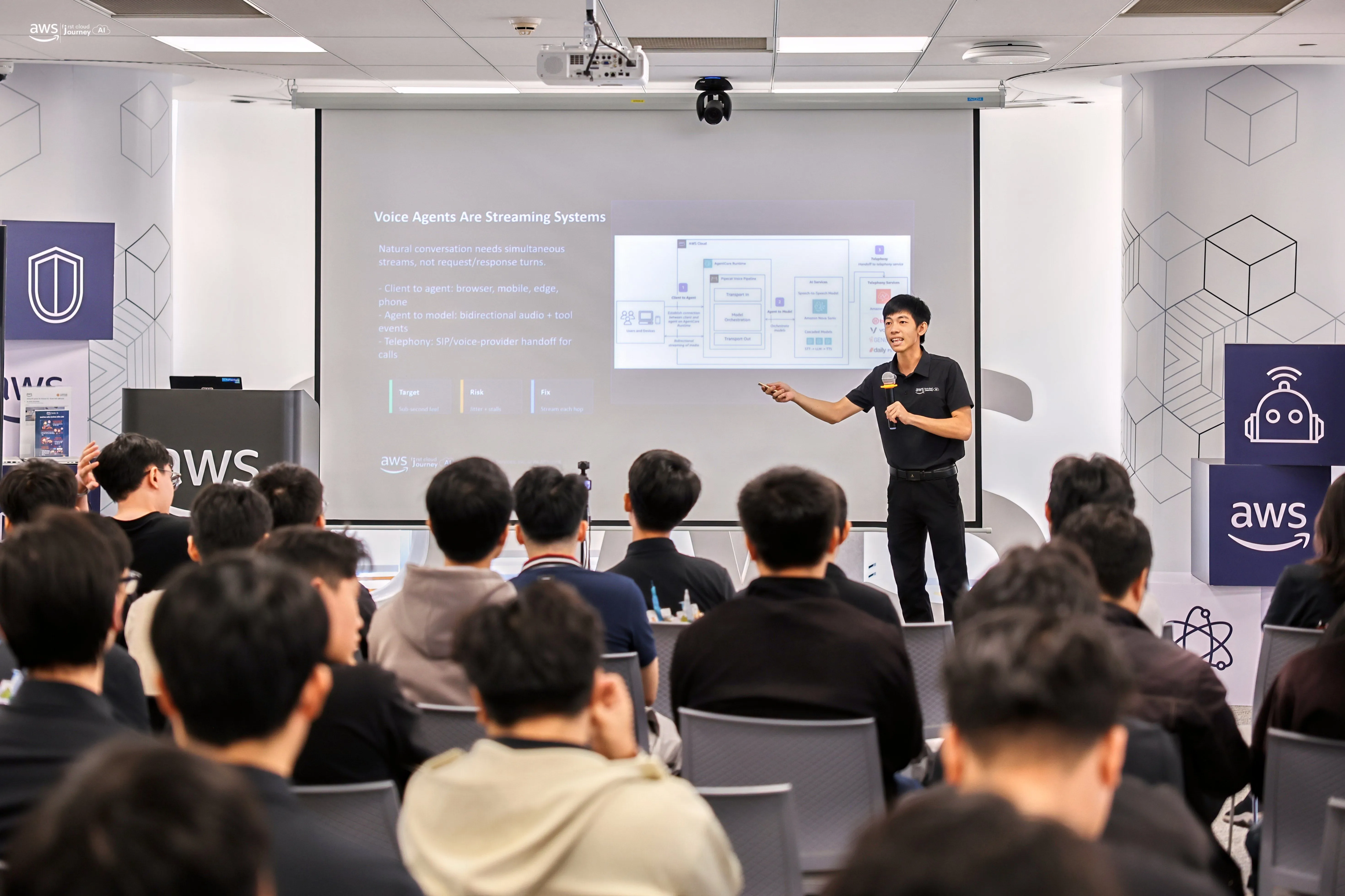
I experienced that silence while presenting in front of more than 300 attendees, with even more people watching through a YouTube livestream.

There is a special kind of silence that happens when a live demo stops working.
I experienced that silence while presenting in front of more than 300 attendees, with even more people watching through a YouTube livestream.
My session was about building human-like AI voice conversations at scale. I had prepared the architecture, tested the application, reviewed the presentation flow, and rehearsed the demonstration. Everything had worked before the event.
Then, during the actual presentation, the demo failed.
For a few seconds, my mind went blank. I could see the audience waiting for the voice agent to respond, but nothing happened as expected. It was uncomfortable, but it also became one of the most valuable learning experiences in my journey as a cloud builder.
The failure reminded me that building a successful AI voice agent is not only about selecting a capable foundation model. It is about designing an entire system that can handle real-world conditions, unexpected failures, network delays, and imperfect integrations.
A Voice Agent Is More Than a Model
When people first see an AI voice agent, the interaction can feel simple.
A user speaks, the system understands the request, and the agent responds naturally.
Behind that conversation, however, many components must work together:
- A telephony or client application receives the user's audio.
- The audio stream is sent to the voice-processing system.
- The model interprets the conversation and determines the user's intent.
- The agent may call external tools or business systems.
- The result is converted into a spoken response.
- The audio is streamed back to the user with minimal delay.
During my talk, I discussed how services and technologies such as Amazon Bedrock, speech-to-speech models, streaming communication, and Model Context Protocol tools can contribute to this architecture.
Each component can work perfectly in isolation while the complete system still fails.
A network request may time out. An authentication token may expire. A tool may return an unexpected response. The microphone may use the wrong audio format. A dependency may become unavailable. Even a small delay can make the conversation feel unnatural.
That is why voice-agent development requires more than model experimentation. It requires system thinking.
Latency Is Part of the User Experience
One of the most important lessons I learned while working with voice agents is that latency is not only a technical metric. It directly affects how users feel about the conversation.
In a text-based chatbot, users may accept waiting a few seconds for an answer. In a spoken conversation, even a short pause can feel awkward.
A voice agent must process audio, understand context, possibly invoke a tool, generate a response, and stream audio back to the user. Every step adds latency.
Developers therefore need to examine the complete conversation path rather than optimizing only the model response.
Some useful questions include:
- How quickly does the application detect that the user has finished speaking?
- How long does the model take to begin responding?
- Does the agent need to wait for a complete tool response?
- Can audio be streamed before the full response is generated?
- What happens when an external system responds slowly?
- Can the user interrupt the agent naturally?
These questions helped me understand that a technically correct response is not always a good conversational experience. A useful voice agent must be accurate, but it must also feel responsive.
Tool Integration Creates New Failure Points
Voice agents become much more valuable when they can perform actions instead of only answering questions.
For example, an agent might retrieve customer information, check the status of an order, create a support ticket, or query an internal knowledge source. Model Context Protocol can provide a structured way for an AI application to interact with tools and external systems.
However, tool integration also creates additional failure points.
The model may select the wrong tool. Required parameters may be missing. The tool may return a response the agent does not expect. The downstream API may be unavailable.
Because of this, tool-enabled agents need clear permission boundaries, input validation, timeout handling, and fallback behavior.
For read-only actions, the agent may be allowed to retry automatically. For write actions, such as updating customer data or creating a transaction, the application may need explicit confirmation from the user.
This is where security, reliability, and user experience intersect.
The agent should not expose a raw error message or remain silent when a tool fails. It should respond in a way that keeps the conversation understandable, such as:
“I’m having trouble accessing that information right now. Would you like me to try again?”
That simple fallback can prevent a technical failure from becoming a complete conversational failure.
Design the Failure Path Before the Happy Path
Before my presentation, most of my attention was on the successful demonstration flow.
The user would speak. The agent would recognize the request. The appropriate tool would be invoked. The response would be generated correctly.
After the failed demo, I began thinking differently.
What happens if the model cannot understand the user?
What happens if the network connection becomes unstable?
What happens if a tool takes too long?
What happens if the audio stream disconnects?
What happens if the demonstration environment behaves differently from the development environment?
A production-ready system needs answers to these questions.
Some of the practices I now consider more carefully include:
- Adding timeouts and retry policies for external calls
- Logging each stage of the conversation
- Using correlation identifiers to trace a request across services
- Monitoring latency for model and tool calls separately
- Creating user-friendly fallback responses
- Restricting tool permissions to the minimum required access
- Testing the system with slow, unavailable, and incorrect dependencies
- Preparing a backup demonstration flow for live presentations
Observability is especially important. If the system fails, developers need to know whether the problem occurred in audio streaming, model processing, tool invocation, authentication, or the downstream service.
Without that visibility, troubleshooting becomes guesswork.
Recovering in Front of the Audience
When my demo failed, I had two options.
I could allow the failure to end the session, or I could continue explaining what the system was designed to do and what might have gone wrong.
I chose to continue.
I explained the architecture, walked through the expected request flow, and shared the lessons behind the implementation. The demo did not end the way I had planned, but the experience made the session more real.
Cloud builders work with failure every day. Systems fail. Deployments fail. Assumptions fail. What matters is how we investigate, recover, and improve.
A smooth demonstration shows what a system can do.
A failed demonstration can reveal whether we truly understand the system.
My Biggest Lesson
My biggest lesson was not “always have a backup demo,” although that is certainly important.
The deeper lesson was that reliability is part of the product.
For AI voice agents, natural speech and model intelligence may attract attention, but resilience determines whether users can depend on the application.
A well-designed agent should know how to respond when it has incomplete information. The surrounding architecture should know how to handle unavailable dependencies. The development team should be able to observe problems and identify their causes.
The failed demo was uncomfortable, especially in front of hundreds of attendees and a livestream audience. However, it gave me a better understanding of both the technology and myself.
I learned to remain calm when the system did not behave as expected. I learned to explain the architecture without depending entirely on the demonstration. Most importantly, I learned to treat failure handling as a primary design requirement rather than an afterthought.
The next time I build or present an AI voice agent, I will still prepare the successful path.
But I will spend even more time preparing for everything that can happen when that path fails.
Enjoyed reading this content? Let the author know!
Your likes, comments, shares, and saves help creators reach more builders.

Loading recommendations
Loading article