
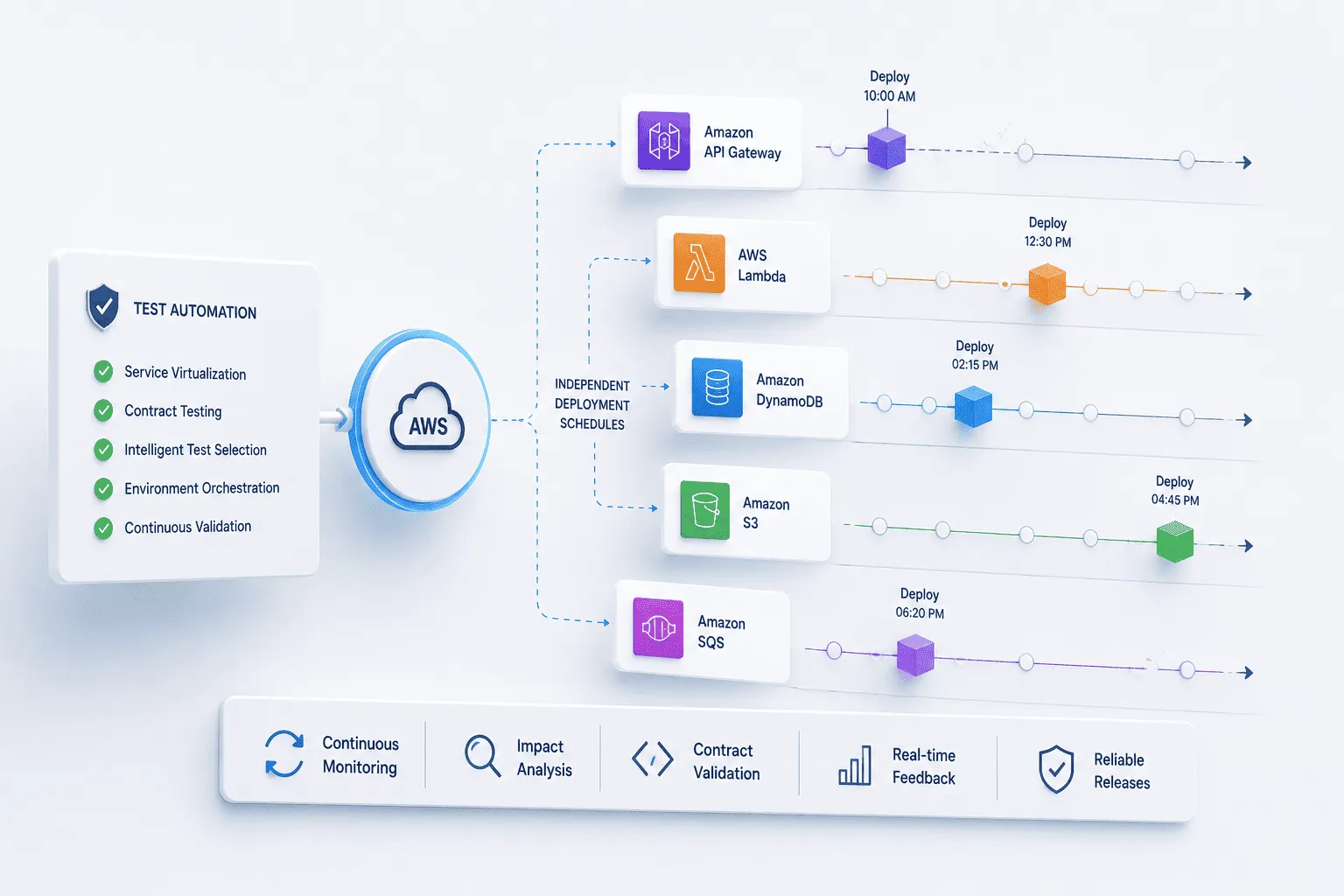
How to Keep Test Automation Accurate When Your AWS Services Deploy on Independent Schedules
Independent AWS deployments break test automation accuracy. Learn how to keep coverage current without manual mock maintenance as services evolve.

Picture this - you have just pushed a fix to your user authentication service. The CI pipeline runs clean. Every test passes. You merge with confidence.
Three hours later, your order processing service starts throwing 401 errors in production. Not because your authentication fix was wrong. Because the order service's test suite was running against a mock that reflected authentication behavior from six weeks ago - before three separate deployments had quietly changed how tokens were validated.
Nobody updated the mock. Nobody knew it needed updating. The authentication service team was not thinking about order processing when they deployed. The order processing team was not monitoring authentication deployments. The test suite that was supposed to catch this exact category of failure was passing perfectly against an outdated representation of a service that had already moved on.
This scenario plays out across AWS environments every week. Not because teams are careless. Because independent deployment schedules are a feature, not a bug - and most test automation infrastructure was not designed with this feature in mind.
The Independent Deployment Problem Is Structural
When services are loosely coupled and deploy independently, each service team can move at their own pace. This is the architecture benefit that microservices are supposed to deliver. The order service team should not have to wait for the authentication service team to release. The payment service should not block the notification service.
The test automation infrastructure supporting these services, however, often does not reflect this independence. Most testing approaches in distributed systems depend on mock files - static representations of how downstream services behave during test execution. When service A tests its integration with service B, it runs those tests against a mock of service B rather than the real service B.
This made sense when services deployed together on coordinated release schedules. When service B changed, the team coordinating the release would update the mocks. The mock lifecycle was coupled to the deployment lifecycle.
In an AWS microservices environment where services deploy independently multiple times per week, this coupling breaks. Service B deployed yesterday. Its response format changed slightly - nothing breaking, just an additional field in the error response. The mock for service B in service A's test suite still reflects last month's behavior. Service A's tests pass. Service A deploys. The additional field causes an unexpected parsing behavior that only surfaces when a specific error condition is triggered in production.
The structural issue is that mock maintenance is a human-paced activity in an environment that is changing at machine pace. Independent deployments compound this problem because there is no coordination event - no release meeting, no shared changelog - that reliably triggers mock updates across all the services that depend on the one that just changed.
What Accurate Test Automation Actually Requires
Solving this structurally rather than procedurally requires changing where test automation coverage comes from.
The procedural approach is better mock discipline - more rigorous processes for updating mocks when services change, shared contract repositories, automated notifications when upstream services deploy. These approaches reduce the gap but do not eliminate it. They still depend on humans tracking service changes and propagating updates across test suites. In an environment with fifteen services each deploying several times per week, the maintenance surface area exceeds what disciplined humans can reliably cover.
The structural approach is to source mock behavior from observed real interactions rather than from human-specified expectations. Instead of a developer writing down what service B should return under various conditions, the system observes what service B actually returns under real conditions and uses those observations as the basis for test execution.
This approach has two properties that are specifically valuable in independent deployment environments.
First, coverage accuracy is tied to observed reality rather than to human memory and diligence. The mock for service B reflects service B's actual current behavior because it was derived from service B's actual current traffic. When service B deploys and changes its behavior, new observations from the updated service automatically reflect the change. The mock update is not a manual step that someone has to remember - it is a natural consequence of the service being observed.
Second, coverage gaps at integration boundaries - the specific failure mode that independent deployments create - are caught systematically rather than discovered in production. When real traffic between services is the source of test coverage, the integration scenarios that actually occur under real usage conditions are the scenarios that get tested. Edge cases and error conditions that only appear in specific usage patterns get covered because they appear in real traffic, not because someone thought to write a test for them.
Keploy implements this approach for API-driven systems on AWS. It captures real HTTP traffic from services running in staging or production environments and generates test cases and dependency mocks from those actual interactions. When an upstream service deploys and its behavior changes, running the traffic capture against the updated service produces mocks that reflect the new behavior automatically. The test suite for downstream services stays current without requiring anyone to track upstream deployments or manually update mock files.
For AWS environments where services are deployed through CodePipeline or GitHub Actions into ECS, Lambda, or EKS clusters, this traffic capture can be integrated into the deployment pipeline itself - capturing representative traffic in staging before promoting to production and using those captures to validate that downstream service integrations still behave correctly after each deployment.
Structuring Test Execution for Independent Services
Beyond mock accuracy, independent deployment schedules require test execution architecture that reflects service independence rather than fighting against it.
In a monolithic deployment model, running the full test suite before each release is practical. Everything deploys together, so running everything once before deployment is the natural model. In an environment where fifteen services deploy independently on their own schedules, running the full integration test suite for every service on every deployment of any upstream dependency is combinatorially impractical.
The test execution structure that works for independent deployment environments is layered rather than monolithic.
Each service maintains a fast suite of tests covering its own behavior - unit tests, contract tests for its own API surface, and integration tests covering the service's interactions with its immediate dependencies. This suite runs on every deployment of that specific service and completes in minutes. It catches regressions within the service's own behavior and validates that its immediate downstream integrations still work.
Broader integration tests that span multiple services run on a schedule - nightly or before significant releases - rather than on every individual service deployment. These catch the cross-service interaction failures that no individual service's test suite can catch. They take longer to run and do not need to run on every deployment, but they provide a regular check on the health of the overall service mesh.
End-to-end tests covering critical user journeys run before production deployments of services that own those journeys. An end-to-end test covering the checkout flow runs before deployments of the order service, not before every service that the order service depends on.
This layering keeps individual service deployment pipelines fast while maintaining comprehensive coverage of cross-service interactions at appropriate checkpoints.
Monitoring as the Test Automation Complement
In an environment where services deploy independently and test automation cannot catch every possible interaction failure before it happens, monitoring becomes the complement to test automation rather than a fallback for when testing fails.
The services that deploy most confidently in AWS environments are the ones where test automation and observability are designed together. Test automation catches the known failure modes before deployment. Observability catches the unknown failure modes after deployment, quickly enough that the impact is contained.
This means instrumenting service interactions with the same rigor applied to service internals. When service A calls service B, the latency, error rate, and response shape of that interaction should be as observable as any metric within service A itself. When service B deploys and its behavior changes in ways that affect service A, the monitoring of service A's calls to service B should surface the change within minutes rather than after users report problems.
The combination - test automation that stays accurate through observed real behavior, test execution structured for service independence, and monitoring that surfaces unexpected interaction changes quickly - is what makes independent deployment schedules a genuine architectural advantage rather than a quality liability.
Enjoyed reading this content? Let the author know!
Your likes, comments, shares, and saves help creators reach more builders.

Loading recommendations
Loading article