
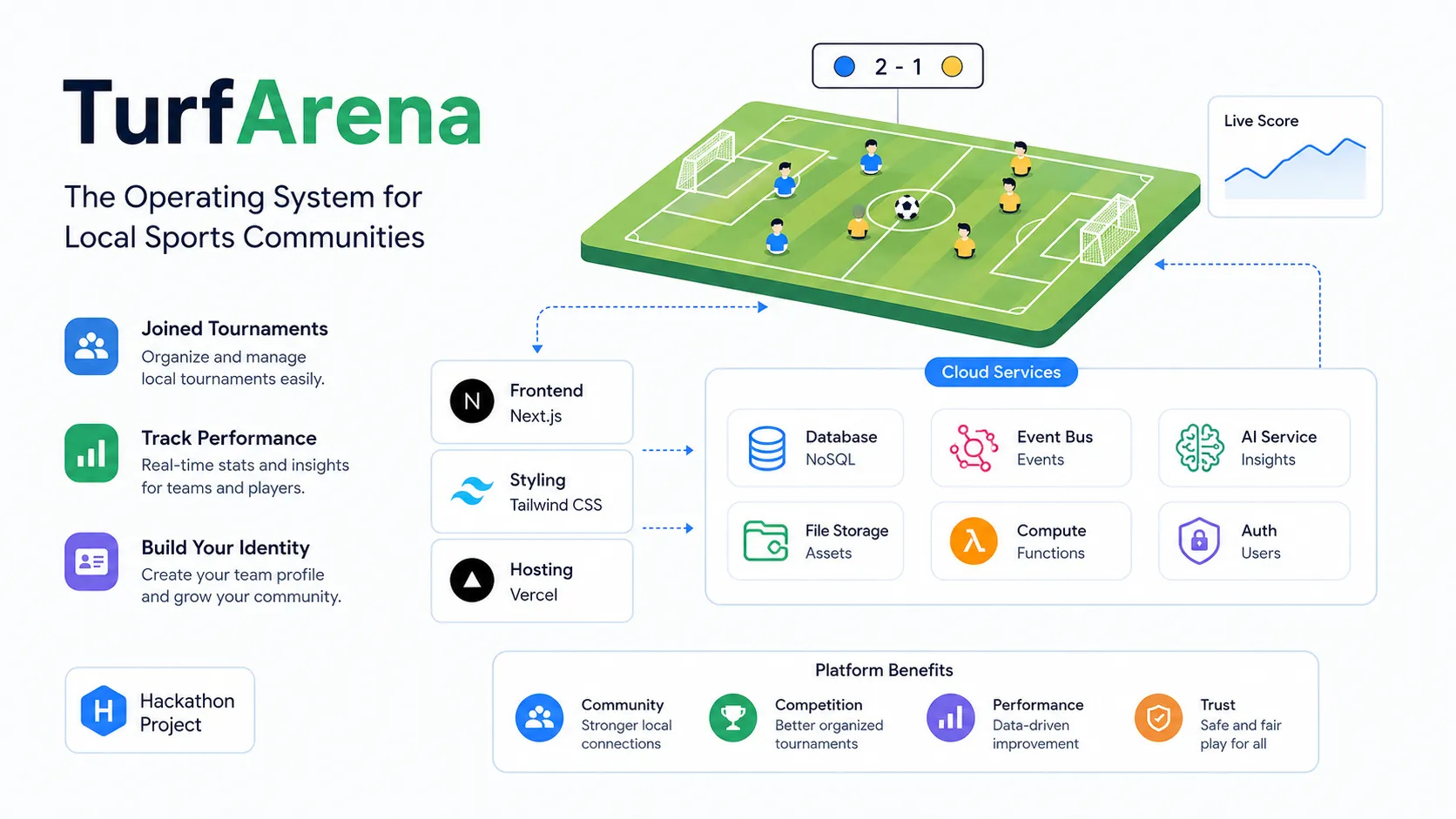
Building TurfArena: A 100% Serverless Operating System for Local Sports Communities
Every weekend, thousands of local sports tournaments are organized across India. Amateurs, students, and working professionals flood neighborhood turfs to play football, cricket, basketball, volleyball, and badminton. Yet, if you look under the hood, this booming ecosystem still relies entirely on chaotic WhatsApp groups, manual spreadsheets, paper diaries, and frantic phone calls. We wondered—could cloud technology simplify this entire ecosystem and give grassroots sports a professional digital foundation?

Project Resources
Explore TurfArena through the live application or browse the complete source code on GitHub.
🌐 Live Application: https://turf-arena-gilt.vercel.app
💻 GitHub Repository: https://github.com/mariyamseemab/TurfArena
The Problem: The Chaos Behind the Weekend Game
Grassroots sports suffer from a massive data and operational black hole. When we analyzed the landscape, we realized that existing digital tools simply do not cater to the unique dynamics of local recreational sports:
- The Scheduling Nightmare: Turf owners lose revenue and customer trust due to accidental double-bookings. When two separate groups show up for the same pitch at 8:00 PM on a Sunday because of a miscommunicated phone call, the experience is ruined.
- The Financial Leakage: Tournament organizers face massive operational overhead tracking team entry fees, distributing brackets, and managing schedule changes.
- The Identity Disconnect: Local players have an intense passion for their sports identity but zero metrics to show for it. There is no historical tracking of career statistics, win rates, clean sheets, or form factors across seasons.
Existing sports applications treat games as static corporate events or simple booking listings. They fail because they treat sports as a transaction rather than an active community.
The Idea: An Operating System for Grassroots Sports
Our vision wasn't just to build another booking marketplace. We wanted to build an operating system—a unified digital tissue connecting players, team captains, tournament organizers, and turf owners into a single, cohesive ecosystem.
We envisioned a platform where a player could build a permanent digital sports profile, a captain could manage a roster cleanly, an organizer could run a multi-sport knockout league with automated bracket generation, and a turf owner could protect their venue from scheduling conflicts. To bring this to life across 44 responsive application pages, we knew our backend infrastructure had to be highly performant, resilient against sudden weekend traffic spikes, and incredibly cost-effective.
Why AWS? The Engineering Design Decisions
We chose a hybrid architecture, deploying our Next.js 16 App Router frontend on the Vercel Edge Network and our entire data and event layer on AWS. Here is why we chose our specific AWS stack based on strict design constraints:
Amazon DynamoDB: Scale Without Infrastructure Overhead

DynamoDB Tables
Grassroots sports data is highly unpredictable. Traffic remains completely silent on a Tuesday morning but explodes exponentially on Friday night and through Sunday afternoon. We chose Amazon DynamoDB with
PAY_PER_REQUEST billing because it handles massive scaling spikes natively without requiring us to provision or pay for idle compute instances. By mapping out specialized data patterns across 9 tables using composite keys, we achieved single-digit millisecond latency at zero baseline cost.Amazon EventBridge: Decoupled Multi-Sport Lifecycles

Event-Driven Architecture
A single update in a sports match triggers a cascade of secondary requirements. Entering a score means updating brackets, recalculating player career stats, modifying leaderboards, and evaluating profile achievements. Doing this synchronously within an API request would cause unacceptable response lags. We chose Amazon EventBridge to build an event-driven architecture (EDA). The API publishes a lightweight custom event to our bus and immediately returns success, allowing EventBridge to route data asynchronously and safely to downstream consumers.
Upstash Valkey: High-Speed Memory Protection
To prevent high-concurrency booking conflicts, we required a sub-millisecond memory layer to evaluate and enforce reservation states. Valkey was chosen as our high-performance, open-source caching standard to execute atomic check-and-lock guardrails before any data writes hit our permanent database layer.
Amazon Bedrock (Nova Micro): Zero-Management Analytical Intelligence

TurfArena integrates Amazon Bedrock Nova Micro for intelligent sports insights
We wanted our AI coaching and match prediction feature to be fast and cost-effective without the complexity of training, fine-tuning, or hosting dedicated machine learning models. We chose Amazon Bedrock using the Nova Micro model because it provides exceptional natural language and logical execution speeds directly over our structured DynamoDB statistical payloads.
Engineering Challenges: Our Struggles and Solutions
Building an interconnected platform within a tight hackathon window presented several stark infrastructure and integration challenges:

Tournament Flow
Challenge 1: The High-Concurrency Booking Race Condition
The Problem: In a popular sports city, prime slots are highly contested. If two captains hit "Book Slot" at the exact same millisecond, standard database read-then-write lookups suffer from race conditions. Both operations see the slot as "available," both proceed to checkout, and you end up with a double-booking.
The Solution: We implemented an atomic memory-locking strategy ahead of our primary database. The exact millisecond a booking request is initiated, our API attempts an atomic cache write with conditional parameters (
SET NX). If Captain A’s request arrives a fraction of a millisecond earlier, the cache logs their temporary lock and grants them a 5-minute checkout window. Captain B’s request instantly short-circuits with a 423 Locked state without stressing the database.Challenge 2: Environment Overrides on Build Deploys
The Problem: During our initial deployment phase, an automated cloud database connector was overriding our manual environment variables with empty strings upon build completion, causing the application to silently fall back to its offline mock data state.
The Solution: We isolated the problem by implementing strict logging prefixes across our microservices (
[DynamoDB], [Valkey], [API]). We traced the empty string injections, removed the conflicting automatic connector, and enforced strict environment parameters using the Vercel CLI directly.Challenge 3: Theme-Aware Visual Disappearances
The Problem: Rapid prototyping across 44 pages resulted in legacy, hardcoded light-theme color classes on several layout panels. When our global dark glassmorphism theme was initialized, text elements on those panels became completely invisible due to contrast blending.
The Solution: We conducted a comprehensive visual and accessibility audit across all 44 layouts, purging hardcoded hex values and replacing them with theme-aware CSS custom tokens to guarantee complete visual clarity.
Deep Dive: The Anatomy of a Valkey Atomic Slot Lock
To understand how TurfArena protects operational integrity, look at the lifecycle of a real-time reservation. We cannot allow database latencies to dictate lock states.
The locking lifecycle relies on strings with a strict time-to-live parameter. When a reservation request hits the serverless API, it immediately attempts to write a unique key identifying the turf, date, and specific time slot. By appending the
NX parameter, the write succeeds only if the key does not already exist in memory.
Real-Time Booking (Valkey/Redis)
If it succeeds, an automatic 5-minute (300 seconds) countdown begins. If the user completes checkout, the lock is upgraded to a permanent database entry and a 24-hour cache state. If they abandon the session, the memory key naturally expires, seamlessly returning the slot to the open market without requiring any manual cron jobs or database cleanup scripts.
Architecture: The Journey of a Request
To visualize how TurfArena handles data flow, let’s trace what happens when a player books a turf venue slot:

Architecture connection diagram
Lessons Learned: What Building Serverless Taught Us
Our journey with TurfArena reshaped how we think about cloud-native development:
- Design Your NoSQL Patterns Upfront: Coming from a relational background, we quickly learned that you cannot treat DynamoDB like SQL. You cannot easily perform joins later. You must know your application access patterns from day one and design your Global Secondary Indexes and composite partition keys explicitly around those lookups.
- Serverless Doesn't Mean Simple: Eliminating servers removes infrastructure management, but it shifts the engineering complexity to configuration management. Orchestrating environment variables, deployment pipelines, and fallback strategies across development, preview, and production stages requires disciplined architecture planning.
- Feature Flags are a Developer's Best Friend: By wrapping our primary cloud connectors in an
AWS_ENABLEDfeature flag layer, we allowed our frontend and backend tracks to run completely independently. The application safely degrades to robust mock datasets when offline, allowing for seamless local prototyping.
What's Next: Future-Proofing via the Event Bus
Because we chose an event-driven design, our platform is natively prepared for long-term extension. We don't need to rebuild our core architecture to scale up functionality.
Because Amazon EventBridge completely decouples our workflows, our upcoming features will require zero structural code mutations inside our existing booking or scoring APIs. We can attach an AWS API Gateway WebSocket endpoint to listen to
score.updated events for real-time streaming, route player.achievement events directly to Amazon SNS for instant mobile push notifications, and push historical tournament metrics into Amazon SageMaker for advanced algorithmic predictions—all by simply adding new independent consumers to our existing event bus.The Ultimate Impact
TurfArena began as a hackathon project, but our larger goal is to give every local sports community access to the same digital tools that professional leagues enjoy. AWS helped us build an elastic, zero-maintenance foundation that can grow from small neighborhood match setups to city-wide grassroots sports ecosystems. By removing the operational friction from local sports, we are clearing the pitch so communities can focus entirely on the spirit of the game.
Explore TurfArena
🎥 Project Demo (YouTube)
Watch TurfArena in action, including tournament management, AI coaching, real-time booking, and the overall user experience.
YouTube:
Watch TurfArena in action, including tournament management, AI coaching, real-time booking, and the overall user experience.
YouTube:
https://youtube.com/TurfArena 🌐 Live Application
Experience the deployed application and explore all features firsthand.
Live Demo:
Experience the deployed application and explore all features firsthand.
Live Demo:
💻 Source Code (GitHub)
Browse the complete source code, AWS integrations, architecture, and implementation details.
Repository:
Browse the complete source code, AWS integrations, architecture, and implementation details.
Repository:
https://github.com/mariyam/TurfArena Enjoyed reading this content? Let the author know!
Your likes, comments, shares, and saves help creators reach more builders.

Loading recommendations
Loading article