
Building a Multi-Agent AI IT Service Desk Assistant on AWS with Strands Agents SDK and Amazon Bedrock
Enterprise IT service desks handle thousands of tickets weekly — from password resets to P1 production outages. The challenge isn't just volume; it's the cognitive overhead: triaging severity, diagnosing root cause across sprawling AWS infrastructure, executing the right remediation, managing change records, and communicating status to users and stakeholders — all under SLA pressure.


Building a Multi-Agent AI IT Service Desk Assistant on AWS with Strands Agents SDK and Amazon Bedrock
GitHub: https://github.com/its-me-sweta/IT_Service_Disk_AI_Assistant.gits
Introduction
Enterprise IT service desks handle thousands of tickets weekly — from password resets to P1 production outages. The challenge isn't just volume; it's the cognitive overhead: triaging severity, diagnosing root cause across sprawling AWS infrastructure, executing the right remediation, managing change records, and communicating status to users and stakeholders — all under SLA pressure.
In this post I'll walk through a production-ready, six-agent AI pipeline that automates the full ITIL service management lifecycle using:
- Strands Agents SDK with
@tooldecorators - Amazon Bedrock Nova Pro for AI-driven diagnosis and response generation
- AWS Systems Manager Automation for automated EC2 remediation
- Amazon CloudWatch Metrics + Logs Insights for root cause analysis
- FAISS + Amazon Titan Embed v2 for runbook RAG retrieval
- Amazon ECS, ASG, Lambda for automated service remediation
- Amazon DynamoDB for CMDB, KEDB, tickets, changes, and ITIL audit trail
- Amazon SNS for P1 bridges, on-call paging, and stakeholder alerts
- Amazon SES for user updates, resolution confirmations, and CSAT surveys
- AgentCore Runtime for serverless deployment
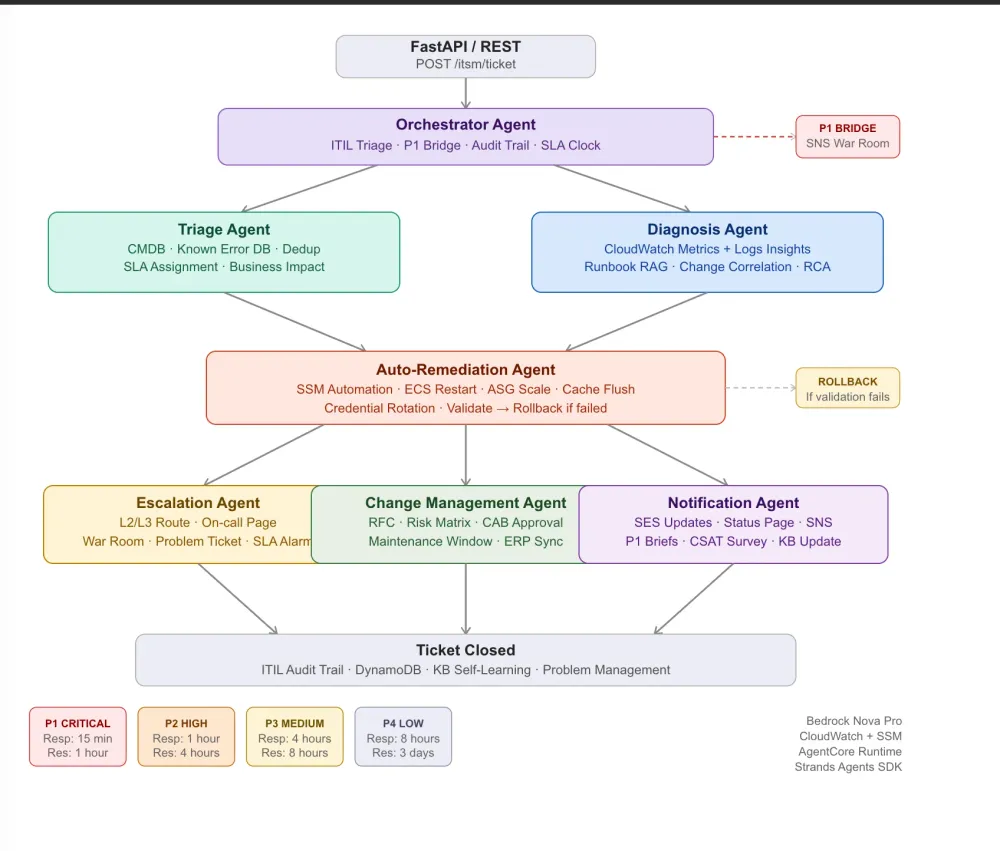
Architecture Overview
1
2
3
4
5
6
7
8
9
10
11
12
13
14
15
16
17
18
19
20
21
22
23
24
25
26
27
28
29
30
31
                   ┌──────────────────────────────────────┐
                   │       FastAPI / REST Layer            │
                   │   POST /itsm/ticket                  │
                   └─────────────────┬────────────────────┘
                                     │
                   ┌─────────────────▼────────────────────┐
                   │         Orchestrator Agent            │
                   │  ITIL Triage · P1 Bridge · Audit     │
                   └──┬───────────────────────────────┬───┘
                      │                               │
         ┌────────────▼────┐             ┌────────────▼──────────┐
         │  Triage Agent   │             │   Diagnosis Agent     │
         │  CMDB · KEDB    │             │  CloudWatch · Logs    │
         │  Dedup · SLA    │             │  Runbook RAG · RCA    │
         └────────────┬────┘             └────────────┬──────────┘
                      └──────────┬────────────────────┘
                                 │
                   ┌─────────────▼────────────────────────┐
                   │      Auto-Remediation Agent           │
                   │  SSM · ECS · ASG · Lambda · Cache     │
                   │  Validate → Rollback if failed        │
                   └─────────────┬────────────────────────┘
                                 │
              ┌──────────────────┼──────────────────────┐
              │                  │                      │
   ┌──────────▼──────┐  ┌────────▼───────┐  ┌──────────▼──────┐
   │ Escalation      │  │ Change Mgmt    │  │ Notification    │
   │ Agent           │  │ Agent          │  │ Agent           │
   │ L2/L3 · On-call │  │ RFC · CAB · ERP│  │ SES · SNS       │
   │ War Room · SLA  │  │ Maintenance    │  │ Status Page     │
   └─────────────────┘  └────────────────┘  └─────────────────┘
The Six Agents
| Agent | Role | AWS Services |
|---|---|---|
| Orchestrator Agent | ITIL triage, routing, P1 bridge | DynamoDB, SNS |
| Triage Agent | CMDB lookup, KEDB, dedup, SLA, impact | DynamoDB |
| Diagnosis Agent | CloudWatch, Logs, topology, runbook RAG, RCA | CloudWatch, Titan Embed v2, FAISS |
| Auto-Remediation Agent | SSM, ECS restart, ASG scale, cache flush, credential rotation | SSM, ECS, ASG, Lambda, Secrets Manager |
| Escalation Agent | L2/L3 routing, war room, on-call paging, Problem tickets | SNS, Lambda, DynamoDB |
| Change Management Agent | RFC, risk matrix, CAB approval, maintenance windows | DynamoDB |
| Notification Agent | User updates, Status Page, stakeholder briefs, CSAT | SES, SNS |
ITIL Priority Framework
1
2
3
4
5
6
ITIL_PRIORITIES = {
    "P1": {"label": "CRITICAL", "response_min": 15,  "resolution_min": 60},
    "P2": {"label": "HIGH",     "response_min": 60,  "resolution_min": 240},
    "P3": {"label": "MEDIUM",   "response_min": 240, "resolution_min": 480},
    "P4": {"label": "LOW",      "response_min": 480, "resolution_min": 4320},
}
P1 triggers an immediate Major Incident Bridge — an SNS broadcast that creates a war room, pages the on-call engineer, and notifies C-suite stakeholders before any other processing continues.
Stage 1 — Triage Agent
CMDB Lookup — Every ticket is linked to a Configuration Item (CI) in DynamoDB, retrieving the CI's tier (TIER1/TIER2/TIER3), owner team, business service, and dependencies.
Known Error Database (KEDB) — If a matching known error exists, the workaround is returned immediately, potentially resolving the ticket before any diagnosis is needed.
Deduplication — Checks for open incidents on the same affected system. Duplicate tickets are linked to the parent and closed automatically.
Business Impact Assessment:
1
2
composite = (tier_score * 0.4) + (user_score * 0.4) + (env_score * 0.2)
revenue_risk = is_customer_facing and environment == "PRODUCTION" and ci_tier == "TIER1"
SLA Assignment — TIER1 CIs receive tighter SLAs than the base ITIL priority:
1
2
if ci_criticality == "HIGH" and priority != "P1":
    resp_min = max(resp_min // 2, 15)   # Minimum 15-minute response regardless
Stage 2 — Diagnosis Agent
The Diagnosis Agent performs AI-driven Root Cause Analysis across four data sources:
1. CloudWatch Metrics (30-minute pre-incident window):
1
2
3
def pull_cloudwatch_metrics(ci_name, namespace="AWS/EC2", lookback_minutes=30) -> dict:
# CPU, memory, error rate — flags anomalies automatically2. CloudWatch Logs Insights — Queries for ERROR/CRITICAL/FATAL log entries correlated with the incident timestamp:
1
2
3
query = """fields @timestamp, @message
           | filter @message like /ERROR|CRITICAL|FATAL|Exception/
           | sort @timestamp desc | limit 20"""
3. Topology Analysis — Checks upstream and downstream CI dependencies. Often the root cause is in a dependency rather than the reported CI.
4. Recent Change Correlation — Checks for deployments, config changes, or patches in the 24 hours before the incident:
1
causal_change_probability = 0.75 if recent_changes else 0.10
Confidence-based routing:
- = 0.85: High confidence → proceed to auto-remediation
- 0.60–0.85: Medium → attempt remediation with monitoring
- < 0.60: Low → escalate to L2 engineer
Runbook RAG uses FAISS + Titan Embed v2 to retrieve the most relevant troubleshooting runbook from the knowledge base.
Stage 3 — Auto-Remediation Agent
Six automated remediation actions available:
| Root Cause | Tool | AWS Action |
|---|---|---|
| Capacity exhaustion | scale_asg_capacity | EC2 Auto Scaling Group scale-out |
| Service crash | restart_ecs_service | ECS force new deployment |
| EC2 issue | run_ssm_automation | SSM Automation document |
| Cache poisoning | flush_cache | ElastiCache flush via Lambda |
| App-level fix | execute_lambda_fix | Lambda remediation function |
| Credential compromise | rotate_credentials | Secrets Manager rotation |
Safety rules:
1
2
3
4
if ci_tier == "TIER1":
    return {"requires_human_confirmation": True}   # NEVER auto-remediate Tier 1 without human
if confidence < 0.60:
    return {"escalation_required": True}           # Low confidence → human diagnosis
Validation + Rollback:
1
2
3
4
def validate_remediation(ticket_id, ci_name, expected_metric, threshold) -> dict:
# 3-minute observation window + CloudWatch health check
# If validation FAILS → rollback_remediation() is called immediatelyStage 4 — Escalation Agent
When auto-remediation fails or is not appropriate:
Team routing by category:
1
2
3
4
5
6
team_map = {
    "network":   "network_ops_team",
    "security":  "security_ops_center",
    "cloud_infra":"cloud_platform_team",
    "access":    "identity_access_team",
}
P1/P2 Escalation Protocol:
page_on_call()— SNS broadcast to the on-call engineeropen_war_room()— Creates dedicated Teams/Slack channelcreate_incident_bridge()— Conference call for live coordination
Problem Management — If the same CI has had 3+ incidents in 30 days, a Problem ticket is automatically created and linked to all related incidents.
SLA Breach Alarm — A CloudWatch alarm fires 30 minutes before SLA breach:
1
2
cw.put_metric_alarm(AlarmName=f"SLA-BREACH-{ticket_id}",
                    AlarmActions=[ON_CALL_TOPIC], ...)
Stage 5 — Change Management Agent
When remediation requires a production change, the Change Management Agent:
Risk Matrix:
1
2
3
4
Risk Score = Impact (1-5) × Likelihood of failure (1-5)
 1–8:  Standard Change  (pre-approved, no CAB)
 9–15: Normal Change    (CAB approval, Wednesday 14:00 UTC)
16–25: Emergency Change (immediate, Emergency CAB notification)
TIER1 CIs automatically set Impact=5. Schema migrations, data migrations set Likelihood=4.
The RFC is linked to the originating incident ticket, and the change window is scheduled in the next available maintenance slot (Tuesday/Thursday 02:00–04:00 UTC for standard changes).
Stage 6 — Notification Agent
Status Page — P1/P2 incidents automatically post to the Status Page via SNS → webhook:
1
2
status_categories = ["operational", "degraded_performance",
                     "partial_outage", "major_outage", "maintenance"]
P1 Stakeholder Briefings — Sent every 30 minutes until resolution, including:
- Current status and ETA
- Actions taken so far
- RCA summary (preliminary or confirmed)
Resolution Confirmation — Users receive a structured post-mortem summary:
1
2
Root Cause: Change-induced regression from RFC-2025-A1B2C3
Prevention: Automated regression tests added to deployment pipeline
KB Self-Learning — Resolved incidents that uncovered new known errors automatically update the KEDB, and runbooks that needed new steps are flagged for review.
AWS Infrastructure Summary
| Resource | Purpose |
|---|---|
| Amazon Bedrock Nova Pro | AI diagnosis, response generation |
| Amazon Titan Embed v2 | Runbook RAG embeddings |
| CloudWatch Metrics + Logs Insights | Anomaly detection and log correlation |
| AWS Systems Manager Automation | EC2 automated remediation |
| Amazon ECS | Container restart remediation |
| EC2 Auto Scaling | Capacity scaling remediation |
| AWS Lambda | App fixes, cache flush, war room, ERP sync |
| AWS Secrets Manager | Credential rotation |
| DynamoDB (10 tables) | Tickets, CMDB, KEDB, changes, problems, users, runbooks, comms, escalation log, analytics |
| Amazon SNS | P1 bridge, on-call paging, stakeholder alerts, Status Page |
| Amazon SES | User updates, resolution emails, CSAT surveys |
| AgentCore Runtime | Serverless agent deployment |
Try It Yourself
1
2
3
4
5
6
7
8
9
10
11
12
13
14
15
16
17
18
git clone https://github.com/its-me-sweta/IT_Service_Disk_AI_Assistant.git
cd it-service-desk-assistant
pip install -r requirements.txt
uvicorn main:app --reload

curl -X POST http://localhost:8000/itsm/ticket \
  -H "Content-Type: application/json" \
  -d '{
    "requester_id": "EMP-001",
    "requester_name": "Sweta Jha",
    "requester_email": "sweta@company.com",
    "title": "Production API returning 503 errors",
    "description": "Users are getting 503 Service Unavailable on checkout API since 14:32 UTC. ~500 affected users.",
    "category": "application",
    "affected_system": "checkout-api-prod",
    "affected_user_count": 500,
    "channel": "monitoring"
  }'
Built with Strands Agents SDK · Amazon Bedrock Nova Pro · AgentCore Runtime
Enjoyed reading this content? Let the author know!
Your likes, comments, shares, and saves help creators reach more builders.

Loading recommendations
Loading article