

The Hidden Cost of "Hey": What I Learned Speaking at Women in FinOps London
Last night I had the privilege of kicking off a Women in FinOps community evening in London with a lightning talk called "The Hidden Cost of Hey." Hosted by the Women in FinOps group, with Finout and Capgemini opening their doors at 95 Queen Victoria Street, it was one of those events where you walk in for the talk and stay for the people.
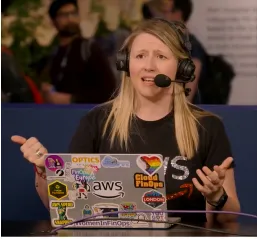
Last night I had the privilege of kicking off a Women in FinOps community evening in London with a lightning talk called "The Hidden Cost of Hey." Hosted by the Women in FinOps group, with Finout and Capgemini opening their doors at 95 Queen Victoria Street, it was one of those events where you walk in for the talk and stay for the people.
And what people they were. FinOps practitioners from Capital One, BT, ITV, Green Pixie, and Finout. Women (and allies) doing the real, often unglamorous work of making cloud spend make sense. The energy in the room was something I wish I could bottle.
The Talk: Why Your Manners Are Costing You Money
Here is the premise of my talk: every time you type "Hey" to an AI, you are spending money you do not need to spend. To see a full article on this click here.
As women, we have been socialised to soften our language. We hedge. We say "I was wondering if you could possibly..." We thank machines. We apologise to chatbots. And in most contexts, that is just good communication. But when you are interacting with a Large Language Model, every single one of those extra words is a token. And tokens cost money.
One "Hey" is one token. Sounds trivial. But here is how it compounds: when you have a long conversation with an AI, that greeting rolls through the context window. It is not one token anymore. It is two, three, fifteen as the conversation grows. Now multiply that by every person in your organisation, across every AI tool they use, multiple times a day. At enterprise scale, politeness becomes a line item.
And it is not just "Hey." It is "Can you do this for me?" (yes, it can, it is AI). It is "Please" and "Thank you" (it does not learn from gratitude). It is "I was wondering if possibly..." (just tell it what you want). It is the endless cycle of "Can you rewrite this?" because we were not explicit enough the first time, and now output tokens, which cost more than input tokens, are stacking up.
Four Pillars of Token Optimisation
I walked through four practical approaches that FinOps teams can implement today:
1. Education. The simplest starting point. Now you know this concept, share it. Next time you see a colleague type "Hey" into an AI tool on a screenshare, gently point out it is costing thousands of dollars at scale. Start small. Build awareness.
2. Automated Prompt Compression. Use AI to fix AI. You can take a bloated, polite prompt and compress it into a direct, explicit instruction. I showed an example where this achieved a 55% reduction in tokens while producing the same (or better) output. The trick is that compressing the input is cheap. The expensive part is regenerating output because your first prompt was too vague.
3. Prompt Caching. If someone has already asked exactly the same question, why run it through the model again? Prompt caching keeps responses available for a short window and serves them directly. This is why chatbots now give you suggested prompts to click rather than type freely. It delivers up to 90% cost savings and 85% latency reduction. It is a no-brainer that not enough teams are implementing yet.
4. Context Window Management. That one-to-fifteen problem I mentioned? There are two approaches to control it. Sliding window forgets older context after a set number of turns, keeping things lean but losing history. Progressive summarisation compresses the conversation periodically, keeping only what matters. Both prevent your context (and costs) from growing unbounded.
The Conversation That Made the Evening
What happened after the talk was, honestly, more valuable than the talk itself.
Women, Communication, and AI
Mallory Beaudreau made an observation that stopped the room. She pointed out that studies show men tend to lead with conclusions ("We need to do this") while women lead with justification ("Here is why, here is the context, here is my conclusion"). The same pattern plays out in how we prompt AI. We provide all the reasoning, all the context, all the hedging, before we get to what we actually want.
Her advice: talk to your AI like you are a confident person in a boardroom. Lead with the conclusion. Let it ask you clarifying questions if it needs more.
I shared what I call the "baby's fine" concept. If you are texting your partner about your child having an accident, do not make them read through the entire story before getting to "but he's fine." Start with the outcome. "He's fine. Here is what happened." Same with AI: start with what you want, then provide context only if needed.
The Gen Z AI Settings Debate
Someone shared that during a training session, the men in the group all set their ChatGPT personality to "be critical, be sarcastic, challenge me" while she had chosen a more supportive setting. It sparked a real conversation about whether women are missing out by not demanding harder feedback from AI. After all, it is a safe space. Nobody is watching you react. If the critique stings, you process it privately and produce something better.
One colleague's approach took it further: she configured her AI assistant with an explicit instruction that says "Do not compliment this." No "Great question!" No "That's a really interesting approach!" Just cut the fluff, save the tokens, give me what I asked for.
The Kiro Governance Problem
Multiple attendees, particularly someone from ITV managing FinOps across their entire group tech division, raised what is clearly becoming the hot topic: how do you control developer usage of AI coding tools?
People are spinning up Kiro instances, running through credits with vibe coding sessions that have no plan, no spec, no governance. One person described developers running three or four servers from their desktop just burning through prompts.
My suggestion: think of it like a welcome package. When someone gets access to an AI coding tool, they receive a mandatory bundle. That bundle contains security requirements (which leadership already cares about) and cost optimisation best practices (which you are sneaking in alongside security). You tag everything deployed through AI tools so you can track it. You create blueprint files that enforce architectural decisions. And you make it clear: if you are found not using the package, you lose access.
The key insight? Bundle FinOps with security. Security is non-negotiable in most organisations. If your cost governance rides alongside security governance, it becomes non-negotiable too.
Green Pixie and the Carbon Layer
I met Kate and Julia from Green Pixie, a company doing something I had not seen before. They append carbon emissions, water consumption, and electricity data to every line item in your cloud bill. So when you are trying to convince an engineer to right-size an instance, you are not just saying "this saves money." You are saying "this saves X kilograms of carbon and Y litres of water."
They told me it changes the conversation completely. Engineers who would push back on cost savings alone will act when you add the environmental dimension. They are now extending this to AI tokens too, so you can see the carbon cost of choosing Opus over Haiku for a task that does not need a frontier model.
It reminded me why I got into this field. I started in FinOps before FinOps had a name, partly because of the environmental angle. Last night pulled me back to those roots.
The Vibe Coding Problem (and What to Do About It)
The conversation kept returning to vibe coding. It is the FinOps challenge of 2026. People are building applications faster than ever, but they are not tracking ROI. They are not planning. They are iterating endlessly because they started without a spec, and every iteration grows the context window and burns more tokens.
The fundamentals of FinOps have not changed. Set budgets. Track usage. Educate teams. Gamify the results. But the speed of AI development means people create things before anyone asks "was this worth building?" We need to bring back spec-driven development in the AI era: plan first, build second, test third, ship fourth. Vibe coding skips straight to production and iterates. That is expensive.
The Community
I have been in the FinOps community since the very beginning. I was one of the eleven original members when it did not really have a name yet. The London chapter started because three of us met at a pub after a conference called CloudyCon and decided to make it happen.
Last night felt like those early days. A room full of people who genuinely care about doing this work well, sharing honestly about their challenges, and leaving with practical ideas they can implement on Monday morning.
To the Women in FinOps organisers, to Finout and Capgemini for hosting, and to every person who stayed for the conversations after the talk: thank you. This is how communities grow. One evening, one honest conversation, one new contact you actually want to keep at a time.
Your Call to Action
Next time you open an AI tool, try being direct. Drop the "Hey." Skip the "Please." Tell it exactly what you want in the format you want it. You will save tokens, get better outputs faster, and maybe, just maybe, carry a little bit of that directness into your next meeting too.
If you want to dive deeper into any of the optimisation techniques I covered, I recorded the full talk for my YouTube Channel and there are more detailed walkthroughs there.
Go the rude way. Your budget will thank you.
Enjoyed reading this content? Let the author know!
Your likes, comments, shares, and saves help creators reach more builders.

Loading recommendations
Loading article