
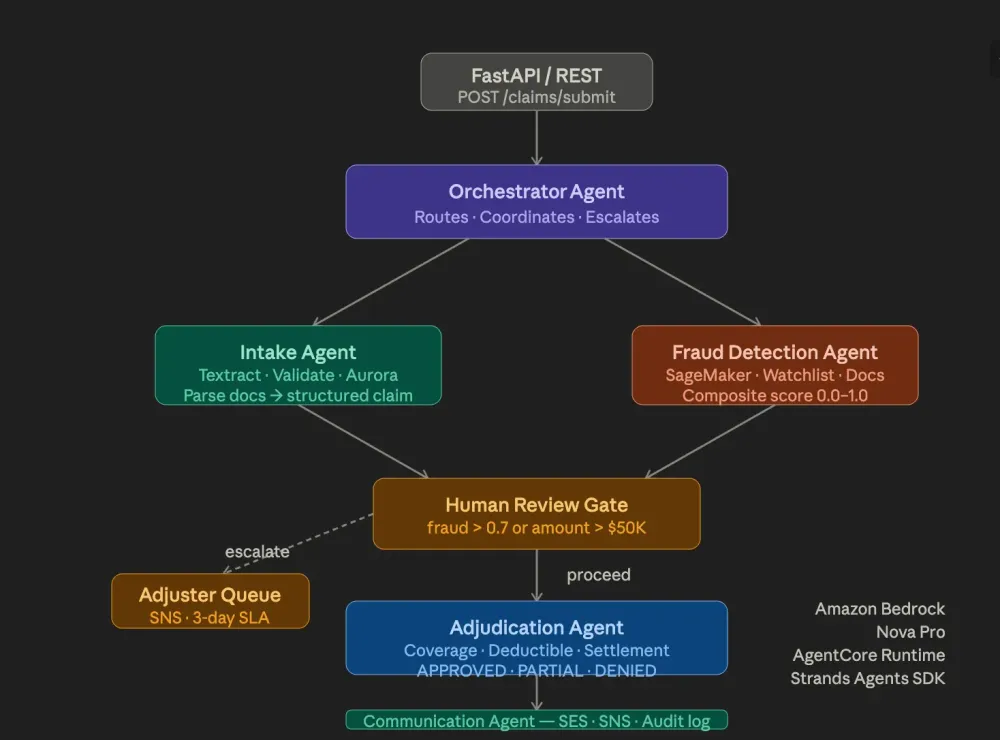
Building a Multi-Agent AI Claims Processing Assistant on AWS with Strands Agents SDK and Amazon Bedrock
11:58Claude responded: A four-agent insurance claims pipeline on AWS that automates document intake, fraud scoring, coverage adjudication, and claimant communication — with a human-i…A four-agent insurance claims pipeline on AWS that automates document intake, fraud scoring, coverage adjudication, and claimant communication — with a human-in-the-loop escalation gate for high-risk claims.


Building a Multi-Agent AI Claims Processing Assistant on AWS with Strands Agents SDK and Amazon Bedrock
GitHub: https://github.com/its-me-sweta/Claim_Processing_AI_Assistant.git
Introduction
Insurance claims processing is one of the most document-heavy, rule-intensive, and fraud-prone workflows in the industry. A single claim touches document extraction, policy validation, fraud scoring, coverage adjudication, and multi-channel communication — all before a dollar is paid out.
In this post, I'll walk you through how I built a production-ready, four-agent AI pipeline that automates this entire workflow using:
- Strands Agents SDK with
@tooldecorators - Amazon Bedrock Nova Pro (
us.amazon.nova-pro-v1:0) as the LLM backbone - Amazon Textract for document extraction
- Amazon SageMaker for fraud scoring
- Amazon RDS Aurora for policy and claim storage
- Amazon SES + SNS for claimant and adjuster notifications
- Amazon DynamoDB for pipeline state and audit trails
- AgentCore Runtime for serverless deployment
- FastAPI as the REST layer
The system includes a human-in-the-loop approval gate for high-value or high-fraud-risk claims — a pattern that aligns with both EU AI Act compliance requirements and real-world enterprise risk controls.
Architecture Overview
1
2
3
4
5
6
7
8
9
10
11
12
13
14
15
16
17
18
19
20
21
22
23
24
25
26
27
28
                        ┌─────────────────────────────────────┐
                        │         FastAPI / REST Layer         │
                        │    POST /claims/submit               │
                        └──────────────┬──────────────────────┘
                                       │
                        ┌──────────────▼──────────────────────┐
                        │         Orchestrator Agent           │
                        │   (Routing · State · Coordination)   │
                        └───┬───────────────────────────┬─────┘
                            │                           │
              ┌─────────────▼────┐         ┌────────────▼──────────┐
              │   Intake Agent   │         │  Fraud Detection Agent │
              │  Textract · RDS  │         │  SageMaker · Watchlist │
              └─────────────┬────┘         └────────────┬──────────┘
                            │                           │
                            └──────────┬────────────────┘
                                       │
                        ┌──────────────▼──────────────────────┐
                        │       Adjudication Agent            │
                        │  Coverage · Deductible · Settlement  │
                        └──────────────┬──────────────────────┘
                                       │
                       ┌───────────────┼───────────────────┐
                       │               │                   │
          ┌────────────▼────┐   ┌──────▼──────┐   ┌───────▼──────┐
          │ Communication   │   │ Human Review│   │  SIU Referral│
          │ Agent (SES/SNS) │   │  Queue      │   │  (SNS Topic) │
          └─────────────────┘   └─────────────┘   └──────────────┘
The Four Agents
| Agent | Role | AWS Services |
|---|---|---|
| Intake Agent | Parse, validate, and store incoming claims | Textract, RDS Aurora |
| Fraud Detection Agent | Score fraud risk using ML + rule signals | SageMaker, DynamoDB |
| Adjudication Agent | Evaluate coverage, apply deductibles, settle | RDS Aurora, DynamoDB |
| Communication Agent | Notify claimants, adjusters, and SIU | SES, SNS |
The Orchestrator Agent ties them together, managing routing decisions and human escalation gates.
Why Strands Agents SDK?
Strands gives you a clean, Pythonic way to define agent tools using the
@tool decorator. No boilerplate JSON schema — the SDK infers parameter types and descriptions from your Python type hints and docstrings.1
2
3
4
5
6
7
8
from strands import tool
def evaluate_coverage(policy_details: dict, loss_type: str, date_of_loss: str) -> dict:
"""
Checks whether the policy covers the claimed loss type and date.
...
"""Each agent is then constructed by passing the model and a list of tools:
1
2
3
4
5
6
7
8
9
from strands import Agent
from strands.models import BedrockModel

agent = Agent(
    model=BedrockModel(model_id="us.amazon.nova-pro-v1:0", region_name="us-east-1"),
    system_prompt=SYSTEM_PROMPT,
    tools=[evaluate_coverage, apply_deductible, calculate_settlement, ...],
    name="adjudication_agent",
)
The agent handles tool selection, parameter extraction, and multi-turn reasoning entirely on its own.
Deep Dive: The Pipeline Stages
Stage 1 — Intake Agent
The Intake Agent is the gateway to the pipeline. It handles three input modalities:
- Structured JSON — Direct API submissions
- PDF/Image documents — Processed via Amazon Textract
- Form data — Key-value extraction from claim forms
1
2
3
4
5
6
7
8
def extract_claim_document(s3_bucket: str, s3_key: str) -> dict:
"""Runs Amazon Textract FORMS analysis on a claim document in S3."""
response = textract.analyze_document(
Document={"S3Object": {"Bucket": s3_bucket, "Name": s3_key}},
FeatureTypes=["FORMS", "TABLES"],
)
# ... key-value pair extraction logicAfter extraction, it validates all required fields:
claim_id,policy_number,claimant_name,date_of_lossloss_typemust be one of:medical | auto | property | liabilityclaimed_amountmust be positivedate_of_losscannot be in the future
If validation passes, the claim is persisted to RDS Aurora and returned to the Orchestrator.
Stage 2 — Fraud Detection Agent
The Fraud Detection Agent computes a composite fraud score using four signals:
1
2
3
4
5
Composite Score =
    0.40 × ML Model Score (SageMaker endpoint)
  + 0.20 × Claim Frequency Anomaly
  + 0.25 × Watchlist Match
  + 0.15 × Document Integrity Score
Risk thresholds:
| Score Range | Risk Level | Action |
|---|---|---|
| 0.0 – 0.3 | Low | Proceed to adjudication |
| 0.3 – 0.6 | Medium | Proceed with enhanced flags |
| 0.6 – 0.8 | High | Route to human review |
| 0.8 – 1.0 | Critical | SIU referral |
The SageMaker integration calls a pre-trained fraud detection endpoint:
1
2
3
4
5
6
7
8
9
10
11
def run_fraud_model(claim_features: dict) -> dict:
"""Invokes the SageMaker fraud detection endpoint."""
payload = json.dumps({"instances": [feature_vector]})
response = sagemaker_runtime.invoke_endpoint(
EndpointName="claims-fraud-detection-endpoint",
ContentType="application/json",
Body=payload,
)
score = float(json.loads(response["Body"].read())["predictions"][0][0])
return {"ml_fraud_score": round(score, 4), ...}A rule-based fallback activates automatically if the SageMaker endpoint is unavailable — a production reliability pattern I'd recommend for any mission-critical pipeline.
Stage 3 — Human-in-the-Loop Gate
Between fraud detection and adjudication, the Orchestrator checks two escalation triggers:
1
2
3
4
5
6
# Trigger human review if:
# 1. Fraud score > 0.7, OR
# 2. Claimed amount > $50,000

if fraud_score > 0.7 or claimed_amount > 50_000:
    trigger_human_review(claim_id, reason, fraud_score, claimed_amount)
The
trigger_human_review tool:- Writes the claim to a Human Review Queue in DynamoDB
- Publishes an SNS notification to the senior adjuster pool
- Returns a queue ID with a 3-business-day SLA
This pattern satisfies both enterprise risk governance requirements and the EU AI Act's Article 14 human oversight provisions for high-risk AI systems.
Stage 4 — Adjudication Agent
The Adjudication Agent is the most rule-intensive component. It evaluates three dimensions:
1. Coverage Evaluation
1
2
# Policy must be ACTIVE, loss_type must be in covered_perils,
# and date_of_loss must fall within the policy period.
2. Exclusion Check
Each loss type has a catalogue of exclusions. For example, auto claims check:
Each loss type has a catalogue of exclusions. For example, auto claims check:
- Driving under influence
- Unlicensed driver
- Racing or speed contests
3. Settlement Calculation
1
2
3
4
net_settlement = min(claimed_amount, coverage_limit)
               × co_insurance_factor
               - deductible
               - salvage_value
1
2
3
4
5
6
7
8
9
10
11
def calculate_settlement(
claimed_amount: float,
coverage_limit: float,
deductible_amount: float,
salvage_value: float = 0.0,
co_insurance_factor: float = 1.0,
) -> dict:
capped = min(claimed_amount, coverage_limit)
net = max(0.0, capped * co_insurance_factor - deductible_amount - salvage_value)
return {"net_settlement": round(net, 2), ...}Decision outputs:
APPROVED | PARTIAL | DENIED | PENDINGStage 5 — Communication Agent
The Communication Agent generates legally compliant, empathetic letters and dispatches them via Amazon SES. It also routes internal alerts:
1
2
3
4
def send_adjuster_alert(claim_id, reason, fraud_score, claimed_amount, priority) -> dict:
"""Publishes to the adjuster SNS topic for human review escalations."""
sns.publish(TopicArn=ADJUSTER_SNS_TOPIC, Message=json.dumps({...}))Key communication rules:
- SIU referrals: The claimant receives a neutral holding notice — never a fraud disclosure
- Denials: Must include the 30-day appeals window
- Every communication is logged to DynamoDB for audit trail compliance
Deployment: AgentCore Runtime
The pipeline is deployed as a serverless function using AWS Bedrock AgentCore Runtime:
1
2
3
4
5
# agentcore_handler.py
def handler(event: dict, context) -> dict:
    claim_payload = event.get("claim", event)
    result = orchestrate_claim(claim_payload)
    return {"statusCode": 200, "body": json.dumps(result)}
The FastAPI layer wraps this for REST access:
1
2
3
4
5
6
7
8
9
10
11
# Submit a claim
curl -X POST https://your-api/claims/submit \
  -H "Content-Type: application/json" \
  -d '{
    "policy_number": "POL-2024-001234",
    "claimant_name": "Jane Smith",
    "date_of_loss": "2024-11-15",
    "loss_type": "auto",
    "claimed_amount": 18500.00,
    "claimant_email": "jane.smith@email.com"
  }'
AWS Infrastructure Summary
| Resource | Purpose |
|---|---|
| Amazon Bedrock Nova Pro | LLM for all four agents |
| Amazon Textract | Document extraction (Intake Agent) |
| Amazon SageMaker Endpoint | Fraud ML model inference |
| RDS Aurora (PostgreSQL) | Policy database + claim records |
DynamoDB (claims-pipeline) | Pipeline state + audit log |
DynamoDB (fraud-watchlist) | Fraud entity watchlist |
DynamoDB (claims-history) | Historical claims for frequency analysis |
| Amazon SES | Decision letter delivery |
| Amazon SNS | Adjuster alerts + SIU referrals |
| AgentCore Runtime | Serverless agent deployment |
Key Design Patterns
1. Tool-First Agent Design
Every agent capability is a discrete, testable
@tool function. This makes unit testing straightforward and keeps business logic out of the system prompt.2. Graceful Degradation
The fraud detection agent falls back to rule-based scoring if SageMaker is unavailable. Critical paths should never have single points of failure.
3. Human-in-the-Loop Gate
Threshold-based escalation ensures high-risk decisions get human review before settlement — a pattern required for enterprise compliance and responsible AI deployment.
4. Audit Trail by Default
Every pipeline stage, status change, and communication is logged to DynamoDB. This is non-negotiable in regulated industries like insurance.
5. Separation of Concerns
Each agent has a single responsibility. The Orchestrator routes and coordinates — it does not evaluate fraud or calculate settlements.
What's Next
This pipeline is a solid foundation. Here are extensions worth exploring:
- RAG-powered exclusion lookup: Replace the static exclusion catalogue with a FAISS or OpenSearch index over policy documents
- AgentCore Memory: Add cross-session claim memory using Amazon Titan Embed v2 for repeat claimant context
- Multi-modal intake: Process claim photos directly with Nova's vision capabilities
- Compliance layer: Add a dedicated GDPR/HIPAA compliance agent using the Strands Compliance Review pattern
Try It Yourself
The full source code for this project is available on GitHub:
https://github.com/its-me-sweta/Claim_Processing_AI_Assistant.git
1
2
3
4
git clone https://github.com/its-me-sweta/Claim_Processing_AI_Assistant.git
cd claims-processing-assistant
pip install -r requirements.txt
uvicorn main:app --reload
Built with Strands Agents SDK · Amazon Bedrock Nova Pro · AgentCore Runtime
Enjoyed reading this content? Let the author know!
Your likes, comments, shares, and saves help creators reach more builders.

Loading recommendations
Loading article