
AI Agent Executive Approval Assistant
An intelligent workflow service that automates approval routing and context-aware decisioning for enterprise requests.


Building an Executive Approval Assistant with Multi-Agent AI on AWS
Executive approvals are deceptively hard to automate. The request might look simple: “Approve this $125,000 vendor renewal.” But behind that one sentence is a workflow that usually requires policy checks, risk scoring, missing-document follow-up, executive routing, reminders, audit records, and a clean final decision.
This project shows a practical way to build that flow as a multi-agent, agentic AI application on AWS.
The Idea
The Executive Approval Assistant is an AI-powered workflow that helps business users submit approval requests and helps executives make faster, better-documented decisions.
Instead of one oversized agent doing everything, the system uses a supervisor agent with specialist agents:
- Intake Agent turns an unstructured request into a typed approval packet.
- Risk Agent scores financial, legal, delivery, and reputation risk.
- Policy Agent checks thresholds, required evidence, and escalation rules.
- Approval Agent starts the durable human approval workflow.
- Decision Router applies the final decision to downstream systems.
The key design principle is simple: let AI handle interpretation and collaboration, while deterministic AWS services handle state, auditability, and side effects.
Why Multi-Agent?
Approval workflows involve different kinds of judgment. A policy review is not the same as financial risk analysis. An executive summary is not the same as routing a signed decision into an ERP system.
Splitting the work into agents gives each component a smaller, clearer job:
| Agent | Job |
|---|---|
| Supervisor | Understands the user request and coordinates the workflow |
| Intake | Extracts structured fields from messy input |
| Risk | Calculates risk signals and flags |
| Policy | Checks evidence and approval thresholds |
| Approval | Sends the request into human approval |
| Router | Handles approved, rejected, or needs-more-info outcomes |
This also makes the demo easier to explain. Each specialist has a reason to exist.
AWS Architecture
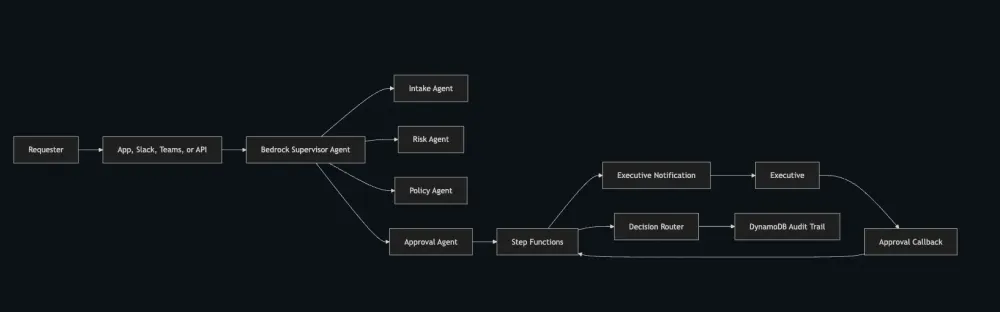
The architecture uses Amazon Bedrock Agents for orchestration, Lambda action groups for reliable business logic, Step Functions for the human wait state, DynamoDB for audit records, and a notification channel for executive review.
1
2
3
4
5
6
7
8
9
10
11
12
13
14
flowchart LR
  User["Requester"] --> Channel["App, Slack, Teams, or API"]
  Channel --> Supervisor["Bedrock Supervisor Agent"]
  Supervisor --> Intake["Intake Agent"]
  Supervisor --> Risk["Risk Agent"]
  Supervisor --> Policy["Policy Agent"]
  Supervisor --> Approval["Approval Agent"]
  Approval --> SFN["Step Functions"]
  SFN --> Notify["Executive Notification"]
  Notify --> Executive["Executive"]
  Executive --> Callback["Approval Callback"]
  Callback --> SFN
  SFN --> Router["Decision Router"]
  Router --> Audit["DynamoDB Audit Trail"]
Workflow
- A requester submits a business approval request.
- The supervisor agent asks the intake agent to normalize the request.
- The risk agent calculates a score and adds risk factors.
- The policy agent checks approval thresholds and missing evidence.
- If the request is ready, the approval agent starts a Step Functions workflow.
- Step Functions sends an approval task to the executive and waits.
- The executive approves, rejects, or asks for more information.
- A callback Lambda returns the task token to Step Functions.
- The decision router updates DynamoDB and sends the final action downstream.
Why Step Functions for Human Approval?
Human approvals are long-running by nature. A decision might come in five minutes, two days, or after multiple reminders. Step Functions supports callback task tokens, which lets a workflow pause until an external process returns a result.
That means the AI agent does not have to “remember” the pending approval in a fragile chat session. The durable state lives in AWS workflow infrastructure.
Example Request
1
2
3
4
5
6
7
8
9
10
{
  "requester": "maya@example.com",
  "business_unit": "Enterprise Sales",
  "amount": 125000,
  "currency": "USD",
  "vendor": "Northwind Analytics",
  "purpose": "Renew customer intelligence platform for strategic accounts",
  "deadline": "2026-07-15",
  "evidence": ["vendor_quote.pdf", "security_review.pdf"]
}
Example Agent Output
1
2
3
4
5
6
7
{
  "approval_id": "APR-20260622-0001",
  "risk_level": "medium",
  "policy_status": "ready_for_executive_review",
  "required_approver": "CFO",
  "summary": "Enterprise Sales requests approval for a $125,000 vendor renewal. Risk is medium due to amount and vendor dependency. Required evidence is present."
}
Production Hardening Ideas
For a real deployment, I would add:
- Bedrock guardrails for sensitive data and response boundaries
- IAM least privilege per Lambda function
- KMS encryption for DynamoDB and S3 evidence storage
- CloudWatch dashboards for approval latency and exception rates
- EventBridge reminders for overdue approvals
- API Gateway authentication with Cognito or enterprise identity
- Human-readable audit export for finance, legal, and compliance teams
What Makes This Agentic?
The system is agentic because the supervisor agent can plan the work, select specialist tools, ask for missing information, and coordinate multi-step completion. But it is still controlled: all irreversible actions go through explicit Lambda tools and Step Functions states.
That balance is the practical sweet spot for enterprise AI.
Code Walkthrough
The included sample repository contains:
- A CDK stack for DynamoDB, Lambda, SNS, and Step Functions
- Python Lambda handlers for each specialist agent
- An OpenAPI schema for Bedrock action groups
- Sample request and callback payloads
- A local smoke test script
- Repository: https://github.com/its-me-sweta/AI_Agent_Executive_Approval_Assistant.git
The project is intentionally compact so it can be shown in a blog post, demo video, or internal builder session.
Closing Thought
The best enterprise AI workflows do not replace the systems that already make businesses reliable. They sit above them, making the experience faster and easier while leaving state, audit, and approvals in infrastructure designed for it.
That is exactly what this Executive Approval Assistant is built to demonstrate.
Enjoyed reading this content? Let the author know!
Your likes, comments, shares, and saves help creators reach more builders.

Loading recommendations
Loading article