
From Idea to Working Code in One Conversation: What Claude Opus 4.7 on Amazon Bedrock Actually Does
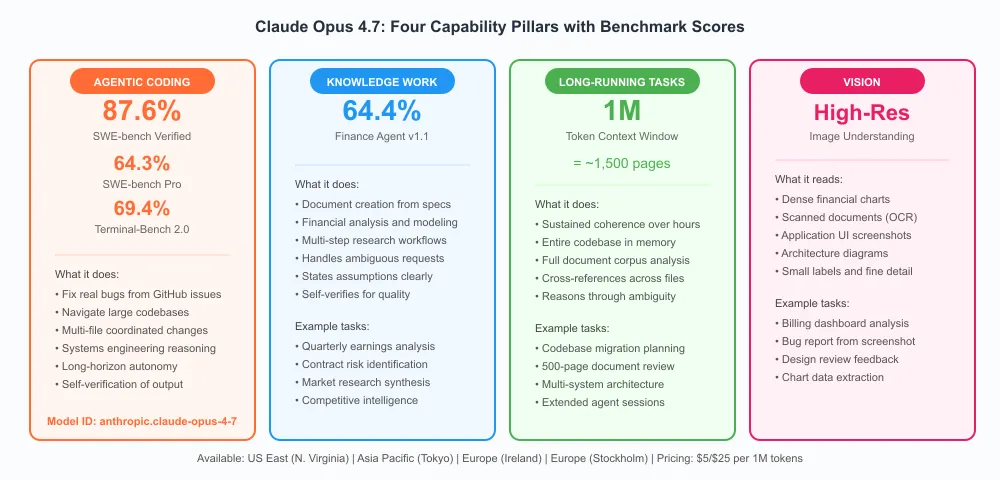
Claude Opus 4.7 scores 87.6% on SWE-bench Verified and brings four capability pillars to Amazon Bedrock: agentic coding, knowledge work, long-running tasks, and vision. Learn what these benchmarks mean in practice with code examples.

What Does 87.6% SWE-bench Actually Mean for Your Team?
Numbers without context are meaningless. So let me put this benchmark in perspective.
SWE-bench Verified is a test where an AI model receives a real GitHub issue from a real open source project and must write the code to fix it. Not pseudocode. Not suggestions. Actual working patches that pass the project's test suite.
Claude Opus 4.7 scores 87.6% on this test. That means if you gave it 100 real software bugs from production repositories, it would correctly fix 87 of them on its own without human guidance.
A year ago, the best models scored around 40%. Two years ago, under 10%. This is not incremental improvement. This is a threshold crossing where AI becomes a genuinely reliable coding partner for production work.
What Is Claude Opus 4.7?
Claude Opus 4.7 is Anthropic's most intelligent model for complex, long-running work. Released on Amazon Bedrock on April 16, 2026, it is purpose-built for tasks that require sustained reasoning over large codebases, multiple documents, or extended research sessions.
Think of it as the model you bring in when the task is too complex for a quick answer. When you need the AI to think through ambiguity, break down a systems architecture problem, or process 500 pages of financial data and produce a coherent analysis.
The Four Pillars: What Opus 4.7 Actually Does Well
1. Agentic Coding (The Headline Act)
This is where the benchmarks speak loudest:
| Benchmark | Score | What It Tests |
|---|---|---|
| SWE-bench Verified | 87.6% | Fix real GitHub issues with working code |
| SWE-bench Pro | 64.3% | Harder variant with more complex multi-file changes |
| Terminal-Bench 2.0 | 69.4% | Run terminal commands to investigate and fix issues |
In practice, "agentic coding" means the model can:
- Read a bug report
- Navigate a large codebase to find the relevant files
- Understand the architecture and dependencies
- Write a fix that works with the existing code style
- Verify its own solution
Real example: A developer on your team gets a support ticket: "The dashboard shows incorrect totals when filtering by date range across multiple time zones." With Opus 4.7 in an agentic coding harness (like Kiro or Claude Code), the model reads the ticket, searches the codebase for the date filtering logic, identifies the timezone conversion bug in the aggregation layer, writes a fix, and generates a test case that covers the edge condition. The developer reviews and merges.
2. Knowledge Work (The Quiet Powerhouse)
Opus 4.7 scores 64.4% on Finance Agent v1.1, a benchmark that tests multi-step financial analysis including data gathering, calculation, and report generation.
What this means in practice:
- Hand it 200 pages of quarterly earnings reports and ask for a competitive analysis. It will read all of them, extract the relevant metrics, identify trends, and produce a structured report.
- Give it a contract with complex terms and ask it to identify risks. It will flag the clauses that matter, explain the implications, and suggest negotiation points.
- Upload raw survey data and ask for insights. It will clean the data, find statistically significant patterns, and write an executive summary.
The model "reasons through underspecified requests, making sensible assumptions and stating them clearly." When your prompt is vague, Opus 4.7 does not guess silently. It tells you what assumptions it made so you can correct course.
3. Long-Running Tasks (The 1 Million Token Advantage)
Most AI models lose coherence when conversations get long. They forget what you discussed 30 minutes ago. They repeat themselves. They drift off topic.
Opus 4.7 has a 1 million token context window. That is roughly 750,000 words, or about 1,500 pages of text, all held in active memory simultaneously.
Real example: You are migrating a legacy system. You upload the entire codebase (300 files), the architecture documentation, and the target platform specifications. You ask: "Create a migration plan that preserves all business logic, identifies deprecated patterns that need rewriting, and estimates effort per module." Opus 4.7 holds all of this in context and produces a coherent plan that references specific files and functions across the entire codebase.
4. Vision (Charts, Documents, and UIs)
Opus 4.7 supports high-resolution image input. It can accurately read:
- Dense financial charts with small labels
- Multi-page scanned documents
- Application UI screenshots (for bug reports, design reviews)
- Architecture diagrams with text annotations
Real example: Upload a screenshot of your AWS billing dashboard and ask: "What is driving the cost increase this month and what should I investigate first?" The model reads the chart, identifies the service with the steepest increase, and suggests specific CloudWatch metrics to check.
How to Use It on Amazon Bedrock
Quick Start (Python)
1
2
3
4
5
6
7
8
9
10
11
12
13
14
15
from anthropic import AnthropicBedrockMantle

# Initialize (uses SigV4 auth automatically)
client = AnthropicBedrockMantle(aws_region="us-east-1")

# Create a message
message = client.messages.create(
    model="anthropic.claude-opus-4-7",
    max_tokens=10000,
    messages=[
        {"role": "user", "content": "Analyze this codebase and identify security vulnerabilities in the authentication flow."}
    ]
)

print(message.content[0].text)
AWS CLI
1
2
3
4
5
6
aws bedrock-runtime invoke-model \
  --model-id anthropic.claude-opus-4-7 \
  --region us-east-1 \
  --body '{"anthropic_version":"bedrock-2023-05-31", "messages": [{"role": "user", "content": "Your prompt here"}], "max_tokens": 32000}' \
  --cli-binary-format raw-in-base64-out \
  invoke-model-output.txt
Available APIs
| API | Best For |
|---|---|
| Anthropic Messages API (via anthropic[bedrock] SDK) | Cleanest developer experience, streaming support |
| Bedrock Invoke API | Direct model invocation, lowest-level control |
| Bedrock Converse API | Multi-turn conversations, Guardrails integration |
| OpenAI-compatible Responses API | Drop-in replacement if migrating from OpenAI |
Adaptive Thinking
Opus 4.7 supports adaptive thinking, which dynamically allocates "thinking token" budgets based on request complexity. A simple classification request gets a brief internal reasoning step. A complex architecture question gets extended deliberation. You do not configure this manually. The model self-allocates based on what the task requires.
The Infrastructure Behind It
Opus 4.7 runs on Bedrock's next-generation inference engine with two properties that matter for production:
- Dynamic capacity allocation: The engine detects demand patterns and pre-provisions capacity. Steady-state workloads get prioritized availability. Burst traffic gets queued rather than rejected.
- Zero operator access: Customer prompts and responses are never visible to Anthropic or AWS operators. This is not a policy. It is an architectural property of the inference engine.
Available Regions
| Region | Status |
|---|---|
| US East (N. Virginia) | Available |
| Asia Pacific (Tokyo) | Available |
| Europe (Ireland) | Available |
| Europe (Stockholm) | Available |
Cross-region inference profiles allow requests to route to available capacity across regions while maintaining data residency requirements.
When to Use Opus 4.7 vs. Other Claude Models
| Use Case | Recommended Model | Why |
|---|---|---|
| Complex multi-file code changes | Opus 4.7 | Highest coding benchmarks, long-horizon reasoning |
| Quick code completion or review | Sonnet 4.6 | 80% of the quality at 60% of the cost |
| Document classification or routing | Haiku 4.5 | Fast, cheap, good enough for simple decisions |
| Multi-day autonomous agent work | Fable 5 | Built for sustained autonomous operation |
| Financial analysis from raw data | Opus 4.7 | Finance Agent v1.1 benchmark leader |
Pricing
| Tier | Input | Output |
|---|---|---|
| On-demand | $5 / million tokens | $25 / million tokens |
| Batch (async) | $2.50 / million tokens | $12.50 / million tokens |
For a typical agentic coding session (analyzing a bug, writing a fix, generating tests): approximately 50K input tokens + 10K output tokens = $0.50 per task. Compare that to the engineering hours saved.
References
- Introducing Anthropic's Claude Opus 4.7 model in Amazon Bedrock (April 16, 2026)
- Claude Opus 4.7 model card
- AWS Weekly Roundup: Claude Opus 4.7 in Amazon Bedrock (April 20, 2026)
- Claude in Amazon Bedrock
- Amazon Bedrock pricing
- Anthropic Claude platform documentation
- Amazon Bedrock Converse API documentation
About the Authors
Sekh Mohammad Warish is a Senior Technical Account Manager at AWS, supporting customers across SAP, GenAI, and cloud modernization. He helps customers adopt emerging technologies and build production-ready solutions on AWS.
Nitish Tipparaju is an Enterprise Support Manager at AWS, leading technical account teams that drive GenAI adoption and operational excellence for customers. He co-leads GenAI upskilling programs and brings hands-on experience helping organizations build their first AI agents on AWS.
Enjoyed reading this content? Let the author know!
Your likes, comments, shares, and saves help creators reach more builders.

Loading recommendations
Loading article