
From Idea to Working Code in One Conversation: What Claude Opus 4.7 on Amazon Bedrock Actually Does
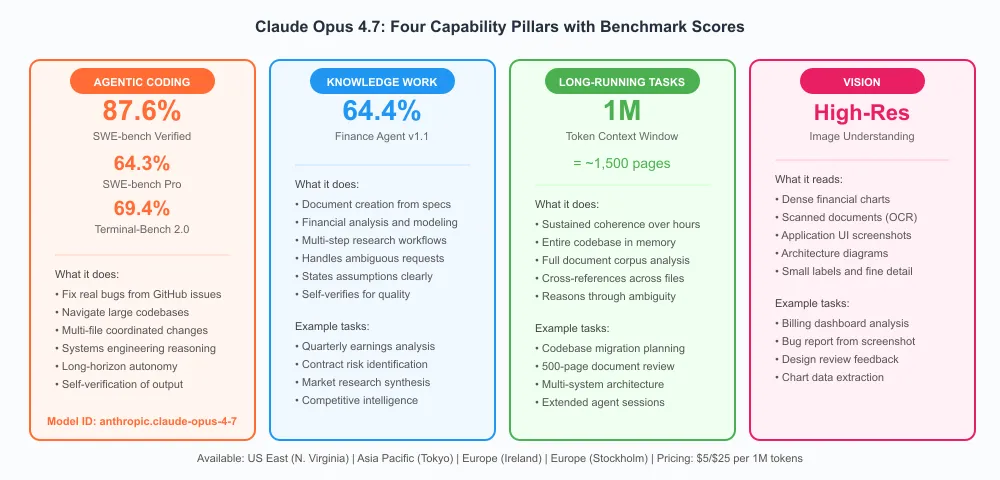
Claude Opus 4.7 scores 87.6% on SWE-bench Verified and brings four capability pillars to Amazon Bedrock: agentic coding, knowledge work, long-running tasks, and vision. Learn what these benchmarks mean in practice with code examples.

What Does 87.6% SWE-bench Actually Mean for Your Team?
Numbers without context are meaningless. So let me put this benchmark in perspective.
SWE-bench Verified is a test where an AI model receives a real GitHub issue from a real open source project and must write the code to fix it. Not pseudocode. Not suggestions. Actual working patches that pass the project's test suite.
Claude Opus 4.7 scores 87.6% on this test. That means if you gave it 100 real software bugs from production repositories, it would correctly fix 87 of them on its own without human guidance.
A year ago, the best models scored around 40%. Two years ago, under 10%. This is not incremental improvement. This is a threshold crossing where AI becomes a genuinely reliable coding partner for production work.
What Is Claude Opus 4.7?
Claude Opus 4.7 is Anthropic's most intelligent model for complex, long-running work. Released on Amazon Bedrock on April 16, 2026, it is purpose-built for tasks that require sustained reasoning over large codebases, multiple documents, or extended research sessions.
Think of it as the model you bring in when the task is too complex for a quick answer. When you need the AI to think through ambiguity, break down a systems architecture problem, or process 500 pages of financial data and produce a coherent analysis.
The Four Pillars: What Opus 4.7 Actually Does Well
1. Agentic Coding (The Headline Act)
This is where the benchmarks speak loudest:
| Benchmark | Score | What It Tests |
|---|---|---|
| SWE-bench Verified | 87.6% | Fix real GitHub issues with working code |
| SWE-bench Pro | 64.3% | Harder variant with more complex multi-file changes |
| Terminal-Bench 2.0 | 69.4% | Run terminal commands to investigate and fix issues |
In practice, "agentic coding" means the model can:
- Read a bug report
- Navigate a large codebase to find the relevant files
- Understand the architecture and dependencies
- Write a fix that works with the existing code style
- Verify its own solution
Real example: A developer on your team gets a support ticket: "The dashboard shows incorrect totals when filtering by date range across multiple time zones." With Opus 4.7 in an agentic coding harness (like Kiro or Claude Code), the model reads the ticket, searches the codebase for the date filtering logic, identifies the timezone conversion bug in the aggregation layer, writes a fix, and generates a test case that covers the edge condition. The developer reviews and merges.
2. Knowledge Work (The Quiet Powerhouse)
Opus 4.7 scores 64.4% on Finance Agent v1.1, a benchmark that tests multi-step financial analysis including data gathering, calculation, and report generation.
What this means in practice:
- Hand it 200 pages of quarterly earnings reports and ask for a competitive analysis. It will read all of them, extract the relevant metrics, identify trends, and produce a structured report.
- Give it a contract with complex terms and ask it to identify risks. It will flag the clauses that matter, explain the implications, and suggest negotiation points.
- Upload raw survey data and ask for insights. It will clean the data, find statistically significant patterns, and write an executive summary.
The model "reasons through underspecified requests, making sensible assumptions and stating them clearly." When your prompt is vague, Opus 4.7 does not guess silently. It tells you what assumptions it made so you can correct course.
3. Long-Running Tasks (The 1 Million Token Advantage)
Most AI models lose coherence when conversations get long. They forget what you discussed 30 minutes ago. They repeat themselves. They drift off topic.
Opus 4.7 has a 1 million token context window. That is roughly 750,000 words, or about 1,500 pages of text, all held in active memory simultaneously.
Real example: You are migrating a legacy system. You upload the entire codebase (300 files), the architecture documentation, and the target platform specifications. You ask: "Create a migration plan that preserves all business logic, identifies deprecated patterns that need rewriting, and estimates effort per module." Opus 4.7 holds all of this in context and produces a coherent plan that references specific files and functions across the entire codebase.
4. Vision (Charts, Documents, and UIs)Opus 4.7 supports high-resolution image input. It can analyze:
- Screenshots of applications (for UI testing or documentation)
- Charts and graphs (extracting underlying data and trends)
- Scanned documents (OCR plus semantic understanding)
- Architecture diagrams (understanding system relationships)
- Photographs with embedded text (whiteboards, signs, handwritten notes)
Real example: You screenshot a Grafana dashboard showing a performance regression. You ask Opus 4.7: "What's causing the latency spike, and what should I investigate first?" The model reads the chart axes, identifies the correlation between the memory metric and the latency metric, notes the deployment marker that preceded the spike, and suggests checking the new service's memory allocation patterns.
How to Access Opus 4.7 on Amazon Bedrock
Model ID
1
anthropic.claude-opus-4-7-20260416-v1:0
Basic Invocation (Python)
1
2
3
4
5
6
7
8
9
10
11
12
13
14
15
16
17
18
19
20
21
import boto3
import json

bedrock = boto3.client('bedrock-runtime', region_name='us-east-1')

response = bedrock.invoke_model(
    modelId='anthropic.claude-opus-4-7-20260416-v1:0',
    body=json.dumps({
        "anthropic_version": "bedrock-2023-05-31",
        "max_tokens": 8192,
        "messages": [
            {
                "role": "user",
                "content": "Analyze this codebase and identify potential memory leaks in the connection pooling module."
            }
        ]
    })
)

result = json.loads(response['body'].read())
print(result['content'][0]['text'])
Extended Thinking (For Complex Reasoning)
Opus 4.7 supports "extended thinking" where it shows its reasoning process before delivering an answer. Enable it for complex tasks where you want to see how the model arrives at its conclusion:
1
2
3
4
5
6
7
8
9
10
11
12
13
14
15
16
17
response = bedrock.invoke_model(
    modelId='anthropic.claude-opus-4-7-20260416-v1:0',
    body=json.dumps({
        "anthropic_version": "bedrock-2023-05-31",
        "max_tokens": 16384,
        "thinking": {
            "type": "enabled",
            "budget_tokens": 10000
        },
        "messages": [
            {
                "role": "user",
                "content": "Design a distributed rate limiter that handles 100K requests/second with less than 2ms added latency."
            }
        ]
    })
)
The response includes both the thinking trace (how it reasoned through the problem) and the final answer.
Streaming for Long Outputs
For long-running tasks, use streaming to get results as they generate:
1
2
3
4
5
6
7
8
9
10
11
12
13
14
15
16
17
18
response = bedrock.invoke_model_with_response_stream(
    modelId='anthropic.claude-opus-4-7-20260416-v1:0',
    body=json.dumps({
        "anthropic_version": "bedrock-2023-05-31",
        "max_tokens": 32000,
        "messages": [
            {
                "role": "user",
                "content": "Write comprehensive API documentation for all 47 endpoints in this service specification: [attach spec]"
            }
        ]
    })
)

for event in response['body']:
    chunk = json.loads(event['chunk']['bytes'])
    if chunk['type'] == 'content_block_delta':
        print(chunk['delta'].get('text', ''), end='')
Pricing on Amazon Bedrock
| Component | Price |
|---|---|
| Input tokens | $15.00 per million |
| Output tokens | $75.00 per million |
| Context caching (write) | $18.75 per million |
| Context caching (read) | $1.88 per million |
Cost example: A complex code review session (50K input tokens with a codebase, 5K output tokens with analysis):
- Input: 50,000 / 1,000,000 × $15.00 = $0.75
- Output: 5,000 / 1,000,000 × $75.00 = $0.375
- Total: ~$1.12 per complex analysis
For comparison, Sonnet 4 costs $3/$15 per million tokens (input/output). If your task does not require Opus-level reasoning, Sonnet saves ~80% while still being excellent for most coding tasks.
When to Use Opus 4.7 vs. Sonnet 4 vs. Haiku
Use Opus 4.7 when:
- The task requires reasoning across more than 100K tokens of context
- You need the highest accuracy on complex multi-file code changes
- The work involves ambiguous requirements that need interpretation
- You are doing extended research or analysis sessions
Use Sonnet 4 when:
- Standard coding tasks (single-file changes, unit tests, refactoring)
- Customer-facing content generation
- Most day-to-day development work
- Cost is a factor and the task does not require elite reasoning
Use Haiku when:
- Classification, tagging, or routing tasks
- Quick Q&A against documentation
- High-volume, low-complexity operations
- Latency is the primary constraint
Getting Started
- Enable Claude Opus 4.7 in your Bedrock console (us-east-1 or eu-west-1)
- Request model access if not already granted
- Start with the streaming API for interactive use cases
- Enable extended thinking for complex reasoning tasks
- Use context caching to reduce costs on repeated analyses
Claude Opus 4.7 is not a chatbot that writes better emails. It is a reasoning engine that can hold your entire system in memory and think through problems that would take a senior engineer hours. Use it where that capability justifies the cost, and use the rest of the Claude family everywhere else.
Claude Opus 4.7 is available on Amazon Bedrock in US East (N. Virginia) and EU West (Ireland). Cross-region inference enables access from any supported region. Visit the Amazon Bedrock pricing page for current rates.
Enjoyed reading this content? Let the author know!
Your likes, comments, shares, and saves help creators reach more builders.

Loading recommendations
Loading article