
Defense in Depth: Building Layers of Security for AI on AWS
A beginner-friendly walkthrough of the seven-layer defense in depth security model for generative AI workloads on AWS, with simple analogies and the key AWS services that map to each layer.

When I came across defense in depth in the Udacity Future AWS Agentic Engineer Nanodegree, the concept finally clicked for me. So let me explain it the way I understood it.
The Big Idea
Imagine your house only had one lock on the front door. One failure and everything inside is exposed. Defense in depth says: add a deadbolt, a security camera, motion sensors, a fence, and maybe a noisy dog. Each layer works independently. If one fails, the others still hold.
The same thinking applies to securing AI workloads on AWS. You stack multiple redundant defenses so that if any single control is compromised, additional layers exist to isolate threats and help you prevent, detect, respond to, and recover from security events (Udacity, Future AWS Agentic Engineer Nanodegree).
The Seven Layers
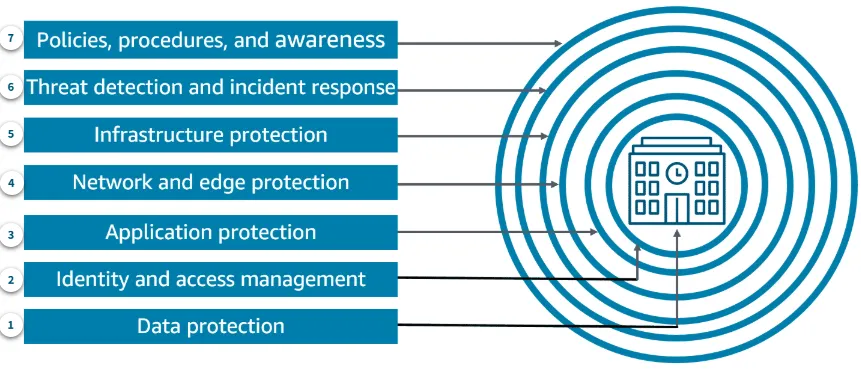
Looking at the defense in depth model, there are seven rings of protection around your AI workloads. Here is how I think about each one.
Layer 1: Data Protection is the vault inside the house. Your training data, vector embeddings, and anything your models process during inference live here. AWS KMS encrypts it, Amazon Macie watches for sensitive data leaks, and S3 bucket policies control exactly who gets in.
Layer 2: Identity and Access Management is the guest list at the door. It answers: who (or what) is allowed to do what? AWS IAM lets you create granular roles following least privilege, so a sandbox evaluator cannot touch production inference. Amazon Cognito adds multi-factor authentication for end users, meaning even a perfect prompt injection attack still has to prove identity first.
Layer 3: Application Protection is the bouncer checking IDs. This protects the code and APIs between your users and your AI models. AWS WAF inspects incoming requests and blocks common attacks. Amazon Bedrock Guardrails acts as a safety rail on your model's output, filtering harmful content, denied topics, and PII before responses ever reach the user.
Layer 4: Network and Edge Protection is the fence and gate around the property. Amazon VPC isolates your AI resources in private subnets away from the public internet. At the edge, CloudFront and AWS Shield handle DDoS attacks before they reach your application, while AWS Network Firewall controls traffic flow between subnets.
Layer 5: Infrastructure Protection is the building inspector making sure the walls are solid. Amazon Inspector continuously scans for software vulnerabilities in your compute environment. AWS Systems Manager keeps everything patched and compliant, so the infrastructure running your models stays hardened.
Layer 6: Threat Detection and Incident Response is the security camera system with 24/7 monitoring. Amazon GuardDuty uses ML to flag suspicious activity like unusual model invocations. AWS CloudTrail logs every API call for forensic investigation. Amazon Detective ties it all together so your team can connect the dots fast during an incident.
Layer 7: Policies, Procedures, and Awareness is the neighborhood watch. Technology is only as good as the people and culture around it. This includes your org's AI usage policies, incident response runbooks, and security training. AWS Organizations and Service Control Policies let you set guardrails at the organizational level, like restricting which foundation models teams can access.
Why This Matters Even More for AI
Standard cloud security principles apply here, but generative AI adds new attack surfaces. Prompt injection is ranked the number-one risk by OWASP for LLM applications. Data poisoning can corrupt training data. Agentic AI systems, where models autonomously use tools and take actions, create entirely new trust boundary challenges.
Defense in depth means no single layer needs to be perfect. Each one independently reduces risk, and together they build a security posture far stronger than any individual control. You can use a combination of AWS services and partner solutions at each layer to strengthen the security and resiliency of your generative AI workloads (Udacity, Future AWS Agentic Engineer Nanodegree).
Start from the inside out: lock down your data, set up least-privilege IAM, add application guardrails, isolate your network, harden your infrastructure, turn on monitoring from day one, and wrap it all in clear organizational policies. You do not have to do everything at once. Just keep adding layers.
Enjoyed reading this content? Let the author know!
Your likes, comments, shares, and saves help creators reach more builders.

Loading recommendations
Loading article