
Building Web MCP for Amazon Bedrock Agents
Learn how to build a custom MCP server for Amazon Bedrock AI agents using Strands Agents SDK and Playwright. Real-world example: AgriNova AI.

Introduction: Why AI Agents Need MCP Servers
As generative AI applications evolve from simple chatbots into autonomous AI agents, access to external tools and real-time information becomes critical. Foundation models excel at reasoning, but they're inherently limited by static training data — they can't check today's weather, today's market prices, or today's government scheme updates on their own.
This is the problem Model Context Protocol (MCP) solves. MCP is a standardized protocol for connecting AI agents with external systems, tools, APIs, and data sources. It allows developers to build reusable, modular capabilities that any MCP-compatible agent framework can consume — without rewriting integration code for every project.
In this guide, I walk through how I built a custom Web MCP Server in Python using Playwright, and integrated it with Amazon Bedrock-powered agents using the Strands Agents SDK. As a real-world validation, this MCP server powers AgriNova AI, an agricultural intelligence assistant that helps Indian farmers access live market prices, government schemes, and weather data.
What Is MCP (Model Context Protocol)? Why It Matters for AI Agents
Traditional AI applications often rely on tightly coupled integrations, where every external system requires custom implementation baked directly into the agent itself. This creates real problems at scale:
- Difficult maintenance — every integration is a one-off
- Limited reusability — code can't be shared across projects
- Vendor lock-in — integrations tied to specific frameworks
- Growing complexity — adding tools becomes harder over time
MCP solves this by standardizing the protocol between AI agents and external capabilities. Instead of embedding every integration into the application, capabilities are exposed as discoverable MCP tools that any agent can invoke dynamically.
Benefits of an MCP-Based Architecture
| Benefit | Description |
|---|---|
| Modularity | Agent logic and tool logic stay fully decoupled |
| Reusability | One MCP server can serve multiple AI applications |
| Simplified agent logic | Business logic lives outside the foundation model |
| Standardized interfaces | Tool discovery and invocation become predictable |
| Scalability | New capabilities don't require touching core agent code |
MCP Server Architecture for Amazon Bedrock Agents
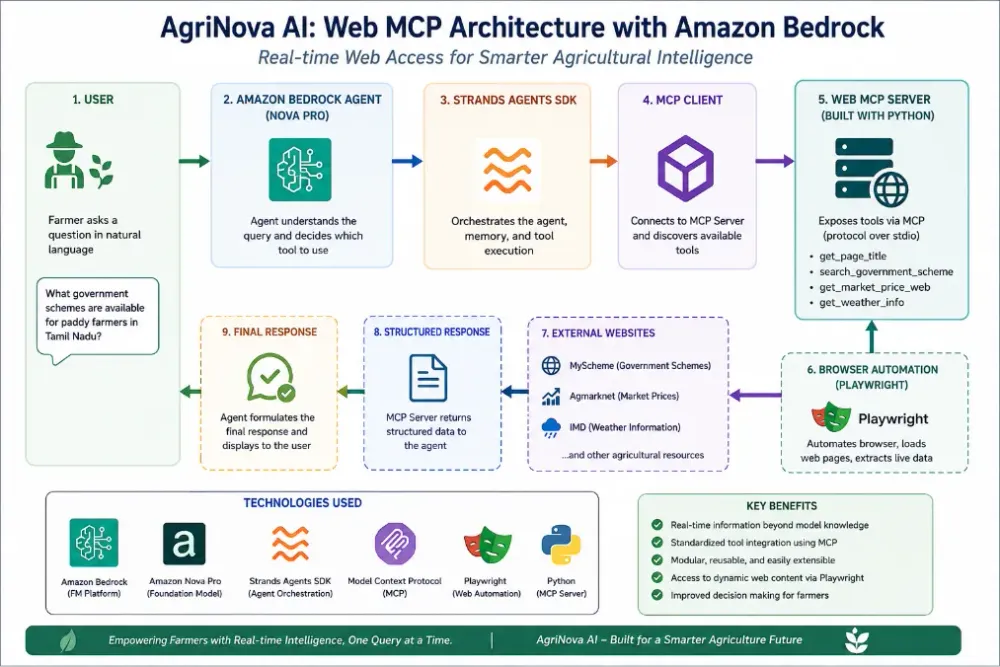
The solution architecture has five core components:
- Amazon Bedrock — managed foundation model infrastructure
- Amazon Nova Pro — the reasoning LLM
- Strands Agents SDK — agent orchestration framework
- Custom Web MCP Server — the tool execution layer (this guide's focus)
- External Web Resources — live data sources (government portals, market data, etc.)
Architecture Flow
1
2
3
4
5
6
7
8
9
10
11
12
13
14
15
16
17
User Query
    ↓
Amazon Bedrock Agent (Nova Pro)
    ↓
Strands Tool Selection
    ↓
MCP Client
    ↓
Custom Web MCP Server
    ↓
Playwright Browser Automation
    ↓
External Websites
    ↓
Structured Response
    ↓
Agent Response
The foundation model focuses purely on reasoning and decision-making, while the MCP server handles execution — interacting with external web resources, parsing results, and returning structured data.
Building the Web MCP Server: Step-by-Step
The MCP server is implemented using the Python MCP SDK. It exposes multiple tools that AI agents can discover and invoke dynamically — no hardcoded integration logic required inside the agent itself.
Example Tool Capabilities
- Website metadata retrieval (page titles, structured data)
- Government scheme discovery
- Market price information retrieval
- Weather and rainfall data lookup
Each capability is registered as an MCP tool with a well-defined JSON schema. This schema tells the agent:
- When a tool should be used
- What parameters it requires
- What information it returns
Because the implementation follows the open MCP standard, the same tool server can be reused across different agent frameworks — not just Strands or Bedrock.
Why Use Playwright for AI Agent Web Scraping?
Many modern websites — especially government and data portals — rely heavily on JavaScript and client-side rendering. Plain HTTP requests (via
requests or urllib) often fail to retrieve meaningful content because critical data loads asynchronously after initial page load.This is exactly the problem Playwright solves for AI agent tool design.
Playwright provides:
- ✅ Full browser automation (headless Chromium/Firefox/WebKit)
- ✅ JavaScript execution
- ✅ Dynamic page rendering
- ✅ Reliable content extraction from SPA-style websites
This lets the MCP server interact with websites the same way a human user would — clicking, waiting, scrolling, and reading rendered content. For AI agents that need real-time web access, this capability is essential, not optional.
Integrating MCP with Amazon Bedrock Agents via Strands SDK
The Strands Agents SDK provides native support for MCP integration, making the workflow straightforward:
- Start the MCP server
- Create an MCP client
- Discover available tools (
list_tools_sync()) - Register tools with the agent
- Let the model dynamically select tools at runtime
Once registered, Amazon Nova Pro autonomously decides when a tool should be invoked based on the user's query:
- Market price questions → triggers market retrieval tools
- Government scheme queries → triggers scheme discovery tools
- Weather-related requests → triggers weather lookup tools
The model handles reasoning; the MCP server handles execution. This separation is the core value proposition of MCP-based agent design.
Real-World Case Study: AgriNova AI
To validate this architecture in production, the Web MCP server was integrated into AgriNova AI — an agricultural intelligence assistant built with:
- Amazon Bedrock
- Amazon Nova Pro
- Strands Agents SDK
- Memory-enabled conversations
- Agricultural training datasets
- Government APIs (data.gov.in, Agmarknet)
- Custom MCP integrations
The Web MCP server extends AgriNova's capabilities by giving it access to external agricultural resources — without embedding website-specific scraping logic directly into the core agent. This demonstrates how MCP transforms a domain-specific assistant into an extensible, reusable agent system.
Key Benefits Observed in Production
| Observation | Why It Matters |
|---|---|
| Modular design | Agent and tool implementations stay fully independent |
| Reusability | The same MCP server supports multiple AI applications |
| Simplified agent logic | Business logic lives outside the foundation model |
| Standardized tool interfaces | Tool discovery/invocation become predictable |
| Improved scalability | New capabilities added without touching core agent workflows |
Lessons Learned Building a Production MCP Server
Building a custom MCP server surfaced several practical insights worth sharing:
- MCP significantly simplifies tool integration patterns — no more bespoke glue code per service
- Protocol-based design pays off at scale — agent architectures benefit from standardization early
- Playwright is highly effective for dynamic web retrieval, where plain HTTP clients fail
- Tool descriptions are critical for accurate model selection — vague schemas lead to wrong tool calls
- Proper MCP session management is essential for reliable production deployments — stdio connections can be fragile and need explicit error handling
The most important lesson: MCP enables developers to think beyond one-off integrations and instead build reusable capability layers for AI systems.
Conclusion: MCP Is the Future of Agent Connectivity
Model Context Protocol is emerging as a foundational building block for modern agentic AI systems. By combining Amazon Bedrock, Amazon Nova Pro, the Strands Agents SDK, and a custom Web MCP Server, it's possible to build AI agents that move beyond static knowledge and interact with real-world information dynamically.
As more organizations adopt agent-based architectures, MCP provides a powerful, standardized framework for connecting AI systems with the tools and data they actually need to deliver meaningful outcomes.
The future of AI agents isn't just better models — it's better connectivity. MCP is a major step toward that future.
About This Project
This architecture was implemented and tested in AgriNova AI, an agricultural intelligence assistant for Indian farmers. If you're building MCP-integrated agents on Amazon Bedrock, I'd love to hear about your experience — drop a comment below or connect with me on LinkedIn.
LinedIn-https://www.linkedin.com/in/thirumalaiboobathi-b-902a51233/
Enjoyed reading this content? Let the author know!
Your likes, comments, shares, and saves help creators reach more builders.

Loading recommendations
Loading article