
How I Built an Amazon Quick Agent That Delivers Daily GenAI Intelligence
An AWS Solutions Architect built an autonomous agent on Amazon Quick that delivers a daily GenAI competitive intelligence brief, categorized by a 3-layer stack model, replacing 45 minutes of manual scanning with a 2-minute morning read.


I'm a Solutions Architect at AWS supporting Amazon Devices and Services. I work with Principal Engineers and Senior Principal Engineers who stay current on every GenAI announcement. When AWS or a competitor ships something relevant, they expect me to have context as their Technical Advisor. Not a hot take. Just awareness of what happened and where it sits in the landscape.
The GenAI space moves daily. AWS and competitors ship 3-5 announcements per week across three stack layers . Dozens of channels. Newsletters I never open. The math doesn't work if you try to keep up manually.
So I built an Amazon Quick autonomous agent that does it for me. This article shows the agent's design, the opinionated framework behind it, and how you can build your own version in 10 minutes.
The information treadmill nobody talks about
Here's the honest accounting of what "staying current" used to cost me:
- 15 minutes scanning internal AWS announcement channels for GenAI updates
- 10 minutes checking competitor blogs (Google, OpenAI, Anthropic, Meta, Microsoft, xAI)
- 10 minutes reading tech news aggregators for what I missed
- 10 minutes synthesizing: what does this mean for my customers?
That's 45 minutes on a good day. On a bad day, back-to-back meetings from 9 AM, it doesn't happen at all. I'd go three days without checking, then walk into a call blind.
The problem isn't laziness. Scanning for information and synthesizing information are two different jobs. Humans are good at synthesis. We're terrible at consistent, daily scanning across 8+ sources.
The mental model: a 3-layer AI stack
Before building the agent, I needed an opinionated framework. Raw news doesn't add value without structure. Every announcement lands in one of three layers:

Layer 1: APPLICATION (Apps that boost productivity)
This is what end users touch. The products people compare at dinner.
| AWS | Competitors |
|---|---|
| Kiro CLI, Kiro IDE, Amazon Quick Suite | GitHub Copilot, Cursor, Google Gemini App, ChatGPT, Claude.ai, Grok |
Layer 2: FRAMEWORK (Models and tools to build GenAI apps)
This is what builders use. APIs, SDKs, orchestration.
| AWS | Competitors |
|---|---|
| Amazon Bedrock, Amazon Bedrock AgentCore, Strands Agents SDK | Azure AI Studio, Google Vertex AI, OpenAI Assistants API, LangChain, CrewAI |
Layer 3: INFRASTRUCTURE (Hardware to build and train models)
This is what runs underneath. Chips, training clusters, inference engines.
| AWS | Competitors |
|---|---|
| Amazon SageMaker, Trainium, Inferentia | Azure ML, Google TPUs, NVIDIA DGX Cloud |
This framework does two things. First, it categorizes any announcement instantly. You know where it fits before you read the details. Second, it forces the question: what's the AWS equivalent? That's the question my customers ask. The stack model pre-answers it.
Note: This is my personal framework for organizing the landscape, not official AWS positioning.
The agent: what it does
I built this on Amazon Quick's autonomous agent platform. The same capability that launched at the New York Summit on June 17, 2026 .
Here's the setup:
- Schedule: Daily at 7:00 AM, before I open my laptop
- Model: Smart (high thinking effort for better synthesis)
- Source 1: What's New with AWS RSS Feed , all GenAI-related posts from the last 24 hours for AWS announcements
- Source 2: Web search across 6 competitors: Azure, Google, OpenAI, Anthropic, Meta, xAI
- Signal filter: ALL layers for AWS announcements. For competitors, only Application and Framework layers, and only if the announcement is covered by 3+ major tech outlets, represents a strategic shift, or directly competes with an AWS product
- Output: Structured HTML email delivered to my inbox
The critical design choice: quality over quantity for competitors, completeness for AWS. I don't need to know Google expanded Vertex AI to a new region. I need to know when they launch a new agent framework that competes with Amazon Bedrock AgentCore. The signal filter prevents inbox fatigue.
The agent's core prompt
Here's the mental model section I gave the agent. This is the part that makes it opinionated rather than a generic news scraper:
1
2
3
4
5
6
7
8
9
10
11
12
13
14
15
16
17
18
19
20
21
## Your Mental Model — 3-Layer GenAI Stack (2026 Q2)

Map every announcement to one of these layers:

### Layer 1: APPLICATION LAYER (Apps to Boost Productivity)
AWS equivalents: Kiro CLI, Kiro IDE, Amazon Quick Suite
Competitor examples: GitHub Copilot, Cursor, Google Gemini App,
                     ChatGPT, Claude.ai, Meta AI, Grok

### Layer 2: FRAMEWORK/TOOLS LAYER (Models and Tools to Build GenAI Apps)
AWS equivalents: Amazon Bedrock, Amazon Bedrock AgentCore, Strands Agents SDK
Competitor examples: Azure AI Studio, Google Vertex AI Agent Builder,
                     OpenAI Assistants API, LangChain, CrewAI, AutoGen

### Layer 3: INFRASTRUCTURE LAYER (Build and Train AI Models)
AWS equivalents: Amazon SageMaker, Trainium, Inferentia, GPUs
Competitor examples: Azure ML, Google TPUs, NVIDIA DGX Cloud

### Cross-Collaboration
Flag partnerships or cross-company collaborations
(e.g., OpenAI + AWS, Anthropic + Google, Meta + Microsoft)
And the signal filter that keeps noise out:
1
2
3
4
5
6
7
8
9
10
## Signal Filter for Competitors

ONLY include competitor announcements meeting at least one criteria:
- Major cross-company collaborations or partnerships
- Covered by 3+ major tech outlets within 24 hours
- Major product launches or paradigm shifts
- Direct competitive threats to AWS GenAI products

DO NOT include: routine updates, minor versions, regional expansions,
documentation updates, or infrastructure/hardware announcements
What the output looks like
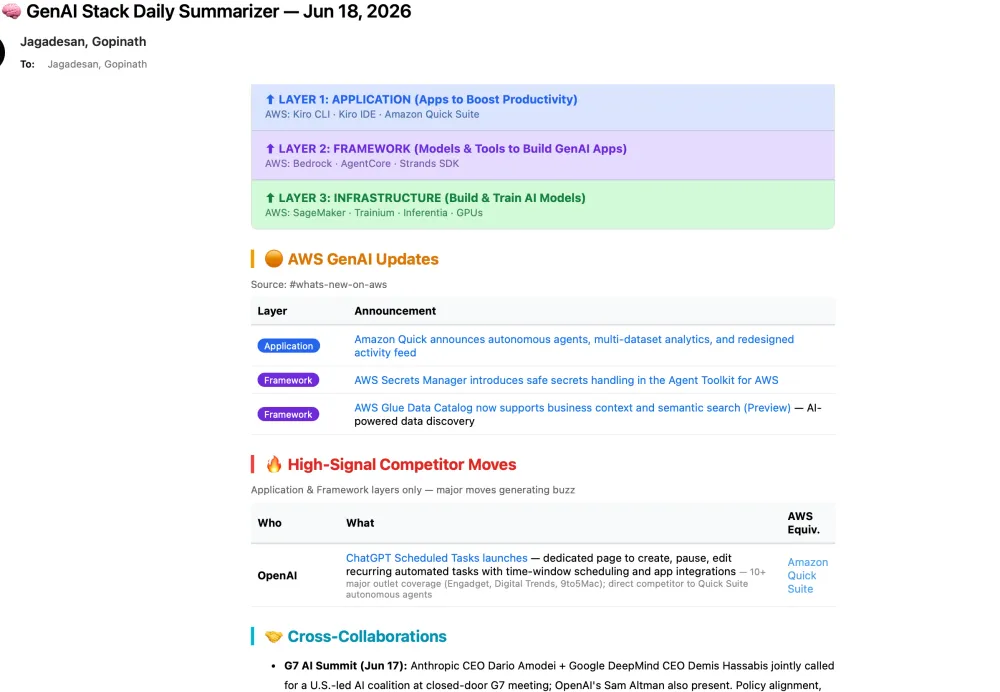
Every morning at 7 AM, this lands in my inbox. Here's a real example from June 18, 2026:
1
2
3
4
5
6
7
8
9
10
11
12
13
14
15
16
17
18
19
20
21
22
23
24
25
26
27
28
29
30
Subject: 🧠 GenAI Stack Daily Summarizer — Jun 18, 2026

┌─────────────────────────────────────────────────────┐
│ ⬆ LAYER 1: APPLICATION                              │
│   AWS: Kiro CLI · Kiro IDE · Amazon Quick Suite     │
├─────────────────────────────────────────────────────┤
│ ⬆ LAYER 2: FRAMEWORK                               │
│   AWS: Bedrock · AgentCore · Strands SDK            │
├─────────────────────────────────────────────────────┤
│ ⬆ LAYER 3: INFRASTRUCTURE                          │
│   AWS: SageMaker · Trainium · Inferentia            │
└─────────────────────────────────────────────────────┘

🟠 AWS GenAI Updates

| Layer       | Announcement                                    |
|-------------|------------------------------------------------|
| Application | Amazon Quick launches autonomous agents          |
| Framework   | Agent Toolkit adds safe secrets handling        |
| Framework   | AWS Glue adds semantic search                  |

🔥 High-Signal Competitor Moves
Application & Framework layers only

| Who    | What                              | AWS Equiv.    |
|--------|-----------------------------------|---------------|
| OpenAI | ChatGPT launches Scheduled Tasks  | Quick Agents  |

🤝 Cross-Collaborations
- G7 AI Safety Summit: Multi-vendor governance framework announced
The color-coded layer badges in the actual HTML email make it scannable in under 2 minutes. I read it on my phone while making coffee.
The meta moment
On June 18, 2026, one day after Amazon Quick launched autonomous agents at the New York Summit, my agent caught that announcement. The same email flagged OpenAI's Scheduled Tasks launch from the same day.
Two companies, same week, same bet: AI that works in the background while you focus on other things. My agent proved the concept by reporting on its own category of product.
The blog post says you can "get back hours every day with autonomous agents." For me, the math is specific: 45 minutes of daily scanning compressed to a 2-minute read, 7 days a week, zero missed days. That's 5+ hours reclaimed per week and ability to stay as true Technical advisor for my customers.
Why this works (and when it doesn't)
This agent works because the task has these properties:
- Predictable cadence: news happens daily, the scan should happen daily
- Clear signal vs. noise criteria: I can articulate what matters and what doesn't
- Simple synthesis once you have the data: categorize by layer, identify the AWS equivalent, done
It would NOT work for tasks requiring judgment about my specific customer's context. The agent doesn't know that my Devices customer cares more about on-device inference than cloud APIs. That's my job at the synthesis layer, reading the brief and deciding what to bring into a specific conversation.
The agent handles the scanning. I handle the "so what does this mean for Ring's architecture?"
Build your own in 10 minutes
Here's what you need:
- Define your domain's "stack model": what's your opinionated framework for categorizing information? It could be layers, quadrants, a competitive map. The structure turns raw news into intelligence.
- Identify your sources: which channels carry signal? What competitor blogs matter? Which news aggregators cover your space?
- Set your signal filter: not everything is worth reading. What's the threshold? For me: major launches, partnerships, and direct competitive threats. Routine updates get filtered out.
- Pick your cadence and output: daily email at 7 AM works for my rhythm. You might prefer a Slack DM at lunch, or a weekly digest on Mondays.
- Create the agent in Amazon Quick: describe what you need in plain language. Pick from the pre-configured library or write your own prompt like the one above. Set the schedule. Done.
The entire setup took 10 minutes. Prompt refinement over the first week took another 30 minutes total, mostly tightening the signal filter after the first few runs included too much noise.
The question for you
What's your information treadmill? Every role has one. Product managers monitoring feature launches across 4 competitors. Engineering leads watching for CVEs in their dependency tree.
The pattern is identical: predictable sources, clear signal criteria, daily cadence, simple synthesis. If your scanning task fits those properties, an autonomous agent handles it overnight while you sleep.
The GenAI landscape will keep accelerating. Manual scanning scales linearly with volume. Your time stays fixed. An agent that runs at 7 AM every morning scales with the landscape. It reads everything. You read the brief.
That's the actual promise of autonomous agents: not replacing your judgment, but ensuring your judgment is informed every single morning.
Enjoyed reading this content? Let the author know!
Your likes, comments, shares, and saves help creators reach more builders.

Loading recommendations
Loading article