
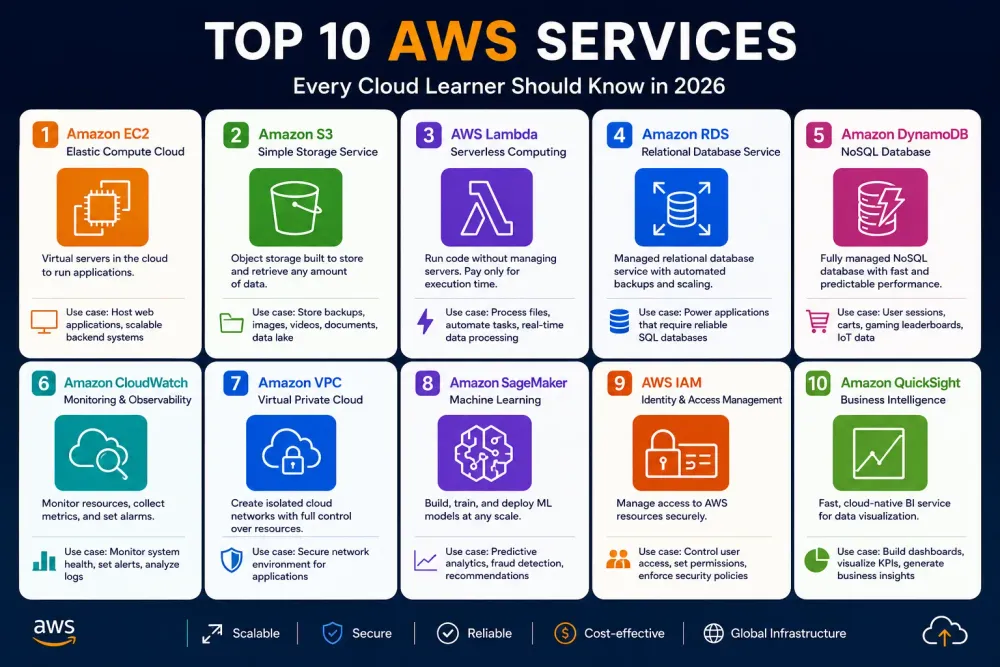
Top AWS Services Every Cloud Learner Should Know in 2026
Amazon Web Services (AWS) is the world's leading cloud computing platform, offering more than 200 services that help businesses build, deploy, and scale applications. Whether you are a student, developer, data analyst, or cloud engineer, understanding core AWS services is essential for building modern cloud solutions.

Top AWS Services Every Cloud Learner Should Know in 2026
Introduction
Amazon Web Services (AWS) is the world's leading cloud computing platform, offering more than 200 services that help businesses build, deploy, and scale applications. Whether you are a student, developer, data analyst, or cloud engineer, understanding core AWS services is essential for building modern cloud solutions.
This article introduces some of the most widely used AWS services and explains their real-world applications.
1. Amazon EC2 (Elastic Compute Cloud)
Amazon EC2 provides virtual servers in the cloud. It allows users to run applications without purchasing physical hardware.
Key Features
- Scalable virtual machines
- Multiple operating system options
- Pay-as-you-go pricing
- High availability and reliability
Real-World Use Case
A startup can host its web application on EC2 and automatically scale resources when website traffic increases.
2. Amazon S3 (Simple Storage Service)
Amazon S3 is an object storage service designed for storing and retrieving data from anywhere.
Key Features
- Highly durable storage
- Versioning support
- Data backup and recovery
- Lifecycle management
Real-World Use Case
Organizations use S3 to store images, videos, documents, backups, and data lake files.
3. AWS Lambda
AWS Lambda enables developers to run code without managing servers.
Key Features
- Serverless computing
- Automatic scaling
- Event-driven architecture
- Pay only for execution time
Real-World Use Case
An image uploaded to S3 can automatically trigger a Lambda function to resize the image.
4. Amazon RDS (Relational Database Service)
Amazon RDS simplifies database management by automating backups, patching, and scaling.
Supported Databases
- MySQL
- PostgreSQL
- MariaDB
- Oracle
- SQL Server
Real-World Use Case
Companies use Amazon RDS to host business applications that require reliable relational databases.
5. Amazon DynamoDB
DynamoDB is a fully managed NoSQL database service.
Key Features
- Millisecond response times
- Automatic scaling
- Serverless architecture
- High availability
Real-World Use Case
E-commerce platforms use DynamoDB to manage user sessions and shopping cart data.
6. Amazon CloudWatch
CloudWatch helps monitor AWS resources and applications.
Key Features
- Real-time monitoring
- Metrics collection
- Log management
- Alert notifications
Real-World Use Case
CloudWatch can notify administrators when CPU usage exceeds a defined threshold.
7. Amazon VPC (Virtual Private Cloud)
Amazon VPC allows users to create isolated networks within AWS.
Key Features
- Custom networking
- Security groups
- Subnets
- Route tables
Real-World Use Case
Organizations create secure cloud environments for hosting sensitive applications.
8. Amazon SageMaker
Amazon SageMaker simplifies the machine learning lifecycle.
Key Features
- Data preparation
- Model training
- Model deployment
- MLOps capabilities
Real-World Use Case
Data scientists use SageMaker to build and deploy predictive analytics models.
9. AWS IAM (Identity and Access Management)
IAM controls access to AWS resources.
Key Features
- User management
- Role-based access control
- Multi-factor authentication
- Security policies
Real-World Use Case
Companies use IAM to ensure employees access only the resources necessary for their jobs.
10. Amazon QuickSight
QuickSight is AWS's business intelligence and data visualization platform.
Key Features
- Interactive dashboards
- Machine learning insights
- Cloud-native architecture
- Pay-per-session pricing
Real-World Use Case
Organizations create executive dashboards for monitoring KPIs and business performance.
Conclusion
AWS provides a comprehensive ecosystem of cloud services that support application development, storage, analytics, machine learning, and security. Mastering services such as EC2, S3, Lambda, RDS, DynamoDB, IAM, SageMaker, and QuickSight can significantly enhance your cloud computing skills and prepare you for modern technology careers.
As cloud adoption continues to grow, learning AWS services is an excellent investment for students and professionals seeking opportunities in cloud engineering, DevOps, data analytics, and machine learning.
Enjoyed reading this content? Let the author know!
Your likes, comments, shares, and saves help creators reach more builders.

Loading recommendations
Loading article