
Unlearning Aloud: The Story
The price of abundance — when AI makes generating easy but the work of thinking still matters. Part 5 of 6 in the Unlearning Aloud series.


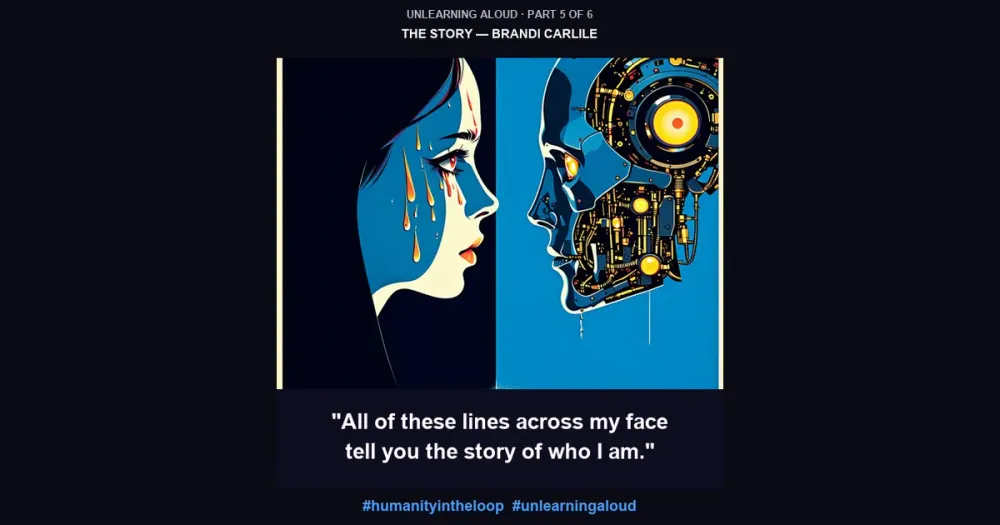
"All of these lines across my face tell you the story of who I am."
— Brandi Carlile, The Story
— Brandi Carlile, The Story
You know the feeling.
A colleague sends you something. "Thoughts?" Maybe a document. Maybe a post. Maybe a recommendation they want you to validate before it goes up the chain.
You start reading. The prose is smooth. The structure is clean. But something is off. There's nothing in here that could only have come from this person. No specific observation. No moment where they were wrong about something. No scar tissue.
They didn't write this. They generated it. And now they're asking you to do the work they skipped.
That feeling, the low-grade irritation, the sense that your time is worth less than their convenience, is telling you something important.
Everything you put out carries your name. AI doesn't have a name. It doesn't have lines on its face. It doesn't lie awake at 3am knowing that something it said cost someone something.
You do. That's not a weakness. That's the whole point.
"I have lived a life and I have paid the price."
AI wrote it. The person forwarded it. Maybe with a line at the top: "Interesting piece. Sharing for the team."
That's not contribution. That's forwarding noise and calling it signal.
We've built tools that make it frictionless to produce. Frictionless production is exactly the wrong thing to optimize for when the world is already drowning in content. Every unreviewed post adds to the noise that makes signal harder to find. It's not neutral. It makes the problem worse.
And if you're the one producing it, you're asking other people to spend their attention on something you weren't willing to spend yours on first.
"These are my scars."
We feel the weight of consequences. AI optimizes. It doesn't dread. It doesn't lie awake at 3am. The moment you stop feeling that weight. The moment you let the system run without your judgment behind it. You've stopped making human decisions. You've become a router.
We care about the particular. And yes, AI can write something specific. It can simulate the texture of the particular. But particularity without humanity is just precision. The detail that makes someone stop and think "how did they know that". That only comes from having been in it. From consequence. From skin in the game. The particular only has value when it's imbued with humanity. #humanityintheloop
We change our minds for reasons we can't explain. Intuition is just experience that hasn't found its words yet. The best thing you will ever write will start with something you feel before you can justify it. If you're not in the loop, that signal never enters the work.
We decide what matters. AI can tell you what's interesting. It has no idea what matters to you, to your team, to the people you're trying to reach. That judgment is yours. If you skip it, nobody else can supply it.
None of these are permanent. AI will replicate them. Imperfectly at first, then well enough to fool people who stopped paying attention. It already is, at the edges.
But here's what I believe: humanity isn't a fixed target. It's a moving one. Every time AI catches up to what we thought was distinctly human, we discover something deeper. Something that only emerges from consequence, from relationship, from the specific condition of being a finite creature who doesn't know what comes next.
AI will always be chasing a version of humanity that no longer exists as the frontier.
That's not a defense. That's an invitation.
"I was made to believe I'd never love nobody but you."
I want to be transparent about something.
This series is co-created. I work with an AI companion on every post. The speed, the structure, the edit, the draft that I pull apart and rebuild.
What's also real: the ideas came from a conversation with an ex-intern, a frustrating meeting about a tool that wouldn't work, a design sprint that felt like it was built for the wrong decade. The voice is mine. The scars are mine. The judgment about what to keep and what to cut. Mine.
The AI absorbed my thinking. I didn't disappear into its output.
That's the line. Not did AI help with this. That's the wrong question. The right question is: is the human in here? Can you feel the specific person who wrote it? Do they have lines on their face?
If yes. That's co-creation. That's responsible use.
If the human skipped the loop and just hit publish. That's theatre.
Theatre is the fastest way to make yourself irrelevant. And AI can produce more of it than anyone can consume.
"All I ask is that you don't say goodbye."
The standard isn't perfection. It's presence.
Show up in your work. Let it cost you something. Write the thing that could only be true coming from you.
That's what earns the read. That's what the lines on your face are for.
What's the last thing you put out that had your fingerprints all over it, not just your name on it? #humanityintheloop
The mental model:
Frictionless production is the wrong thing to optimize for. When execution becomes infinite, the scarce resource becomes signal. The specific, earned, consequence-bearing judgment that only comes from a human who was actually in it. Everything else is noise dressed up as contribution.
Frictionless production is the wrong thing to optimize for. When execution becomes infinite, the scarce resource becomes signal. The specific, earned, consequence-bearing judgment that only comes from a human who was actually in it. Everything else is noise dressed up as contribution.
The diagnostic:
What's the last thing you put out that had your fingerprints all over it, not just your name on it? What would it look like to apply that standard consistently?
What's the last thing you put out that had your fingerprints all over it, not just your name on it? What would it look like to apply that standard consistently?
This post was co-generated with Amazon Quick Desktop. If you don't feel enough humanity in the loop — that's on me.
Greg Kriegler leads the AWS–Deloitte global alliance. He is not an AI researcher. He has fun building with AI and helping people succeed. And sometimes he goes fishing.
🎵 Listen to the soundtrack: The Story — Brandi Carlile
Enjoyed reading this content? Let the author know!
Your likes, comments, shares, and saves help creators reach more builders.

Loading recommendations
Loading article