
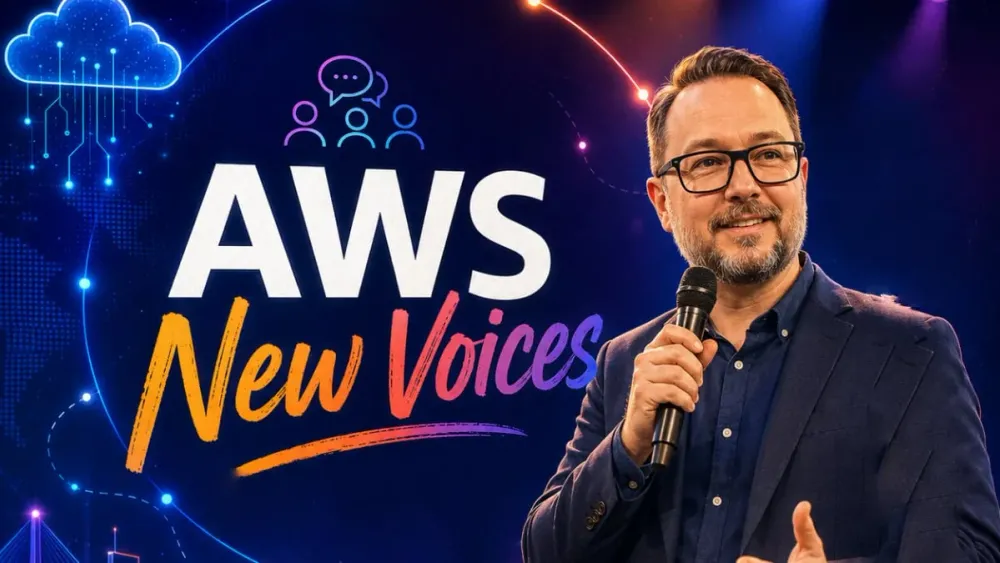
My Experience at AWS New Voices 2026
This year, I participated in AWS New Voices 2026, a program that helped me develop my communication skills, improve how I create presentations, and learn how to deliver a talk more effectively. In this article, I am going to share my 5-week experience.

✨ This year, I participated in AWS New Voices 2026, a program that helped me develop my communication skills, improve how I create presentations, and learn how to deliver a talk more effectively. In this article, I am going to share my 5-week experience.
The sessions took place on Zoom, and on the first day, there were more than 140 participants from different countries, including people from Indonesia, the United States, Italy, Canada, Ghana, and Brazil. For me, that first day was challenging, not only because it was conducted in English, but also because it was an experience full of valuable information. I learned that a good presentation does not depend only on technical knowledge. It needs to have a clear message, use simple words, and create a real connection with the audience.
In this article, I will share what AWS New Voices is, who it is for, and how the first day of my participation in this program went. 👨🏻💻
What Is AWS New Voices?
AWS New Voices is a communication development program for those who want to improve their ability to speak in public, tell stories, and present technical topics more clearly.
The idea was not only to teach someone how to build slides or memorize a presentation. The focus was to help each participant transform technical knowledge into a message that made sense to the audience.
This is very important in technology. You have probably met someone who knows how to explain a service, an architecture, or a solution in detail but may have difficulty turning that knowledge into a simple, engaging, and useful presentation for a customer, right?
That is why this program is important. One of the biggest challenges for people who have technical knowledge is the lack of ability to communicate clearly. And this program was created to help develop that skill.
Who Is AWS New Voices For?
The program was made exclusively for participants of AWS Community Builders, a community formed by professionals who share technical knowledge, create content, participate in events, and contribute to the AWS community.
Since the sessions were conducted in English, it was important for participants to be able to communicate in that language. This did not mean speaking perfect English. It meant being willing to participate, interact, present ideas, and receive feedback.
For me, this was one of the biggest challenges. I can study, read documentation, and consume a lot of technical content in English. But speaking live, with people from other countries, within a presentation dynamic, required another type of preparation.
And that was exactly why the program was so unique and special. It put me in uncomfortable situations and encouraged a constant search for improvement through each exercise and presentation.
How Was the First AWS New Voices Session?
The first session started with general guidance for all participants. The session had a very welcoming atmosphere and, at the same time, was very well organized.
The presenters were Meridith Grundei and Gary Grundei , who conducted the session in a very dynamic way. While Meridith led the explanations and prepared the participants for the activities, Gary acted as a facilitator, using movement, body presence, and background music to create an experience that was very different from a typical technical training.
At the beginning, they presented some instructions called housekeeping guidelines. In summary, participants needed to follow five points:
- Attend 4 out of 5 sessions to receive the program badge.
- Keep their full name updated on the screen for attendance tracking.
- Keep the camera on to make interaction easier.
- Use gallery view so everyone could see each other better.
- Enjoy the experience and have fun during the process.
That last point seemed simple, but it made a difference. The training did not begin with pressure. It began with the idea of creating a safe environment to learn, make mistakes, practice and grow. And that was exactly what we all did. 🤭
Group Dynamics to Break the Ice
After the instructions, we did a few activities to prepare the body and the mind.
First, there was an exercise focused on becoming aware of the environment. The proposal was to feel the floor with our feet and notice our body, our arms, and our hands. Then we did a breathing exercise using the 4, 7, 8 technique:
- Inhaling for 4 seconds.
- Holding the breath for 7 seconds.
- Exhaling for 8 seconds.
We also moved our body, arms, and hands to loosen up in front of the other participants. For someone who is used to technical training, this beginning might seem a little strange. In my case, it felt uncomfortable only at first, because a few seconds later, I was already much more relaxed and ready to continue. 🕺
Only after that did I understand the purpose. Communication begins when we feel present. So, before presenting an idea to an audience, we need to deal with the tension of being in front of other people.
The last activity in that first block was an English tongue twister:
🗽
“You know New York,
you need New York,
you know you need unique New York.”
you need New York,
you know you need unique New York.”
We repeated the phrase a few times and then opened our microphones to say it together. It was fun, but it also showed how diction, rhythm and presence are part of communication and are different for each person.
What Does an Audience Expect From a Speaker?
One of the most important ideas from the first session was about what happens when someone steps onto a stage.
The audience, even without realizing it, tries to quickly answer three questions:
- Who are you?
- Why should I care?
- How are you going to solve my problem?
Knowing that the audience thinks this before we go on stage helps us rethink how we prepare a technical presentation. Many times, we start by talking about a service, architecture, feature, configuration, or code. But the audience first needs to trust the person who is speaking.
To build that trust, they presented the concept of the trust triangle, which is based on three elements: authenticity, logic, and empathy.

The Trust Triangle, by Professor Frances Frei (2020)
- Authenticity means that the audience can experience your real self. In other words, you do not seem to be playing a character.
- Logic means that the audience realizes you know what you are doing. Your reasoning is solid, and your explanation makes sense.
- Empathy means that the audience believes you care about them and about their success.
When these three elements are present, trust increases. And when one of them is missing, the presentation can lose strength, even if the technical content is good.
How Would You Explain the Cloud to Someone From 1625?
After that introduction, it was time for our first practical exercise. And none of us were prepared for what was coming.

How would you explain what the cloud is to someone from 1625?
The question was simple, but difficult because of one detail: how would you explain the cloud to someone from the year 1625? ☁️
We were split into smaller rooms, and I was paired with a person from Ghana. In English, we had to explain to each other the concept of public cloud, as if we were speaking with someone from a time when computers, the internet, and data centers did not exist.
My personal goal was to avoid technical terms. I used the analogy of someone who needed to build something but did not need to do everything alone or in the same place. That person could call other people to help, with each one performing a task somewhere else. Then, the result would be delivered as agreed and on demand.
From that idea, I explained that the cloud is like using distant services to perform tasks, store information, process data, and return results when we need them.
It was the best analogy I could create at that moment. And the exercise taught me something very important: simplifying does not reduce the value of knowledge. Simplifying means making knowledge easier to understand through simple words.
My partner gave a more technical explanation, mentioning services and technologies right at the beginning. It was a good presentation, and I even praised it. But the exercise made me think about whether someone from 1625 would really be able to understand that explanation.
At that moment, it became clear that the goal was different. The goal was not just to explain what the cloud was, but to deconstruct something complicated and make it simple.
How Long Is This Program?
The program has a 5-week duration, with sessions focused on how to develop a good presentation, covering the following topics:
- Knowing your audience.
- Creating a strong introduction.
- Developing the body of the presentation.
- Building a call to action.
- Using visual resources clearly.
I really liked this structure because it showed that a talk does not begin with the slide. It begins with understanding who is listening.
Before choosing what to say, I needed to understand who I was speaking to, what problem that person had and what transformation I wanted to deliver through my message.
My First Lightning Talk
The second exercise was a Lightning Talk. We had five minutes to think about any topic and then present it in up to three minutes. ⚡️
I chose to develop the topic “What AWS Taught Me About Responsibility.”
I began my presentation by talking about my first experience creating services on AWS and how, only later, I understood that the freedom to build something quickly, without responsibility for security, creates risks, costs, and failures. I concluded by saying that today I do not think only about technology, but also about the responsibility of understanding that each permission has a direct impact on security, cost, availability, and even people.
Once again, we were divided into smaller Zoom rooms. This time, I was with a Brazilian participant and a participant from Indonesia.
Even with a Brazilian in the room and the desire to speak Portuguese, we continued the conversation in English, respecting the other participant and the context of the training.
I gave my presentation in about two minutes, and my colleagues also gave excellent presentations and were able to deliver their ideas within the time limit.
This exercise was important because it forced each one of us to organize an idea with a beginning, middle and end.
I learned that in a short presentation, there is no room for rambling. To make it work, I needed to choose one central message and guide the audience toward it.
At the end of this second exercise, we returned to the main room, and I had the opportunity to share my experience with everyone in the program.
I commented that the exercise had been challenging, mainly because of the English language. I also said that, in the future, since I live in Brazil, I will give talks in Portuguese, and that will make it easier to connect the ideas.
Julia Molitzas also shared her experience, and she showed incredible communication confidence in English while explaining how challenging it had been to develop and deliver a Lightning Talk in another language.
Then, more participants raised their hands to share their struggles and victories. As I listened carefully to each one, I felt more comfortable because I understood that I was not alone in that challenge.
What Did I Learn in the First Week of the Program?
The main lesson I took from that first day was that a speaker needs to know the subject well, but what will really leave a mark on the audience is how the message is delivered.
Technical knowledge is important. Without it, the presentation becomes empty. But technical knowledge alone is not enough. It is necessary to organize ideas, simplify concepts, create connection and deliver a message that helps the audience understand something clearly and take action at the end.
At the end, we were all invited to share the experience of that first day in one word, and some words written in the Zoom chat ranged from "challenging" and "transformative" to "AWSome," a combination of AWS and awesome.
For me, the best word to describe that day was insightful, because all the exercises and every shared experience helped me reflect on my own journey. I also realized that, to continue my professional development, I need to listen to different perspectives and improve my communication so I can reach my goal of becoming a speaker who is clear with words, recognized and inspiring. 🧡
Enjoyed reading this content? Let the author know!
Your likes, comments, shares, and saves help creators reach more builders.

Loading recommendations
Loading article