
AgentOps: From Zero to Hero — Operationalizing Agentic AI at Scale with Amazon Bedrock AgentCore 🚀
This blog takes you on a structured journey — from understanding what AgentOps is, to deploying and operating production-grade AI agents at enterprise scale on AWS.

Let's get started with first to understand & touch upon the key agenda's regarding the same .
Table of Contents :-
- What is AgentOps?
- Components of AgentOps
- Why AgentOps? The Operational Imperative
- AgentOps Architecture — A Straightforward View
- Real-World Use Cases
- Where Does AIOps Fit? AgentOps vs. AIOps vs. MLOps vs. GenAIOps
- Conclusion & Key Takeaways
- What is AgentOps?
Traditional software follows deterministic paths. You write code, it executes, and you get a predictable result. Agentic AI breaks this contract entirely.
An AI agent doesn't just execute instructions — it reasons, plans, selects tools, delegates to sub-agents, and makes autonomous decisions in pursuit of a goal. When you scale this to hundreds of agents running in production, the operational complexity explodes:
✅ An agent makes an unexpected tool call that cascades into a $10,000 cloud bill overnight
✅ A multi-agent chain hallucinates a response that bypasses a compliance guardrail
✅ A memory misconfiguration silently leaks one user's context into another user's session
✅ A non-deterministic failure happens once in every 500 runs — impossible to reproduce, harder to debug
AgentOps is the operational discipline purpose-built to solve these problems. It is the practice of deploying, managing, governing, evaluating, and continuously improving AI agents in production — adapting DevOps and MLOps principles to the unique characteristics of agentic systems.
Think of it this way: -
| Evolution | Focus |
|---|---|
| DevOps | Ship code reliably |
| MLOps | Ship ML models reliably |
| GenAIOps | Ship generative AI workloads reliably |
| AgentOps | Ship autonomous AI agents reliably |
AgentOps is not a single tool. It is a discipline — a set of pillars, practices, processes, and AWS services that work together to bring production-readiness to agentic AI.
AgentOps is organized around four foundational pillars. Every production deployment must address all four.
🛡️ Governance & Security
Agents act autonomously on behalf of users. This means every agent decision is a potential security boundary. Governance answers the question: "Who can do what, on which data, with which tools, and who approved it?"
✅ Key Components:
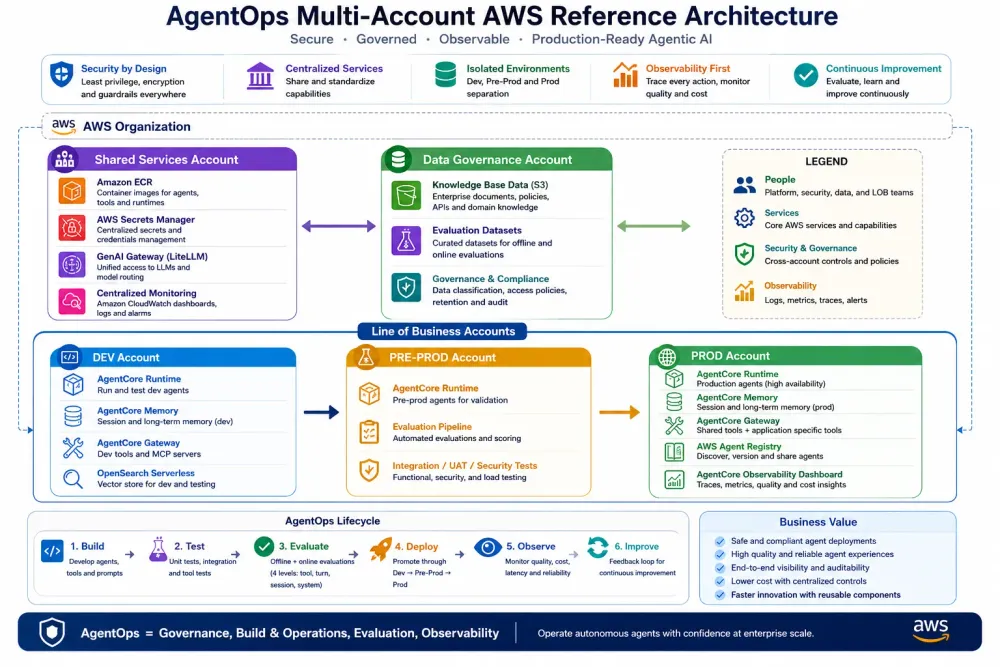
- Multi-Account AWS Strategy — Separate AWS accounts for Dev, Pre-Prod, and Production per line of business, with a shared services account for container images, secrets, and centralized monitoring. Service Control Policies (SCPs) enforce guardrails at the organizational level.
- AgentCore Identity — Manages authentication and authorization across agents. When Agent A calls Agent B, it verifies the calling agent's identity and ensures the downstream agent inherits the user's permission boundaries — not elevated privileges.
- AgentCore Gateway — A single secure endpoint that transforms APIs, Lambda functions, and services into MCP-compatible tools. Agents never handle credentials directly — Gateway manages OAuth, token refresh, and credential storage.
- AgentCore Policy (Cedar) — Deterministic policy engine that intercepts every tool request and evaluates it against business rules before execution. Example: "Can this agent open a claim exceeding $1,000,000?" — evaluated at runtime, not just at deploy time.
- Amazon Bedrock Guardrails — Content safety controls that evaluate both user prompts and model responses to prevent PII disclosure, prompt injection, and off-topic behavior.
- AWS CloudTrail — Full audit trail of every agent action for forensic analysis and compliance reporting.
AgentCore Memory — Scoped, namespaced memory with IAM controls separating short-term (session) context from long-term (cross-session) patterns. Namespaces prevent cross-user context leakage.
🚀 Build & Operations
Agentic systems are not monoliths. They are ecosystems of agents, tools, memory configurations, guardrail policies, and infrastructure — all changing independently. Without discipline, a tool update by Team A breaks Agent B owned by Team C.
✅ Key Components:
- Repository Separation — Four separate repos: Infrastructure (IaC, agent registry, seed code), Agent (agentic solution + shared modules), Tool (tool code with its own CI/CD), Application (the business app consuming the agent).
- AgentCore Runtime — Containerized agent execution environment. Agents are packaged as Docker images, pushed to Amazon ECR, and deployed to AgentCore Runtime. Maintains immutable versioned snapshots automatically.
- Version Aliases — DEV, PREPROD, PROD aliases point to specific immutable Runtime versions. Instant rollback requires only a pointer swap, not a redeployment.
- AWS Agent Registry — Central catalog for discovering, sharing, and reusing agents, tools, MCP servers, and skills across the organization. Supports an approval workflow (Draft → Pending → Approved) before agents are discoverable org-wide.
- CI/CD Pipeline — Every merge to main triggers: container build → ECR push → IaC deploy → AgentCore Runtime deploy → evaluation pipeline → pre-prod gate → production promotion. No manual steps.
- Amazon S3 Vectors / OpenSearch Serverless / Aurora pgvector — Vector stores for RAG knowledge bases, versioned and promoted through CI/CD like any other artifact.
- IaC (Infrastructure as Code) — All environments (dev, pre-prod, prod) are identical, deployed from the same templates. No manual drift.
📊 Evaluation :-
Agents can be right for the wrong reasons, or right individually while failing at the goal. You need structured evaluation at four nested levels.
✅ Key Components:
| Level | What it Evaluates | Example Metrics |
|---|---|---|
| Tool Level | Does the tool work? Does the agent pick the right tool? | Tool selection accuracy, parameter extraction accuracy, RAG retrieval quality |
| Conversation Turn Level | Is each individual response correct? | Correctness, faithfulness, helpfulness, harmfulness, coherence |
| Session Outcome Level | Did the agent achieve the user's goal? | Task completion rate, goal accuracy, memory consistency |
| System Level | Is the system production-ready? | End-to-end latency, TTFT, cost per task, loop detection, throughput |
Two Evaluation Modes:
- On-Demand Evaluation — Runs against specific spans or sessions during development and as a CI/CD quality gate before every release. Must pass before pre-prod promotion.
- Online Evaluation — Continuously monitors live production traffic with configurable sampling. Feeds CloudWatch dashboards and triggers automated rollback on quality drops.
In AWS context :-
AWS Services in Evaluation:
- Amazon Bedrock Evaluations — LLM-as-a-Judge and human worker evaluation for model and knowledge base quality
- AgentCore Evaluations — Online and on-demand agent evaluation
- Amazon Augmented AI (A2I) — Human-in-the-loop review queues
- Strands Evaluation SDK — Tool-level and framework-level evaluation
- Amazon CloudWatch — Metrics, dashboards, and alarms for production quality monitoring
🔍Observability & Monitoring
Observability is where the AgentOps loop closes. Without it, you are flying blind — unable to detect quality degradation, cost spirals, or security anomalies in production.
Four Telemetry Layers:
- Agent & Framework Telemetry — What the agent decided, which tools it called, what reasoning steps it took (from Strands SDK or your framework)
- Service Telemetry — What happened inside AgentCore services (Memory reads/writes, Gateway auth operations, Identity evaluations) — invisible to framework instrumentation
- Infrastructure Telemetry — Runtime container metrics, Lambda execution data, network performance
- Application Telemetry — Business-level metrics distributed across multiple agents and applications
✅Key Components:
- OpenTelemetry (OTEL) SDK — Framework-native instrumentation producing traces, metrics, and logs in the W3C Trace Context standard
- AWS Distro for OpenTelemetry (ADOT) Collector — Sampling, filtering, batching, and routing of telemetry in production
- AgentCore Observability Dashboard — Pre-built CloudWatch dashboard showing agent traces, cost, latency, tokens, and custom metadata with PII redaction and IAM access controls
- CloudWatch Transaction Search — Converts spans to semantic convention format, makes every span searchable
- CloudWatch Application Signals — Correlates GenAI application telemetry with infrastructure metrics for end-to-end troubleshooting
- Third-Party Integration (LangFuse, Arize) — Via OTLP over HTTPS for teams preferring specialized agent-centric observability tooling
What to Instrument:
| Signal | Why It Matters |
|---|---|
| Execution traces | Audit every decision and tool call |
| Token usage (input/output) | Cost attribution per agent, per task |
| Time-to-First-Token (TTFT) | User experience signal |
| Memory operations | Catch misconfiguration before it leaks context |
| Hallucination rate | Responsible AI monitoring |
| Cost per completed task | Economic sustainability at scale |
| Human satisfaction score | The one metric that tells you if it all mattered |
3. Why AgentOps? The Operational Imperative
You might ask: "My agent works fine in development. Why do I need all of this?"🤔
Here is what happens without AgentOps in production:
The Five Failure Modes of Unmanaged Agents
- 1. Cost Explosion An agent enters an unexpected reasoning loop, calling an expensive LLM 500 times in a single session. Without token budget enforcement and cost-per-task monitoring, you discover this on your AWS bill — not in your dashboard.
- 2. Silent Quality Degradation A knowledge base document is updated, changing the ground truth. The RAG retrieval now returns outdated context. The agent continues to answer — confidently and incorrectly. Without online evaluation sampling, this goes undetected for weeks.
- 3. Privilege Escalation in Multi-Agent Chains User A has read-only access. User A's request triggers Agent 1, which calls Agent 2, which calls Agent 3. Without AgentCore Identity propagating the original user's permission context, Agent 3 may operate with elevated privileges — a security boundary violation.
- 4. Context Cross-Contamination A memory namespace misconfiguration causes Agent B to retrieve session context from User A's prior conversation. Without memory governance and telemetry, this is invisible — until a user reports seeing someone else's data.
- 5. Non-Reproducible Failures An agent fails once in every 200 runs. Without execution tracing, you have no record of what tools were called, in what order, with what parameters, when it failed. Debugging becomes guesswork.
✅AgentOps systematically addresses all five.
✅Next End-to-End Request Flow :-
Step 1 — User authentication The app confirms who the user is and whether they're allowed to invoke this agent.
Step 2 — Input guardrails Bedrock Guardrails checks the request for PII, prompt injection, and out-of-scope content before it ever reaches the agent.
Step 3 — Agent reasoning The agent thinks through the request, pulls relevant context from AgentCore Memory, and maps out which tools to call.
Step 4 — Tool authorization AgentCore Policy (Cedar) evaluates whether this agent — acting on behalf of this user — is actually allowed to invoke the requested tool.
Step 5 — Tool execution AgentCore Gateway routes the call to the right backend (Lambda, REST API, or MCP server), handling credentials behind the scenes.
Step 6 — Response assembly The agent synthesizes tool results with memory context and drafts a response.
Step 7 — Output guardrails Bedrock Guardrails does a final check on the response before it reaches the user.
Step 8 — Telemetry emission The OTEL SDK captures traces, metrics, and logs, which flow via ADOT Collector into CloudWatch and any third-party observability tools.
Step 9 — Evaluation sampling A configurable percentage of live sessions is sampled for quality scoring and drift detection in production.

✅The AgentOps Lifecycle Mapped to DevOps Stages :-
| DevOps Stage | AgentOps-Specific Considerations |
|---|---|
| Plan | Assess AI fit, define agent trust model, establish tool permissions, identify human oversight points, get legal/compliance approval |
| Develop | Model selection, prompt engineering, RAG/chunking strategies, tool registry, MCP server setup, A2A patterns, agent evaluations |
| Build | Unit + integration + security + agent tests, RBAC validation, container image build, ECR push |
| Test & Release | Execution path eval, loop limit testing, HITL tests, unauthorized action testing, pre-prod evaluation gate |
| Deploy | AgentCore Runtime deploy, MCP server deploy, canary/blue-green strategy, rollback configuration |
| Maintain & Monitor | Online evaluation, cost tracking, drift alerts, guardrail monitoring, action audit trails, human feedback loop |
5. Real-World Use Cases
AgentOps is not theoretical. Here are real enterprise deployments that demonstrate each pillar in action.
✅Use Case 1 — Swisscom: Enterprise Customer Support & Sales (Governance at Scale)
Challenge: Swisscom needed AI agents handling customer support and sales interactions — requiring strict identity management, tool authorization, and auditability across hundreds of concurrent agent sessions.
AgentOps Application:
- AgentCore Identity ensures every agent action is tied to a verified customer identity, with permission boundaries inherited from the authenticated user
- AgentCore Policy (Cedar) enforces business rules deterministically — an agent cannot offer a discount beyond authorized thresholds, regardless of what the LLM reasons
- CloudTrail + AgentCore Observability provides a complete audit trail for every interaction, satisfying Swiss financial compliance requirements
Result: Production-grade agentic AI for customer-facing interactions with verifiable compliance and rollback capability.
✅Use Case 2 — Allianz: AIOps at Enterprise Scale (Build & Ops)
Challenge: Allianz needed to operationalize dozens of agent use cases across multiple lines of business, with independent teams, independent deployment cycles, and centralized governance.
AgentOps Application:
- Multi-account strategy with separate accounts per LoB, centralized shared services
- AWS Agent Registry for cross-team agent discovery and reuse — Team A's claims verification agent becomes a reusable component for Team B's fraud detection workflow
- Independent CI/CD pipelines per agent and tool repository, with centralized evaluation gates before any agent reaches production
Result: A scalable, governed agentic AI platform — not a collection of one-off chatbots.
6. Where Does AIOps Fit? AgentOps vs. AIOps vs. MLOps vs. GenAIOps ? 🧐
This is a common source of confusion. These are related but distinct disciplines — each solving a different problem at a different layer of the stack.

7. Conclusion & Key Takeaways
Agentic AI is not the future — it is being deployed in production today at Swisscom, Allianz, and enterprises across every industry. But deploying an agent is not the hard part. Keeping it reliable, secure, cost-efficient, and continuously improving across thousands of daily interactions — that is the hard part. That is what AgentOps solves.
1. AgentOps is not optional at scale. A single agent in a demo is forgiving. A hundred agents in production serving paying customers is not. Every production agent deployment needs governance, versioning, evaluation, and observability before it serves its first live request.
2. Treat agents like microservices — with extra security. Every agent is a versioned, deployable artifact with its own CI/CD pipeline, its own evaluation gate, and its own observability instrumentation. The same discipline you bring to microservice operations applies here — and then some.
3. Security in agentic systems is identity propagation, not just access control. Traditional IAM is necessary but not sufficient. When User A triggers a chain of 5 agents, you need AgentCore Identity to ensure the original user's permission boundaries propagate through every hop — preventing privilege escalation in multi-agent chains.
4. Evaluation must be multi-level and continuous. A tool can work perfectly while the agent picks the wrong tool. A conversation turn can be factually correct while the session fails to achieve the user's goal. Instrument all four levels — tool, turn, session, system — and monitor all of them in production continuously.
5. AIOps and AgentOps are complementary, not competing. AIOps monitors your infrastructure. AgentOps operates your agents. In a mature platform, CloudWatch anomaly detection (AIOps-style) feeds alerts into your AgentOps runbooks — they are two disciplines solving problems at different layers of the same stack.
6. Start with Pillar 1 — everything else builds on it. Multi-account isolation, SCPs, and IAM boundaries cost nothing in terms of implementation complexity and prevent the most expensive mistakes. Before you write a single line of agent code, set up your multi-account structure.
7. The AgentOps loop never stops. Production telemetry feeds evaluation feeds design decisions feeds better agents. This loop — observe → evaluate → improve → redeploy — is the engine of continuous improvement in agentic AI. Set it up from Day 1.
✅ Quick Reference: AgentOps AWS Services Map where under same pillar there are multiple AWS services can be leveraged . Let's take a snap as follows :-
| Pillar | AWS Service / Component | What It Does |
|---|---|---|
| Governance | AgentCore Identity | Cross-agent auth and permission propagation |
| Governance | AgentCore Policy (Cedar) | Deterministic tool authorization at runtime |
| Governance | AgentCore Gateway | Secure tool endpoint with credential management |
| Governance | Bedrock Guardrails | Input/output safety filters |
| Governance | AWS CloudTrail | Full audit logging |
| Build & Ops | AgentCore Runtime | Containerized, versioned agent execution |
| Build & Ops | AWS Agent Registry | Org-wide agent and tool discovery |
| Build & Ops | Amazon ECR | Container image storage |
| Build & Ops | AWS CodePipeline | CI/CD orchestration |
| Build & Ops | AgentCore Memory | Session + long-term agent memory |
| Evaluation | AgentCore Evaluations | Online + on-demand agent evaluation |
| Evaluation | Bedrock Evaluations | LLM-as-a-Judge and human evaluation |
| Evaluation | Amazon A2I | Human-in-the-loop review |
| Evaluation | Strands Evaluation SDK | Tool and framework-level evaluation |
| Observability | OTEL SDK + ADOT | Instrumentation and telemetry collection |
| Observability | AgentCore Observability | Pre-built agent dashboards in CloudWatch |
| Observability | CloudWatch Transaction Search | Span-level searchable trace storage |
| Observability | CloudWatch Application Signals | GenAI + infra telemetry correlation |
Enjoyed reading this content? Let the author know!
Your likes, comments, shares, and saves help creators reach more builders.

Loading recommendations
Loading article