
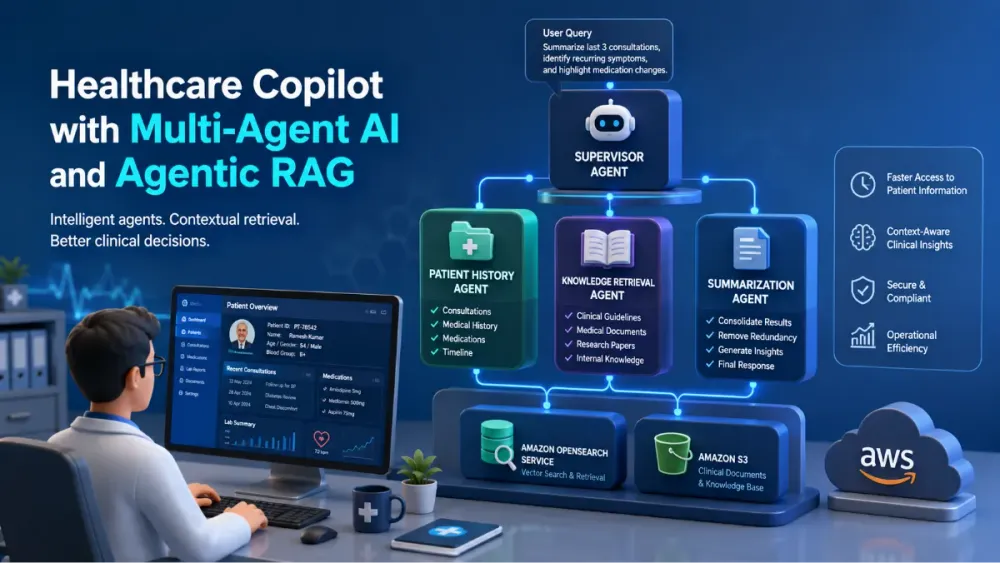
Healthcare Copilot with Multi-Agent AI and Agentic RAG
xplore how specialized AI agents retrieve, analyze, and summarize clinical information to deliver intelligent healthcare assistance.

Introduction
Healthcare organizations generate vast amounts of patient and clinical data every day, including consultation records, prescriptions, laboratory reports, discharge summaries, and medical knowledge documents. Accessing the right information at the right time is critical for clinicians, yet searching through fragmented systems and lengthy records can be time-consuming.
Retrieval-Augmented Generation (RAG) has emerged as a powerful approach for improving information retrieval in AI-powered applications. By combining large language models with external knowledge sources, RAG enables more accurate and context-aware responses. However, many healthcare workflows involve multiple reasoning steps, planning, and coordination across different information sources. Traditional RAG systems often struggle with these complex scenarios.
This is where Agentic RAG can play a significant role. By introducing specialized AI agents capable of planning, retrieving, reasoning, and summarizing information, healthcare organizations can move beyond simple question answering and toward intelligent clinical copilots.
Why Traditional RAG Is Not Always Enough
Traditional RAG systems typically follow a straightforward workflow:
- Receive a user query.
- Retrieve relevant documents.
- Provide retrieved context to a language model.
- Generate a response.
While effective for many use cases, this approach has limitations when handling complex healthcare requests.
Consider the following query:
"Summarize the patient's last three consultations, identify recurring symptoms, and highlight any medication changes."
This request requires multiple tasks:
- Retrieving consultation history.
- Identifying symptom patterns across visits.
- Comparing medication records.
- Generating a concise summary.
A traditional RAG pipeline may retrieve relevant documents but lacks the orchestration required to break down and coordinate these subtasks efficiently.
Key limitations include:
- Single retrieval workflow.
- Limited task planning capabilities.
- Lack of specialized reasoning components.
- Difficulty handling compound healthcare queries.
- Reduced flexibility for complex clinical workflows.
These challenges motivate the need for a more intelligent and coordinated architecture.
Introducing the Clinical Copilot Concept
A Clinical Copilot is an AI-powered assistant designed to support healthcare professionals by providing quick access to relevant patient information and clinical knowledge.
Rather than replacing medical expertise, the copilot acts as an intelligent assistant that helps clinicians make informed decisions faster.
Key capabilities include:
- Retrieving patient history.
- Summarizing consultations.
- Surfacing relevant medical knowledge.
- Generating contextual insights.
- Reducing manual search effort.
- Improving operational efficiency.
To achieve these capabilities effectively, multiple specialized agents can collaborate within an Agentic RAG architecture.
Multi-Agent Architecture
Instead of relying on a single retrieval component, an Agentic RAG system distributes responsibilities among specialized agents.
Supervisor Agent
The Supervisor Agent acts as the central coordinator.
Responsibilities include:
- Understanding user intent.
- Breaking down complex requests.
- Planning task execution.
- Routing tasks to specialized agents.
- Aggregating results.
For example, when a clinician requests a patient summary, the supervisor determines which agents should participate in generating the final response.
Patient History Agent
The Patient History Agent focuses on patient-specific information.
Responsibilities include:
- Retrieving consultation history.
- Accessing treatment records.
- Reviewing medication history.
- Building patient timelines.
This agent ensures that relevant patient information is collected before further analysis.
Knowledge Retrieval Agent
Healthcare professionals often require access to medical knowledge beyond patient records.
Responsibilities include:
- Retrieving clinical guidelines.
- Accessing internal knowledge repositories.
- Searching medical documentation.
- Providing supporting references.
This agent enhances responses with contextual medical information.
Summarization Agent
After information has been gathered, the Summarization Agent produces a coherent response.
Responsibilities include:
- Combining outputs from multiple agents.
- Removing redundant information.
- Generating concise summaries.
- Presenting clinically relevant insights.
The result is a structured response tailored to the clinician's request.
Example Workflow
Consider the following scenario:
A doctor asks:
"Provide a summary of the patient's recent consultations and identify recurring symptoms."
The workflow may proceed as follows:
- The Supervisor Agent receives the request.
- The Patient History Agent retrieves consultation records.
- The Knowledge Retrieval Agent gathers relevant clinical references if needed.
- The Supervisor Agent combines collected information.
- The Summarization Agent generates a final clinical summary.
- The response is returned to the doctor.
This approach allows complex requests to be handled through coordinated agent collaboration rather than a single retrieval step.
Where Agentic RAG Adds Value
Patient History Summarization
Clinicians spend significant time reviewing historical records. Agentic RAG can automatically summarize patient histories and highlight key findings.
Clinical Decision Support
Relevant information can be surfaced quickly, helping healthcare professionals access contextual insights during consultations.
Operational Efficiency
Healthcare staff can retrieve information faster, reducing administrative burden and improving productivity.
Knowledge Discovery
Medical documents, internal guidelines, and institutional knowledge become easier to search and utilize.
Improved Context Awareness
By coordinating multiple agents, the system can deliver responses that are more comprehensive and contextually relevant.
Key Architectural Considerations
Retrieval Quality
The effectiveness of any RAG system depends heavily on retrieval quality. Accurate retrieval remains the foundation of reliable AI-generated responses.
Agent Coordination
Multiple agents introduce orchestration complexity. Efficient task routing and communication are essential to avoid unnecessary processing.
Semantic Caching
Many healthcare queries are similar in nature. Semantic caching can reduce latency and operational costs by reusing previously generated responses when appropriate.
Scalability
Healthcare systems often serve large numbers of users. The architecture should support scalable retrieval, processing, and agent execution.
Security and Compliance
Healthcare data is highly sensitive. Systems must incorporate robust access controls, encryption, auditing, and compliance measures to protect patient information.
🛠️ Production Architecture on AWS
To bring this multi-agent framework to life natively on AWS, we can map the architectural layout using Amazon Bedrock Agents and decoupled containerized microservices:
1
2
3
4
5
6
7
8
9
10
11
12
13
14
15
16
17
18
19
20
21
22
                  ┌──────────────────────────────┐
                  │   Application Load Balancer  │
                  └──────────────┬───────────────┘
                                 │
                  ┌──────────────▼───────────────┐
                  │   Spring Boot Microservices  │
                  │         (Amazon ECS)         │
                  └──────────────┬───────────────┘
                                 │ (Session State)
                  ┌──────────────▼───────────────┐
                  │       Supervisor Agent       │
                  │   (Amazon Bedrock Agents)   │
                  └───────┬──────────────┬───────┘
                          │              │
        ┌─────────────────┴─┐          ┌─┴─────────────────┐
        │Patient History Agt│          │Knowledge Retr Agt │
        └─────────┬─────────┘          └─────────┬─────────┘
                  │                              │
┌─────────────────▼─────────────────┐  ┌─────────▼─────────┐
│     Amazon OpenSearch Serverless  │  │     Amazon S3     │
│ (Vector Search + Exact BM25 Match)│  │ (Medical Manuals) │
└───────────────────────────────────┘  └───────────────────┘
- Orchestration & Routing (Supervisor Agent): Handled via Amazon Bedrock Agents. The Supervisor utilizes the model's native orchestration loop to parse the clinical prompt, determine task dependencies, and invoke the sub-agents dynamically using session-based state management.
- Deterministic Medical Retrieval (Patient History Agent): Powered by Amazon OpenSearch Serverless. To ensure critical medical terms (like ICD-10 diagnostic codes, patient IDs, or exact pharmaceutical dosages) are never generalized by semantic-only matching, we implement Hybrid Search—combining dense vector embeddings with exact keyword matching (BM25).
- Enterprise Scaling & Middleware: Hosted on Amazon ECS (Elastic Container Service) running Spring Boot microservices behind an Application Load Balancer (ALB). The backend handles initial client requests, session caching, and streams the agent responses to the user interface.
- Security & Guardrails: To ensure strict healthcare compliance, a Guardrails for Amazon Bedrock layer is applied to automatically intercept data, masking Patient Health Information (PHI) and personal identifiers (PII) before any text enters the LLM processing cycle.
⚡ Engineering Mitigations for Production Realism
Moving an agentic system from a concept to a live hospital dashboard requires tackling production constraints head-on:
- Eliminating Scrambled Reasoning (Loop Detection): Multi-agent loops can stall or chain-call infinitely if an agent gets confused. We implement a strict recursion counter in the Bedrock session context. If an execution chain passes 5 agent-to-agent steps without generating a terminal payload, the system cuts the execution and surfaces a graceful fallback query.
- Optimizing Latency & Token Costs: Running 4 specialized agents sequentially causes massive latency and token consumption. By deploying Semantic Caching via an in-memory database, repetitive administrative clinical queries are intercepted at the ECS layer, serving cached responses instantly and avoiding expensive downstream LLM processing.
- Strict Context Control: Large consultation histories can choke standard context windows. The Patient History Agent uses an incremental map-reduce strategy—compressing past records into structured semantic summaries before passing the consolidated payload to the final Summarization Agent.
Future Directions
As Agentic AI continues to evolve, healthcare copilots may incorporate additional capabilities such as:
- Agent-to-agent communication.
- Dynamic workflow planning.
- Human-in-the-loop validation.
- Predictive healthcare insights.
- Personalized patient recommendations.
- Advanced clinical reasoning workflows.
These developments have the potential to further enhance healthcare operations and decision-making processes.
Conclusion
Traditional RAG systems have significantly improved information retrieval for AI applications. However, healthcare environments often require more than retrieval alone. Complex workflows demand planning, coordination, and specialized reasoning capabilities.
By combining Multi-Agent AI with Agentic RAG, organizations can build intelligent healthcare copilots capable of retrieving patient information, accessing clinical knowledge, and generating contextual insights through coordinated agent collaboration.
While challenges remain around scalability, cost, latency, and compliance, Agentic RAG represents a promising architectural approach for the next generation of AI-powered healthcare systems.
# generative-ai# rag# aws-community-builders# amazon-bedrock-agents# healthcare-life-sciences-industry
Any opinions in this article are those of the individual author and may not reflect the opinions of AWS.Enjoyed reading this content? Let the author know!
Your likes, comments, shares, and saves help creators reach more builders.

Loading recommendations
Loading article