
AWS Kiro and OutcomeOps: Better Together for Enterprise Spec-Driven Development
Kiro is the spec-driven IDE developers want. OutcomeOps is the organizational intelligence layer they need at enterprise scale. This post walks through how to wire OutcomeOps to Kiro as an MCP server running inside your AWS account, what happens at generation time when ADRs and ISO 27001 controls get cited inline, and why the integration matters for regulated industries.

Kiro is the spec-driven IDE I have been waiting on. Natural language turns into EARS-style requirements, then architecture, then working code — all without leaving VS Code. For a single repo or a greenfield project, it is genuinely magical.
But at enterprise scale, every spec-driven IDE hits the same wall: it knows the repository in front of it, not the organization behind it. Kiro can read your local files and steering documents. It cannot read the ADRs that live in Confluence, the security controls that map to ISO 27001 clauses your auditors actually check, the PCI DSS requirements your payments team enforces, or the architectural standards three platform teams agreed on six quarters ago and nobody reviews anymore.
That gap is what OutcomeOps fills. And as of June 2, 2026, OutcomeOps is generally available on AWS Marketplace — deployed via Terraform into the customer's AWS account, Bedrock inference in the customer's region, MCP server endpoint running in the customer's VPC.
This post walks through what "Kiro + OutcomeOps" actually does at the engineer's keyboard, why it matters for regulated industries, and how to wire it up.
The Local Optimization Pattern
I have watched this pattern play out across five platform shifts in fourteen years — cloud, DevOps, containers, platform engineering, and now AI. The first wave of tools optimizes locally. The second wave is whatever supplies the systemic context that lets local tools scale.
Kiro is the first wave for AI-assisted development. Excellent at:
- Turning vague prompts into structured specs with explicit requirements, design, and tasks
- Adaptive autopilot across files in a single workspace
- Native MCP client support, with Powers for AWS services, observability, and security tools
- Interactive steering and hooks
What Kiro does not have natively — and is not trying to have — is persistent organizational intelligence. The code graphs, ADRs, architecture standards, compliance rules, and cross-repo patterns that live outside any single workspace.
That is by design. Kiro is an IDE. The organizational intelligence layer is a platform problem. The pattern that works is to keep them as two complementary pieces, connected over MCP.
How the Integration Works at the Keyboard
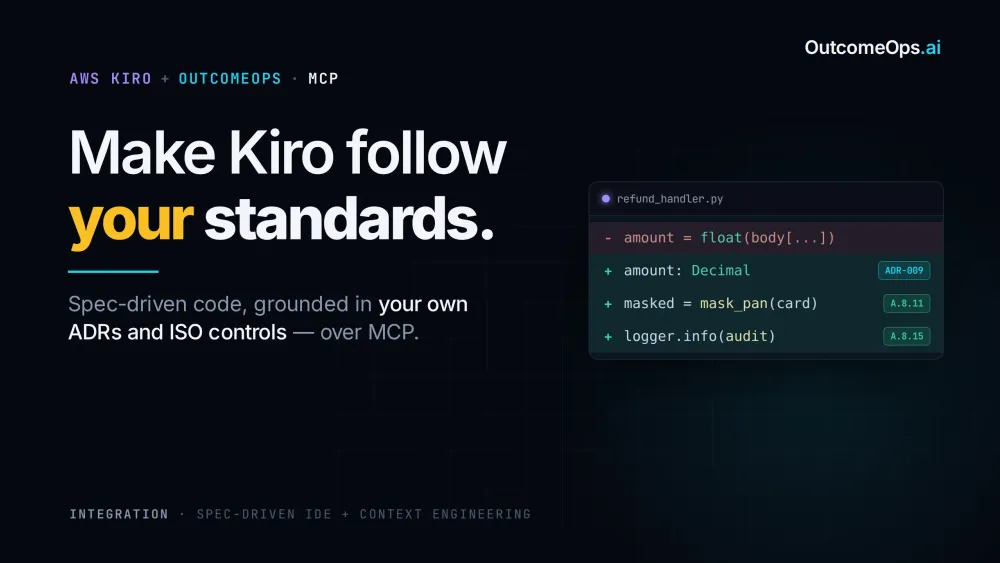
The engineer's workflow looks like this. They describe an outcome in Kiro: "Build a Lambda handler that processes a payment refund." Kiro drafts the code in seconds, the way any spec-driven IDE would. Clean, readable, and missing the context only the organization has.
On its own, that draft would store the refund amount as a
float and log the full card number. Then the OutcomeOps Power goes to work.Kiro's MCP client invokes the OutcomeOps endpoint with the spec context. OutcomeOps queries its knowledge base — the customer's code graph, ingested ADRs, ISO and PCI DSS control mappings, team handler patterns — and returns the relevant standards with citations and relevance scores. Kiro then revises the draft before the engineer ever sees it:
amount = float(body[...])becomesamount: Decimal— cited to ADR-009 (Decimal over float for monetary values)- The raw card number gets
masked = mask_pan(card)— cited to ISO 27001 A.8.11 (Data Masking) - An audit log line is added — cited to ISO 27001 A.8.15 (Logging)
- The handler shape conforms to the team's own validation and response pattern from the code graph
Same spec. Same Kiro flow. Now grounded in how the company actually builds software.
The citations are not decorative. They are the audit trail. A reviewer can click any chip and see the source document — the ADR in the customer's ADR repo, the ISO control in the customer's compliance mapping, the team handler standard in the customer's code graph. When a regulator asks "why does this Lambda mask card numbers?" the answer is
A.8.11 with a link to the control document, not "because the engineer remembered."The full walkthrough is on YouTube: OutcomeOps as a Kiro Power . 90 seconds, the same payment refund handler scenario.
The MCP Configuration
Connecting OutcomeOps to Kiro is a single MCP server registration. From the customer's Kiro workspace:
1
2
3
4
5
6
7
8
9
10
11
{
  "mcpServers": {
    "outcomeops": {
      "url": "https://mcp.outcomeops.<customer-region>.amazonaws.com",
      "transport": "http",
      "headers": {
        "Authorization": "Bearer ${OUTCOMEOPS_TOKEN}"
      }
    }
  }
}
One endpoint, one bearer token, running inside the customer's AWS account. Auth is the customer's IAM identity center. The MCP endpoint terminates inside the customer's VPC. Token rotation, audit logging, and access scoping all run through standard AWS controls the customer already operates.
For organizations that want one-click activation across many engineers, OutcomeOps can be packaged as a custom Kiro Power and pushed to a team's
.kiro/settings.json via standard config management. The Power exposes the same MCP endpoint with workspace-level scoping — different teams can query different slices of the organizational knowledge graph.
Why This Pattern Matters for Regulated Industries
Regulated enterprises have three properties that make pure spec-driven IDEs insufficient on their own:
- The compliance regime is the architecture. ISO 27001, PCI DSS, HIPAA, FedRAMP, GDPR — these are not afterthoughts bolted onto code review. They define what "correct" means at the function level. A spec-driven IDE that generates a refund handler without knowing ISO 27001 A.8.11 exists is generating code that will fail the audit, even if every line is technically valid.
- Tribal knowledge does not scale across offshore rotations. Most regulated enterprises run engineering teams that rotate. The senior engineer who knows "we always use
Decimalfor money because of the rounding incident in 2023" leaves the project after six months. Their knowledge walks out with them. The next contractor has no reason to know that ADR exists unless it lives in a queryable layer. - Hosted AI tools are blocked by the security team. Every regulated enterprise we talk to has the same collision: security has blocked claude.ai, ChatGPT, and Copilot because they are vendor SaaS endpoints outside the customer's trust boundary. Engineering needs the AI anyway. Pure spec-driven IDEs that route inference to vendor cloud cannot solve this. The integration with OutcomeOps keeps inference inside the customer's AWS account — Bedrock in the customer's region, the MCP endpoint in the customer's VPC, the knowledge base in the customer's S3 and DynamoDB.
The "Better Together" framing matters here because Kiro alone can address neither (1) nor (2) by architecture, and (3) only partially. OutcomeOps alone is a chat and MCP product — it lacks the spec-driven IDE experience developers actually want. Together they cover the whole loop: developers stay in the IDE they reach for, the AI knows the organization's standards, and nothing leaves the trust boundary.
What Customers Are Seeing
The teams running this pattern report a few measurable effects:
- Higher first-time PR approval rates. Standards are enforced during generation, not caught in code review. The reviewer's job shifts from "did the engineer remember the rules" to "is this the right business outcome."
- Reduced architectural drift across portfolios. When every Lambda handler cites the same handler standard, drift gets harder to introduce. The standard is in the generated code, not in a wiki the engineer might or might not have read.
- Compounding knowledge across team rotations. Each accepted PR with cited ADRs strengthens the organizational knowledge graph. Offshore engineers rotating onto the project query the same graph the senior engineers built. Onboarding compresses from weeks to days.
- Token spend that drops as the platform matures. Cache hit rates against the OutcomeOps MCP endpoint climb over time as the same ADRs and code graphs get retrieved repeatedly. On our own internal usage building OutcomeOps with this pattern, we observed cache reads of 17.3 billion tokens against 887K raw input tokens — a ratio that only exists when the context layer is genuinely stable and queryable.
When This Combination Does Not Make Sense
Be honest about the cases where the integration is overkill.
If you are a three-person startup building a greenfield SaaS product with no compliance requirements, just use Kiro. The local optimization is the right optimization at that stage. There is no organizational complexity yet to encode, no compliance regime to enforce, no architectural drift to detect because you do not have enough architecture to drift from.
OutcomeOps starts compounding value as organizational complexity grows: 20+ engineers, a regulated industry, multiple teams contributing to overlapping codebases, decades of tribal knowledge that needs to survive team rotation, or any environment where "just ask Steve" is how architecture decisions actually propagate. If you recognize any of those patterns, the integration is worth standing up.
The Bigger Picture
Spec-driven IDEs like Kiro are the creative front end of AI-assisted engineering. Context engineering platforms like OutcomeOps are the durable back end. Together they move teams past "vibe coding plus manual review" toward real outcome ownership — where the standards that govern code are in the code at generation time, the audit trail is built-in, and nothing the AI does happens outside the customer's trust boundary.
If your organization is evaluating Kiro (or any spec-driven IDE), the organizational intelligence layer is what determines whether it scales past the first proof-of-concept. Layer your standards on top from day one. Do not let great local tools create systemic debt.
OutcomeOps is available now on AWS Marketplace , deployed via Terraform into your AWS account, with the MCP endpoint ready to register as a Kiro Power.
Enjoyed reading this content? Let the author know!
Your likes, comments, shares, and saves help creators reach more builders.

Loading recommendations
Loading article