
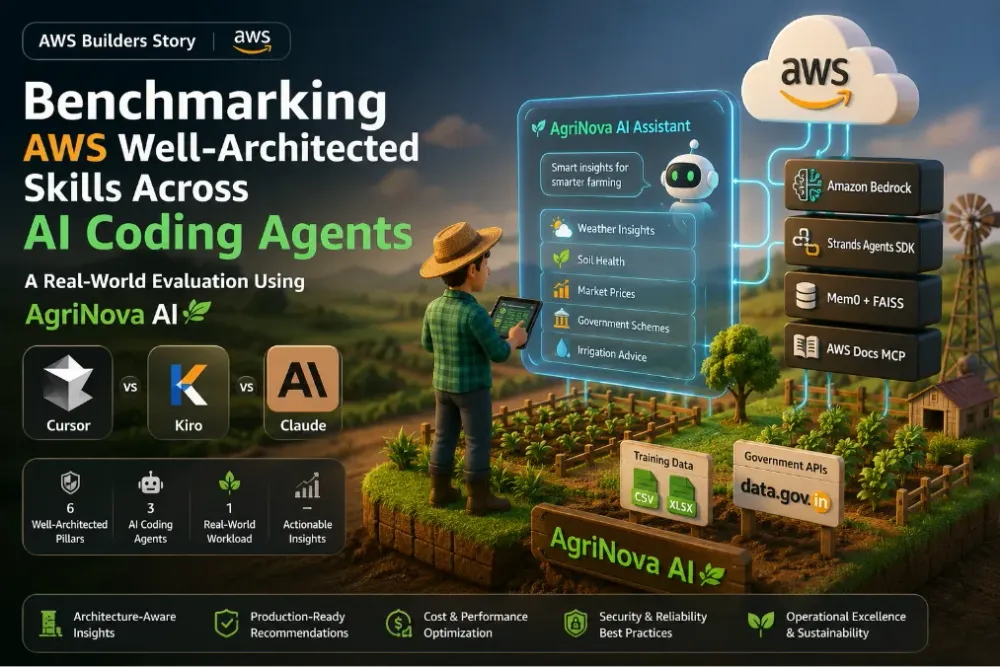
AWS Well-Architected Benchmark with AgriNova AI
Benchmarking Cursor, Kiro, and Claude using AWS Well-Architected Skills on AgriNova AI to evaluate architecture-aware AI coding agents.

Introduction
AI coding assistants are rapidly becoming the default engineering companion. Developers increasingly ask AI systems to design architectures, review workloads, generate code, and recommend production improvements instead of manually consulting documentation.
But an important question remains:
Can AI coding agents produce architecture-aware engineering guidance, or do they remain code-focused assistants?
To explore this, I benchmarked AWS Well-Architected Skills & Steering using a real AI workload — AgriNova AI, an agriculture-focused assistant — across multiple AI coding agents:
- Cursor
- Kiro
- Claude
Instead of evaluating toy applications, the experiment used a production-style AI system involving tools, APIs, datasets, memory layers, and external integrations.
The objective was simple:
Evaluate how different AI coding agents interpret the same AWS Well-Architected review workflow and measure their architectural awareness.
Project Overview – AgriNova AI
AgriNova AI is an agriculture intelligence assistant designed to support farmers with contextual recommendations and domain-specific guidance.
Capabilities include:
- Weather insights
- Rainfall prediction
- Soil health recommendations
- Irrigation guidance
- Market price tracking
- Government schemes
- Water management
- Equipment subsidies
- Crop planning and calendar recommendations

Technology Stack
| Layer | Technology |
|---|---|
| Foundation Model | Amazon Nova Pro |
| Agent Framework | Strands Agents SDK |
| Memory Layer | Mem0 + FAISS |
| Knowledge Layer | AWS Docs MCP |
| APIs | wttr.in + data.gov.in |
| Data Layer | CSV / Excel |
| Evaluation Framework | AWS Well-Architected |
Why AWS Well-Architected Skills?
AWS recently introduced Well-Architected Skills & Steering for AI coding environments.
Instead of architecture reviews happening after development, these skills bring AWS guidance directly into AI-assisted workflows.
The evaluation covers six pillars:
| Pillar | Objective |
|---|---|
| Security | Identity, secrets, access boundaries |
| Reliability | Recovery and fault tolerance |
| Performance Efficiency | Optimization and scaling |
| Cost Optimization | Resource efficiency |
| Operational Excellence | Monitoring and observability |
| Sustainability | Energy and resource optimization |
Benchmark Setup
Skill Used
1
wa-review
Benchmark Workload
1
AgriNova AI
AI Coding Agents Evaluated
- Cursor
- Kiro
- Claude
Evaluation Prompt
1
2
3
4
5
6
7
8
9
10
Review AgriNova AI architecture using AWS Well-Architected principles.

Evaluate:

1. Security
2. Reliability
3. Performance Efficiency
4. Cost Optimization
5. Operational Excellence
6. Sustainability
The same workload and evaluation prompt were used across all tools to ensure consistency.
Benchmark Results
1. Cursor – Architecture Reviewer
Cursor approached AgriNova primarily from an architectural perspective.
Recommendations focused on AWS design maturity and operational improvements.
Security Recommendations
- Amazon Cognito
- API Gateway + WAF
- IAM Least Privilege
- Tool allowlists
Reliability Recommendations
- EventBridge
- Amazon SQS
- Retries
- Circuit breakers
- Fallback caches
Performance Improvements
- Response caching
- Step Functions orchestration
- Lightweight model routing
Operational Excellence
- CloudWatch
- AWS X-Ray
- SLO tracking
- CI/CD quality gates
Observation
Cursor behaved similarly to an architecture consultant.
Its outputs emphasized:
System design → AWS integration → Operational maturity
2. Kiro – Production Auditor
Kiro produced the deepest implementation-aware review.
Instead of stopping at architecture diagrams, Kiro inspected runtime behavior and source implementation.
Analysis scope included:
- agriNovaAI.py
- Tool registrations
- Mem0
- FAISS
- AWS Docs MCP
- External APIs
- Dataset loading patterns
Security Findings
Critical issue detected:
1
os.environ["BYPASS_TOOL_CONSENT"] = "true"
Impact:
- Unrestricted tool execution
- Government API access without approval
- Memory writes without confirmation
Recommendation:
Remove bypass and introduce approval boundaries.
Reliability Findings
Detected:
1
requests.get(...)
without:
- timeout
- retry
- fallback
Risk:
External API delays could block the complete workflow.
Recommended fix:
1
requests.get(url, timeout=(3,10))
Add:
- retries
- exponential backoff
- cached fallback responses
Cost Findings
Current execution:
1
2
3
17 tools
+ MCP manifest
→ every inference call
Recommended optimization:
1
2
3
4
5
Intent Classifier
       ↓
Relevant Tool Selection
       ↓
Nova Pro
Expected improvement:
40–60% reduction in token consumption
Observation
Kiro behaved less like a coding assistant and more like a production engineering auditor.
It identified:
- Runtime issues
- API risks
- Reliability gaps
- Operational concerns
3. Claude – Well-Architected Assessor
Claude generated the most structured Well-Architected review.
Analysis scope:
- 1178 lines analyzed
- 17 registered tools
- 6 datasets
- Weather API integration
- data.gov.in integration
- AWS Docs MCP
AWS Well-Architected Scorecard
| Pillar | Score | Status |
|---|---|---|
| Security | 3 / 10 | 🔴 Critical |
| Reliability | 5 / 10 | 🟠 Medium |
| Performance | 5 / 10 | 🟠 Medium |
| Cost | 6 / 10 | 🟡 Moderate |
| Operational Excellence | 4 / 10 | 🔴 Critical |
| Sustainability | 6 / 10 | 🟢 Foundation |
Security Findings
Highest-priority observations:
Tool approval bypass
1
os.environ["BYPASS_TOOL_CONSENT"] = "true"
Risk:
- Uncontrolled execution
- Reduced production safety
Secret management
Current API key handling requires improvement.
Recommended:
- AWS Secrets Manager
- Systems Manager Parameter Store
Reliability Findings
Current implementation depends heavily on external APIs.
Detected:
1
requests.get(...)
without resilience mechanisms.
Risk:
A stalled weather endpoint could stop the entire execution flow.
Performance Findings
Claude identified duplicate execution paths.
Examples:
- Duplicate tool registration
- Repeated weather calls
- Redundant inference overhead
Recommendations:
- Cache responses
- Reuse HTTP sessions
- Remove duplicate registrations
Operational Excellence Findings
Current observability relies mainly on:
1
print()
Missing:
❌ Structured logs
❌ Request tracing
❌ Metrics
❌ Dashboards
❌ Request tracing
❌ Metrics
❌ Dashboards
Recommended stack:
- CloudWatch Logs
- AWS X-Ray
- Request IDs
- Operational dashboards
Sustainability Findings
AgriNova naturally aligns with sustainability goals.
Strengths:
- Irrigation optimization
- Water conservation
- Soil-based recommendations
Suggested improvement:
Move from always-on execution to:
- AWS Lambda
- ECS Fargate
- Scale-to-zero workloads
Result:
Reduced idle compute and energy consumption.
Evaluation Criteria and Scoring Framework
To make the comparison more structured, each AI coding agent was evaluated against a common set of criteria derived from AWS Well-Architected review objectives.
The goal was not to measure model intelligence, but to assess how effectively each agent identified architectural risks, implementation issues, and actionable improvements within the AgriNova AI workload.
Evaluation Metrics
| Metric | Description | Weight |
|---|---|---|
| Architecture Awareness | Ability to identify architectural patterns, AWS service recommendations, and system-level improvements | 25% |
| Code & Implementation Awareness | Ability to inspect source code, runtime behavior, APIs, and integrations | 25% |
| Security Analysis | Ability to identify security risks, secrets management issues, and access control concerns | 15% |
| Operational Excellence | Quality of observability, monitoring, logging, and operational recommendations | 15% |
| Actionability | Practicality and implementation readiness of recommendations | 10% |
| Output Structure & Clarity | Organization, readability, and ease of consumption of findings | 10% |
Scoring Scale
Each category was scored on a scale of 1–10:
- 1–3 → Limited Coverage
- 4–6 → Moderate Coverage
- 7–8 → Strong Coverage
- 9–10 → Excellent Coverage
The scores are based on qualitative analysis of the generated outputs and should be viewed as comparative observations rather than absolute performance measurements.
Benchmark Results
| Metric | Cursor | Kiro | Claude |
|---|---|---|---|
| Architecture Awareness | 9 | 8 | 9 |
| Code & Implementation Awareness | 5 | 10 | 9 |
| Security Analysis | 7 | 9 | 9 |
| Operational Excellence | 8 | 8 | 9 |
| Actionability | 8 | 9 | 9 |
| Output Structure & Clarity | 7 | 8 | 10 |
Overall Assessment
| Tool | Overall Score (/10) | Primary Strength |
|---|---|---|
| Cursor | 7.3 | Architecture Guidance |
| Kiro | 8.7 | Deep Implementation Analysis |
| Claude | 9.2 | Structured Well-Architected Assessment |
Benchmark Limitations
This benchmark focuses on qualitative architectural evaluation rather than statistical model performance. The results may vary depending on workload complexity, prompt design, available project context, and tool integrations.
Future iterations may include:
- Finding detection rate
- Severity coverage scoring
- Response consistency across multiple runs
- Time-to-insight measurements
- Recommendation implementation success rate
These additions would further strengthen the benchmarking methodology and provide more quantitative comparisons.
Benchmark Summary
| Tool | Role | Strength | Review Style |
|---|---|---|---|
| Cursor | Architecture Reviewer | AWS architecture guidance | Architecture-first |
| Kiro | Production Auditor | Runtime + implementation inspection | Code-first |
| Claude | WA Assessor | Structured scoring and analysis | Framework-first |
Key Engineering Findings
Highest priority improvements identified across all agents:
| Priority | Improvement |
|---|---|
| P1 | Remove tool bypass |
| P1 | Protect secrets |
| P1 | Add API timeout and retries |
| P2 | Introduce caching |
| P2 | Tool routing |
| P2 | Structured observability |
| P3 | Lambda + scale-to-zero |
| P3 | Memory persistence |
Recommended Target State
1
2
3
4
5
6
7
8
9
10
11
12
13
14
15
16
17
18
19
20
21
22
23
24
25
26
27
28
Farmer Query
      ↓

API Gateway

      ↓

AgriNova Agent

      ↓

Tool Routing Layer

      ↓

Weather / Market / Soil Services

      ↓

Memory + Training Data

      ↓

CloudWatch + X-Ray

      ↓

Lambda + Scale-to-zero
Final Thoughts
This experiment demonstrated that AWS Well-Architected Skills significantly influence AI coding outputs.
The same workload produced three different engineering perspectives:
Cursor → Architecture Reviewer
Focused on AWS service design and operational maturity.
Kiro → Production Auditor
Focused on implementation, runtime behavior, and operational risks.
Claude → Well-Architected Assessor
Focused on structured scoring and production readiness.
This highlights an important shift:
AI coding agents are evolving beyond code generation into architecture-aware engineering assistants.
Using a real workload such as AgriNova AI made the evaluation significantly more meaningful than benchmarking against toy examples.
Thank You for Reading 🙌
Thank you for taking the time to read this article and explore this benchmark journey with AgriNova AI and AWS Well-Architected Skills.
This experiment was an attempt to understand how AI coding agents evolve from code assistants into architecture-aware engineering companions, and how the same workload can produce completely different engineering perspectives.
If you found this article useful:
⭐ Feel free to like and share it with the community
💬 Drop your thoughts, observations, or experiences in the comments — I would genuinely love to hear different viewpoints and benchmark approaches from other builders.
💬 Drop your thoughts, observations, or experiences in the comments — I would genuinely love to hear different viewpoints and benchmark approaches from other builders.
I am also continuously improving AgriNova AI. If you have suggestions around:
- Architecture improvements
- AWS Well-Architected practices
- Bedrock / Agent workflows
- Cost optimization ideas
- Security enhancements
- Production readiness recommendations
please share them — feedback from the community is always valuable.
Future improvements planned for AgriNova AI include:
✅ Better guardrails and security controls
✅ Observability with CloudWatch and X-Ray
✅ Tool routing and token optimization
✅ Serverless scale-to-zero architecture
✅ Memory persistence improvements
✅ Production-grade reliability patterns
✅ Observability with CloudWatch and X-Ray
✅ Tool routing and token optimization
✅ Serverless scale-to-zero architecture
✅ Memory persistence improvements
✅ Production-grade reliability patterns
Thank you again for reading and being part of this learning journey 🌾🤖
Enjoyed reading this content? Let the author know!
Your likes, comments, shares, and saves help creators reach more builders.

Loading recommendations
Loading article