


Part 3 of 6
---
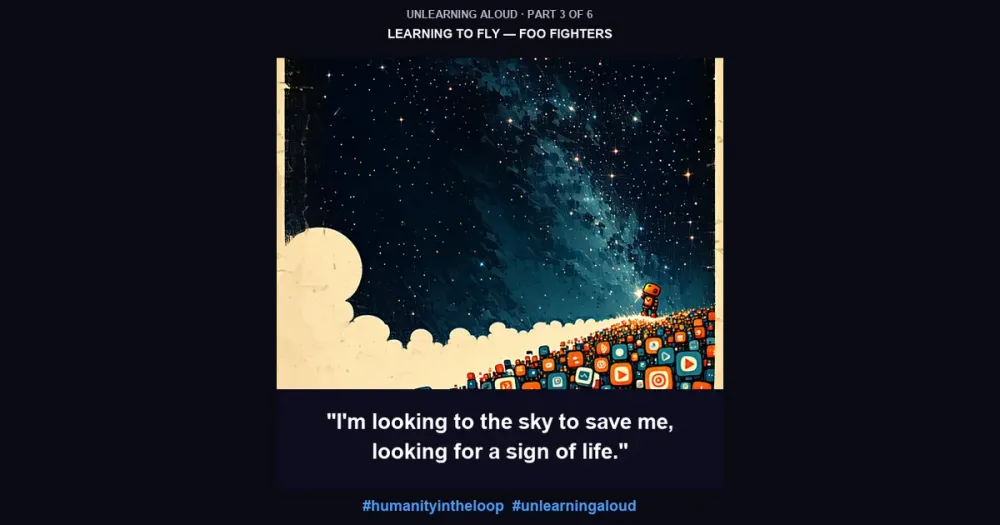
"Looking for a sign of life,
looking for something to help me burn out bright."
— Foo Fighters, Learning to Fly
---
I stared at the plan. It was clearly written by an AI companion. Sloppily. The activities made sense in a world where we optimize for idea generation. They did not make sense in a world where ideas were abundant and we had no concept of what needed optimizing.
And so I grappled with the core of the question: where do we fit? Not as a reviewer. As the thing that makes the work worth doing.
---
"Fly along with me, I can't quite make it alone."
Here's what I had to unlearn: I was still using AI. Asking it to do things. Handing it tasks like a capable assistant. Build the report. Write the brief. Fill the gap.
The shift is from user to orchestrator. A user asks AI to do something. An orchestrator designs the conditions, the boundaries, the handoffs. And steps in only when the system needs something only a human can provide. The provocation, not the execution. The judgment call, not the task.
---
"Try to make this life my own."
Unlearn: Every agenda, every workflow, every job description assumes execution is the constraint. Look at your next meeting. Ask: what is this designed for? Odds are it's designed to move information up a chain that no longer needs to be climbed.
Learn: Design for judgment. Before any process, ask: where is the human uniquely required here, and at which specific moments? Everything else is a candidate for the loop.
Unlearn: Using AI to do the work faster. Faster is the trap. The point isn't speed. It's doing things that were structurally impossible before. AI running the rhythm so you can focus on what only you can do.
Learn: Design your handoffs. Every time something moves from human to AI or AI to human, trust is either built or eroded. Designed handoffs get smarter. Accidental handoffs fill up with noise. And the humans in them stop trusting the system.
Unlearn: Waiting for the playbook. There isn't one. The people who figure this out are writing it one experiment at a time. And starting over when the ceiling rises.
You don't need to write code. You need to learn to direct.
The system runs better when you design it. But it only matters when you're in it. Not as a checkpoint, but as the thing that makes the loop worth running.
That's humanity in the loop. Not a safety net. The whole point.
What are you still designing for the old constraint?
Tell me what you're unlearning. #humanityintheloop
---
The mental model:
User vs. orchestrator. A user asks AI to do something. An orchestrator designs the conditions, defines the boundaries, designs the handoffs. And steps in only when the system needs something only a human can provide. The provocation, not the execution. The judgment call, not the task.
The diagnostic:
Look at your last three AI interactions. Were you a user or an orchestrator? What's the difference in the outcome?
---
This post was co-generated with Amazon Quick Desktop. If you don't feel enough humanity in the loop — that's on me. See Post 5.
Greg Kriegler leads the AWS–Deloitte global alliance. He is not an AI researcher. He has fun building with AI and helping people succeed. And sometimes he goes fishing.
Enjoyed reading this content? Let the author know!
Your likes, comments, shares, and saves help creators reach more builders.

Loading recommendations
Loading article