


"When I wake up in the morning, love, and the sunlight hurts my eyes."
— Bill Withers, Lovely Day
You know that feeling. Something is wrong, but it's outside your field of vision.
Not a data problem. A gut feeling. A deal that's too quiet. A relationship that's gone dark. You can't point to it. You just feel it. Like something moved at the edge of the frame.
In a matrixed organization, that feeling is your most important signal. The information that would confirm it, or clear it, is sitting somewhere just outside the frame. In someone else's world. Across a boundary nobody designed for you to cross.
That gap is where most management energy gets wasted. Chasing what you should already know.
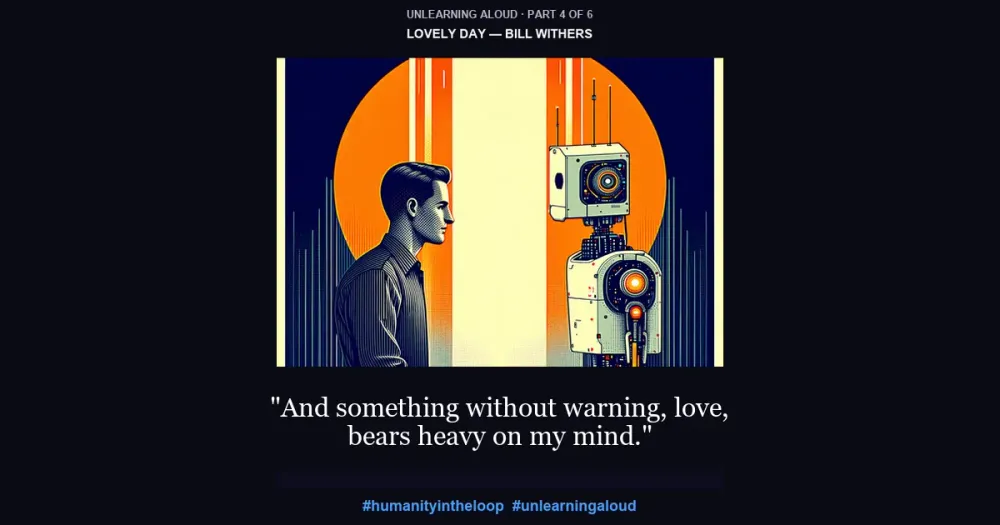
"And something without warning, love, bears heavy on my mind."
For most of my career, the answer to that question was: meetings. Status updates. Weekly reviews. The XBR. A monthly briefing that took three days to prepare and was stale the moment it landed.
We built elaborate systems to move information up the chain so the person at the top could know enough to make decisions. And then we rebuilt those systems every time the org changed. All the work was happening laterally — all the information was flowing vertically. Or diagonally — every matrix made it worse. When you work across functions, geographies, and partner organizations, the information you need to do your job lives in a dozen different places — most of which don't report to you and aren't optimized to keep you informed.
You end up managing what you don't know. That's exhausting. And it scales badly.
"Then I look at you, and the world's alright with me."
What if the manager's job isn't to know everything. What if it's to build the infrastructure that lets the right things flow?
Not a reporting structure. A knowledge architecture. Concentric rings of shared information, each one a little wider than the last, each one governed by explicit agreements about what crosses the boundary and under what conditions.
I call them knowledge contracts.
A knowledge contract is an agreement between two managers that says: here's what I'll share with you, here's what you can share with me, and here's what stays in our own rings. It's not a data sharing agreement in the legal sense. It's a working agreement about trust, context, and relevance.
When the contracts are in place, the AI doesn't have to guess what matters. It knows what's in scope. It knows when to surface something and when to let it go. It knows when a human needs to step in. Not because the data is wrong. Because something human is required to move it forward.
Every time knowledge crosses a boundary, from one ring to the next, from AI to human or human to AI, context expands. Design those handoffs intentionally and the system gets smarter over time. Let them happen by accident and the system fills up with noise. The handoff isn't a technical problem. It's a human one.
Think of it as five layers working together.
Raw signal gets processed into patterns. Patterns become context. Context flows through the rings according to the contracts. The AI watches the edges and surfaces moments that need a human. The human makes the call, injects the judgment (#humanityintheloop), and the loop continues, richer than before.
No one layer does the job. The whole thing only works if the pipes are built and the contracts are in place.
"Just one look at you, and I know it's gonna be a lovely day."
Knowledge rings aren't a perfect system. But it changes how we wake up in the morning. It's waking up and already knowing the thing you needed to know. The issue that was about to blow up. Simmered before it had a chance to boil over. Not because you caught it. Because the system caught it and knew it needed you.
"Tricia's deal has gone quiet. Three weeks, no movement."
"Dan had four Deloitte meetings this week. Nothing in SIFT."
"Maria's counterpart changed. Nobody updated the contract."
Not alerts. Moments that matter. The system recognized it couldn't move these forward alone.
That's what the knowledge rings make possible. Visibility into the right things, at the right time, from the right people. The rings govern what flows. The contracts define the trust. And the AI watches the edges of your field of vision so you don't have to.
You wake up and the simmer that would've turned to a boil is already handled. That's a truly lovely day.
I'm still building mine. But I can see it. The rings expand as trust is earned. The contracts evolve as relationships deepen. The AI gets better at watching the edges as it learns when to ask for humanity in the loop.
That's the point. AI won't replace humanity. Humanity is always one step ahead. That's not a moment. That's the whole game.
The mental model:
The information you need to do your job lives in other people's worlds. Knowledge rings are concentric layers of shared context. Knowledge contracts are the explicit agreements that govern what flows between them. The manager's job is to build and maintain the infrastructure that lets the right things flow.
The diagnostic:
What information are you currently chasing that should already be finding you? Who holds it, and what's the agreement about whether it reaches you?
This post was co-generated with Amazon Quick Desktop. If you don't feel enough humanity in the loop — that's on me. See Post 5.
Greg Kriegler leads the AWS–Deloitte global alliance. He is not an AI researcher. He has fun building with AI and helping people succeed. And sometimes he goes fishing.
🎵 Listen to the Unlearning Aloud playlist on Spotify
Enjoyed reading this content? Let the author know!
Your likes, comments, shares, and saves help creators reach more builders.

Loading recommendations
Loading article