
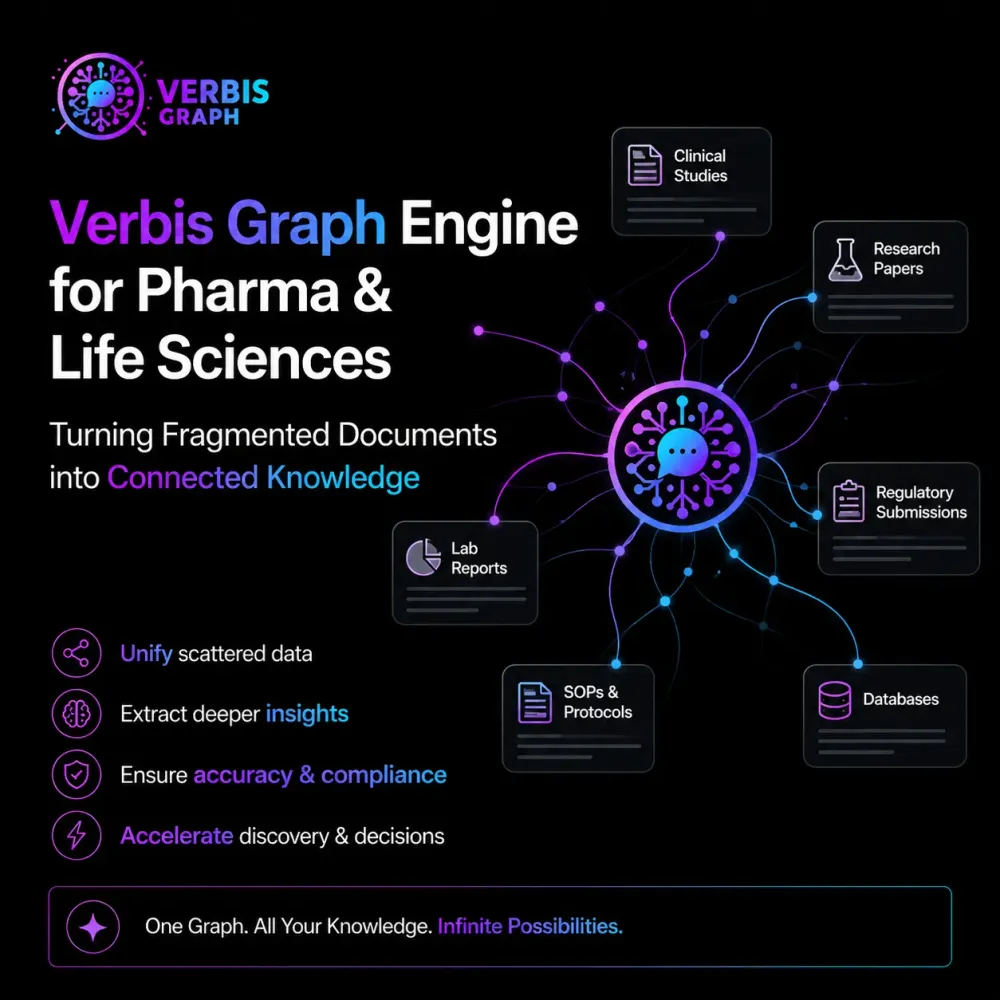
Verbis Graph Engine for Pharma & Life Sciences: Turning Fragmented Documents into Connected Knowledge
In many Pharma and Life Sciences organizations, critical knowledge exists, but it is scattered across documents, teams, and systems, making it difficult to access quickly and use effectively. When knowledge is fragmented, it becomes harder for teams to stay aligned and move efficiently across regulatory, clinical, quality, scientific, and operational work.
Pharma and Life Sciences organizations operate in some of the most knowledge-intensive environments in the world. Regulatory documentation, clinical materials, SOPs, quality records, scientific publications, technical files, and internal reports all contain critical information, yet much of that knowledge remains difficult to access when teams need it most.
In practice, the problem is rarely a lack of information. The real challenge is fragmentation.
Knowledge is spread across departments, repositories, formats, and workflows. Teams often spend too much time searching through documents, validating findings, and reconnecting information that already exists somewhere in the organization. In highly regulated environments, this creates more than inefficiency. It creates friction in decision-making, slows collaboration, and makes it harder to act with confidence.
This is where a graph-based knowledge approach becomes valuable.
The challenge in Pharma & Life Sciences
Most organizations already have the content they need. The issue is that the knowledge inside documents is often trapped in silos.
A Regulatory team may need information linked to Clinical content. Quality teams may need to trace supporting documentation across different systems. Medical, R&D, and Operations may all depend on overlapping knowledge, but the paths to that information are slow, manual, and disconnected.
This creates three common problems:
Information silos
Important knowledge remains separated by system, department, or document type.
Important knowledge remains separated by system, department, or document type.
Slow retrieval
Teams lose time searching manually across large collections of files and repositories.
Teams lose time searching manually across large collections of files and repositories.
Low confidence in answers
In regulated industries, answers must be grounded, traceable, and explainable.
In regulated industries, answers must be grounded, traceable, and explainable.
From isolated documents to connected knowledge
Verbis Graph Engine is designed to help transform large document collections into a connected knowledge layer.
Rather than treating every file as an isolated unit, a graph-based approach helps reveal relationships across entities, topics, studies, processes, products, and supporting documentation. This makes it easier to navigate complex information landscapes and retrieve relevant knowledge with more context.
For Pharma and Life Sciences teams, that means a better way to work across large volumes of structured and unstructured information, while reducing the manual effort required to find and connect what matters.
Why this matters operationally
The value of connected knowledge is practical.
When knowledge becomes easier to access and reuse, organizations can reduce time spent searching, improve visibility across document-heavy workflows, and support stronger cross-functional collaboration.
That matters in areas such as:
- Regulatory Affairs
- Clinical Operations
- Medical Affairs
- Quality and Compliance
- R&D and Scientific Teams
- Manufacturing and Operations
These functions often depend on information that is already present inside the organization, but difficult to retrieve efficiently across systems and document sets.
A practical path to evaluation
For enterprise teams, the most useful evaluation is usually not theoretical. It is operational.
That is why a 1-month PoC/Pilot model is valuable. It gives organizations the ability to test the approach using real documents, real workflows, and real business questions. Instead of evaluating abstract claims, teams can assess relevance, usability, and practical impact in their own environment.
Deployment through AWS Marketplace
For organizations already working in AWS environments, marketplace-based access makes evaluation and deployment more practical.
Verbis Graph Engine is available through AWS Marketplace:
This provides a more direct route for teams that want to explore graph-based knowledge retrieval within existing cloud and procurement processes.
Closing thought
Pharma and Life Sciences organizations do not need more information. They need better access to the knowledge they already have.
A graph-based knowledge layer can help reduce fragmentation, improve visibility across critical documentation, and support faster, more confident decisions in complex enterprise environments.
# rag# intelligent-document-processing# retreival-augmented-generation# generative-ai# amazon-elastic-container-registry
Any opinions in this article are those of the individual author and may not reflect the opinions of AWS.Enjoyed reading this content? Let the author know!
Your likes, comments, shares, and saves help creators reach more builders.

Loading recommendations
Loading article