
Bridging the AI Adoption Gap: From Early Adopters to Enterprise-Wide AI-Assisted Workflows with Amazon Kiro CLI
How a managed profile and workspace system transforms Amazon Kiro CLI from a search engine replacement into a contextually-optimized AI workflow platform for enterprise teams

Contributors: Tom Romano , Sr. Solutions Architect, AWS ; Rahul Kumar , Senior Agentic SDLC Customer Success Specialist, AWS.
PUBLICATION NOTE: I'm excited to share this post from Ryan Behan, SVP of Engineering and Principal Architect at Netsmart, and his team. This is a great real-world example of not just adopting a new AI developer tool, but engineering a framework around it to drive enterprise-wide adoption at scale. Ryan and team didn't wait for a perfect solution — they built one, using Kiro itself to do it. The result is a compelling blueprint for any engineering organization looking to move beyond individual productivity gains and turn AI-assisted development into an organizational capability. - Tom
The Challenge: Moving Beyond the “AI Search Engine”
With new powerful tools available such as Kiro CLI, we aim to ensure our organizations maximize the potential of these tools. There is often a gap between early adopters and mainstream adoption of developer assistance tools that must be bridged rapidly to maximize their utility. For example, in the very early days of using Amazon Q (now Kiro), users leveraged it as a sophisticated search engine: they asked questions, got answers, wrote some code or documentation and moved on. While this provided immediate value, it scratched the surface of what’s possible with AI-assisted workflows. The real power lies in contextual understanding, specialized expertise, and near seamless integration with existing development and operations processes.
One challenge for enterprise AI adoption is this gap between early adopters who craft sophisticated prompts and configure complex contexts, and the majority of IT professionals who need immediate, practical value. We saw this behavior internally — a smaller set of engineers accelerated their adoption, but many used it in a very simple fashion. To gain true adoption we needed more than great examples of advanced techniques, we needed a system to deliver that experience to the organization.
As leaders and practitioners, we must spend the time to lower the barrier of entry of AI in order to create a tide that lifts all boats. Slowing down to go fast, we must create frameworks to facilitate our organization’s advanced adoption. This blog discusses the journey Netsmart has taken to meet this challenge.
The Solution: A Managed AI Workflow Framework
Our team at Netsmart developed “k-mgr”, a management system for Amazon Kiro that addresses context optimization through specialized profiles and project-aware workspace configurations. The goal: eliminate the “one size fits all” problem that limits most AI implementations and provide a low-friction path for teams to get value from Kiro quickly.
Without a managed approach, users spend too much time on the learning curve — figuring out how to configure rules, agents, prompts, hooks, Model Context Protocol (MCP) servers, and Powers — or worse, have a below-average experience and give up. By providing a streamlined path to focused AI with curated MCP integration, users immediately experience AI that’s equipped to interact with their code, infrastructure, and services.
Balancing Context and Specialization
As we were developing our k-mgr solution, AWS was simultaneously working on Kiro Powers — both addressing a fundamental challenge of managing context from different angles. This convergent evolution validates a critical insight: the future of enterprise AI isn’t about more powerful models, it’s about smarter context management.
Traditional AI implementations suffer from “context bloat” — loading everything upfront overwhelms the AI’s context window and burns through computational resources. AWS research shows that connecting just five MCP servers can consume 50,000+ tokens [1] (roughly 40% of an AI model’s context window) before writing a single line of code.
The principle is straightforward: load only what is needed for the immediate task at hand. This keeps specialized expertise available on demand while preserving maximum capacity for the user’s actual work.
With AWS now providing dynamic loading capabilities through Kiro Powers and Skills, our k-mgr evolved to leverage Kiro Powers as the underlying engine while maintaining our enterprise-focused governance layers.
Optimizing Context with Kiro Powers
88% Context Reduction
Kiro Powers provided a flexible system to bring the tailored nature of Kiro CLI agents to the IDE. As you capture and condense domain knowledge and expertise for agents and rules, you run the risk of context bloat. An example of the power in dynamic context loading is how a Kiro Power pairing custom steering rules and a knowledge MCP allowed us to trim context consumption on our operations agent from 51% to 11% [2]. This is massively important as you reduce the risk of frequent context compaction, impacting task clarity and focus.
Kiro Powers allow you to bring domain and platform specific tasks and capabilities to a project with portability which was not previously available. This begins to provide a repeatable and consistent experience across the Kiro control surface.
Here are some examples across different implementations of optimizing context. Each image is annotated with the type of configuration we had for summarized domain knowledge. Each agent was provided the same prompt, asking to explain how an aspect of the system worked.
Before Prompting — You’ll notice the fully loaded agent is at 47%, which is a less-than-ideal starting point, while the agent with MCP and Kiro have more headroom in the context window.

After Prompting — The fully loaded agent increased by 4%, the MCP enabled agent. increased by 4%, and although the Kiro IDE agent increased by 11%, we still have more headroom in our context window than the agents. For both the Agent with MCP and Kiro Agent with a Power, the end user is less likely to encounter context compaction.

If you observe the timings, although the fully loaded agent responded the fastest, it’s a time/context trade-off. The Kiro Power certainly wins out with respect to context consumption.
Specialized AI Profiles
Rather than a generic AI assistant, we enable teams with specialized “experts” through managed profiles. Each leverages the rich configuration capabilities of Amazon Kiro, for example:
- Incident Response Specialist: Operations-focused persona with base knowledge on AWS infrastructure, troubleshooting guidance, and templated information capture for incident investigation. Cloned and tuned by specific teams to accelerate their response workflows.
- Java Development Expert: Educated on general and organization-specific Java coding standards. Serves as a base agent that Java-based teams extend for their own needs.
- Database Development Expert: Helps developers and operations staff interact with database platforms, coding standards, and platform tooling.
Workspace Management
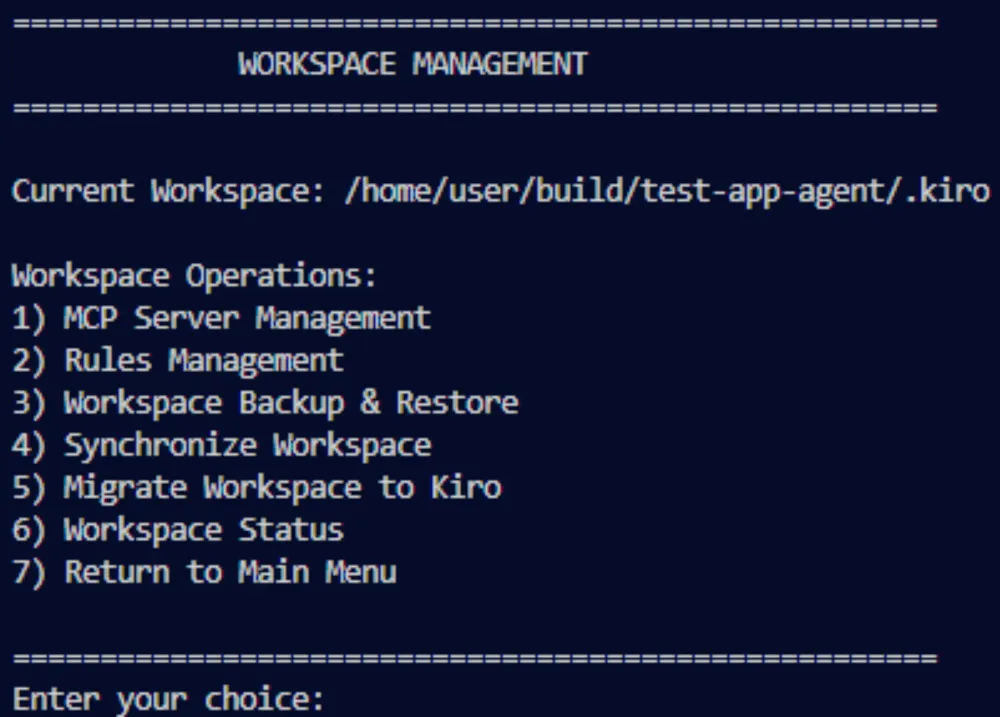
Not every project needs every capability. Our workspace management system allows teams to create project-specific AI configurations that include only relevant context and tools, centrally managed in Git.

The following are the observed benefits of the workspace management system, as observed by myself and other practitioners using and mentoring other team members in our community of practice:
- Reduced Noise: AI responses focus only on relevant technologies and patterns for that project.
- Faster Results: Purpose-fit context windows lead to quicker, more targeted responses. Fewer prompts reduce the path to results.
- Higher Accuracy: Specialized knowledge without conflicting guidance from irrelevant domains, reducing risk of hallucination.
- Resource Efficiency: Only necessary MCP servers active per project, managing context.
Enhanced Capabilities Through MCP Integration
MCP servers extend Amazon Kiro beyond conversation, but traditional MCP deployment faces significant friction: finding servers from verified sources, managing access token editing configuration files manually, and handling environment variables across different shells.
Our system streamlines this through curated, centrally managed MCP deployment — including global servers available across profiles, project-specific servers for targeted needs, and internally developed MCP servers custom built for our platforms.

Accelerating AI Adoption: Real-World Results
Implementing this framework has accelerated mainstream adoption at Netsmart. The following are examples of realized gains.
Friction-Free Delivery
The Scenario: Technical resources know about AI, and many may have used it superficially but want more. Individuals can spend significant time just learning how to set up and configure a single MCP server and its dependencies — time better spent exploring what they can do once it’s deployed.
By centralizing and orchestrating MCP deployment, we provide a curated menu of approved MCPs with simplified configuration. No more hunting through GitHub projects, editing JSON files, or relying on copy/paste from a working setup.
Measurable Impact: We achieved a 98% reduction in time to deploy and realize value [3]. This aligns with AWS’s own findings about the efficiency gains from dynamic loading approaches.
Customized AI Persona Success: Incident Response Case Study
Incident recovery is a function of application architecture and operational maturity. Ephemeral, self-healing designs, monitoring, and orchestrated automation close much of the gap, however not every nuanced scenario can be covered. AI — specifically customized AI paired with organizational knowledge — closes this gap.
During production incidents we have begun deploying our specialized incident investigator agent with less experienced associates supporting the response, achieving remarkable and consistent results.
The Scenario: During a high-traffic window, we encountered a complex, multi-service performance issue affecting a subset of workflows across multiple Availability Zones. The only recent change was a standard scale-out operation, which initially obscured the underlying cause. Because different components were responding in slightly different ways. Experienced teams internally and external partners, needed additional time to fully diagnose the situation. By pairing our incident investigator agent with an engineer who was less familiar with this part of the stack, we were able to reach the same root cause in about one-third of the time typically required.
Measurable Impact: Achieved 66% reduction in time to root cause in complex incidents compared to traditional incident response approaches [4]. This improvement was consistent across multiple incident engagements, demonstrating the reliability and effectiveness of the customized AI-assisted approach while simultaneously accelerating associate learning and maintaining process consistency.
When building and supporting critical technology systems that help community-based providers deliver care, every second counts, and Amazon Kiro helps us move with speed and confidence.
What’s Next: From Framework to Platform
The success of our k-mgr approach has revealed the next evolution: transforming these enterprise governance patterns into platform services. While we’ve proven that context optimization works at scale, the real opportunity lies in making this intelligence pervasive across the entire development lifecycle.
This isn’t about replacing human expertise; it’s about amplifying it. When a lesser experienced developer encounters a complex database issue at 2 AM, they shouldn’t need to remember to activate the right AI persona — the system should recognize the context and provide the specialized assistance automatically.
The convergence of our governance-focused approach with AWS’s dynamic loading capabilities through Kiro Powers helps create a clear path forward: enterprise-ready AI that scales from individual productivity gains to organizational transformation, all while supporting the compliance and specialization requirements that make it applicable in production environments.
About the Author and Contributors
Ryan Behan
SVP, Engineering & Principal Architect, Netsmart
Ryan is senior vice president of engineering and principal architect at Netsmart, where he leads engineering strategy and cloud-native architectural design for enterprise healthcare platforms. With more than two decades of healthcare IT experience, he has led efforts across platform transformation, engineering operations and AI-assisted automation to strengthen reliability, improve engineer experience and accelerate deployment velocity. He holds a Bachelor of Science in computer science from the State University of New York at Plattsburgh and serves as an advisory board member at The Center of Excellence in Wireless and IT at Stony Brook University and Grafana Labs.
Tom Romano
Senior Solutions Architect, AWS Worldwide Public Sector
Tom is a Senior Solutions Architect at AWS Worldwide Public Sector based in Tampa, Florida, with more than five years at AWS and a background as a full-stack developer, product manager, and data engineer. He works with GovTech customers to design and build solutions leveraging serverless architectures, generative AI, and modern data and DevOps practices, with deep expertise in Python, serverless development, and data engineering. A passionate builder and instructor, he is an advocate for Amazon DynamoDB and shares a deep enthusiasm for harnessing generative AI to accelerate software delivery and customer outcomes.
Senior Agentic SDLC Customer Success Specialist, AWS
Rahul is a Senior Agentic SDLC Customer Success Specialist at AWS with 17 years of experience, including more than five years at Amazon. He specializes in Kiro, Amazon Q Developer, and Amazon Bedrock AgentCore, partnering with enterprise customers to integrate agentic AI across every phase of the software development lifecycle. His work focuses on turning complex engineering challenges into successful AI-driven outcomes.
Notes:
- [1] Taft, Darryl. “AWS Tackles AI’s ‘Too Much Information’ Problem.” The New Stack, Dec. 2025
- [2] Based on a point-in-time internal comparison of the same operations agent configuration before and after applying a knowledge MCP and custom steering rules, as illustrated in Image 2 of this blog, which showed context consumption decreasing from 51% to 11%.
- [3] Based on internal observations pre- and post-implementation of AWS Kiro powers in November 2025.
- [4] Based on internal observations in November 2025.Built by AI, for AI — we used Amazon Kiro CLI itself to build k-mgr. The initial version was built over a weekend and pilot ready; Amazon Kiro took the idea to real-world solution in 12 hours, including watching the kids!
Enjoyed reading this content? Let the author know!
Your likes, comments, shares, and saves help creators reach more builders.

Loading recommendations
Loading article