

Build for the People, Not the Pictures: What Leading a Student Community Taught Me
Lessons from leading AWS Student Builder Group CUST

Postpone it, or move it online?
That was the decision in front of me before our first major session. We had planned AWS Launchpad as an in-person event. Then the situation in Islamabad worsened, educational institutions closed, and suddenly the call was mine. I chose online, with plenty of doubts. Would students show up? Would they participate? Would something go wrong at the last minute, in front of an audience?
Around 60 people attended, and everything ran smoothly. My first reaction was simply: phew.
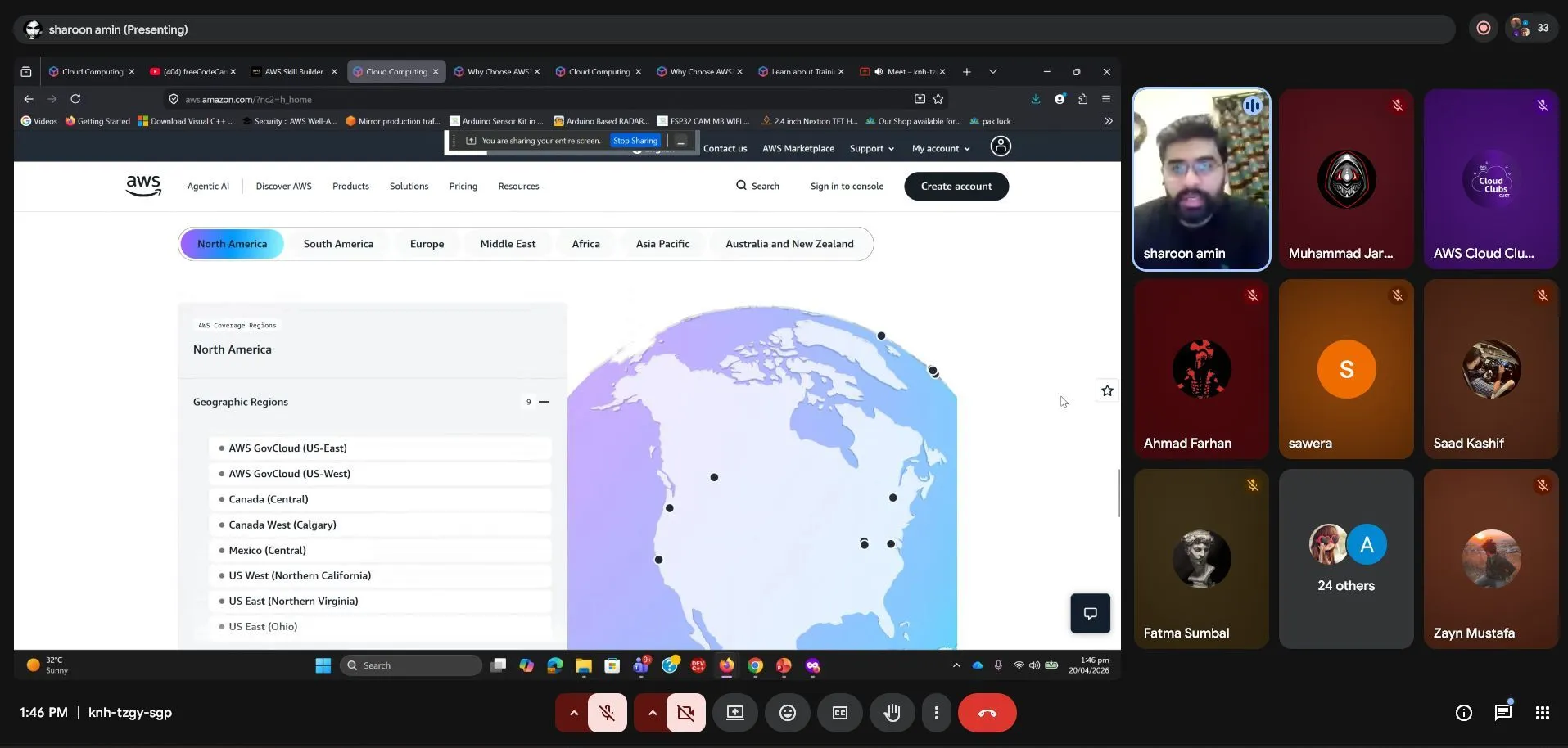
It wasn’t a huge achievement, but it was the first time I had to make a decision like that and see it through without knowing the outcome. I learned that you rarely get to have everything figured out before you decide. Sometimes you make the best call you can and take responsibility for it.
I’m a student at Capital University of Science and Technology (CUST) in Islamabad, Pakistan, where I lead AWS Student Builder Group CUST and the Canva Student Community. I didn’t start with any idea of how to lead a community. This article is about what I figured out along the way, and what I hope helps you if you’re thinking of starting one.
You get an opportunity, not a manual
In my second semester, I started helping Fasih ur Rehman, then the president of our university society, with different tasks. Gradually he trusted me with more responsibility and introduced me to faculty members. I wasn’t leading anything yet. I was just getting things done and trying to be someone people could rely on.
As Fasih neared graduation, there was one initiative he couldn’t take forward himself: establishing an AWS Cloud Club at CUST. He asked me to take it over. (Cloud Clubs have since been renamed AWS Student Builder Groups.) I knew very little about community building, but I decided to give it a shot.
Looking back, I think he trusted me because I had shown I could follow through. But the opportunity was only the starting point. I soon realized that holding a title and knowing how to lead are two very different things.

Leadership is not a solo job
Abdullah Haroon helped me become an AWS Cloud Club leader and still guides me, often pointing out details and possibilities I would otherwise miss. Along with Fasih, he is one of the people I consider my gurus.
Their guidance taught me that leading doesn’t mean figuring everything out alone. You need people to learn from, the willingness to ask questions, and the humility to admit what you don’t know.
I also had to learn to trust my own team, which wasn’t easy for me. But a community can’t grow if every decision and task passes through one person. Delegating gives others room to contribute, and it gives the whole team a chance to grow.
My core team is the reason this community runs. They took ownership needing me to check every detail, and every event we’ve held is better because of them.
My core team is the reason this community runs. They took ownership needing me to check every detail, and every event we’ve held is better because of them.
Collaborate instead of competing
Some of the best things we’ve done came from working with other communities.
At a dinner for Canva student communities, I met Shahmeer Abdullah, who had just been selected as the AWS Student Builder Group Leader at GIKI. His cohort was new, and I was around six months into my own role. We talked about everything: communities, leadership, what we were each trying to build. A good friendship started that night.
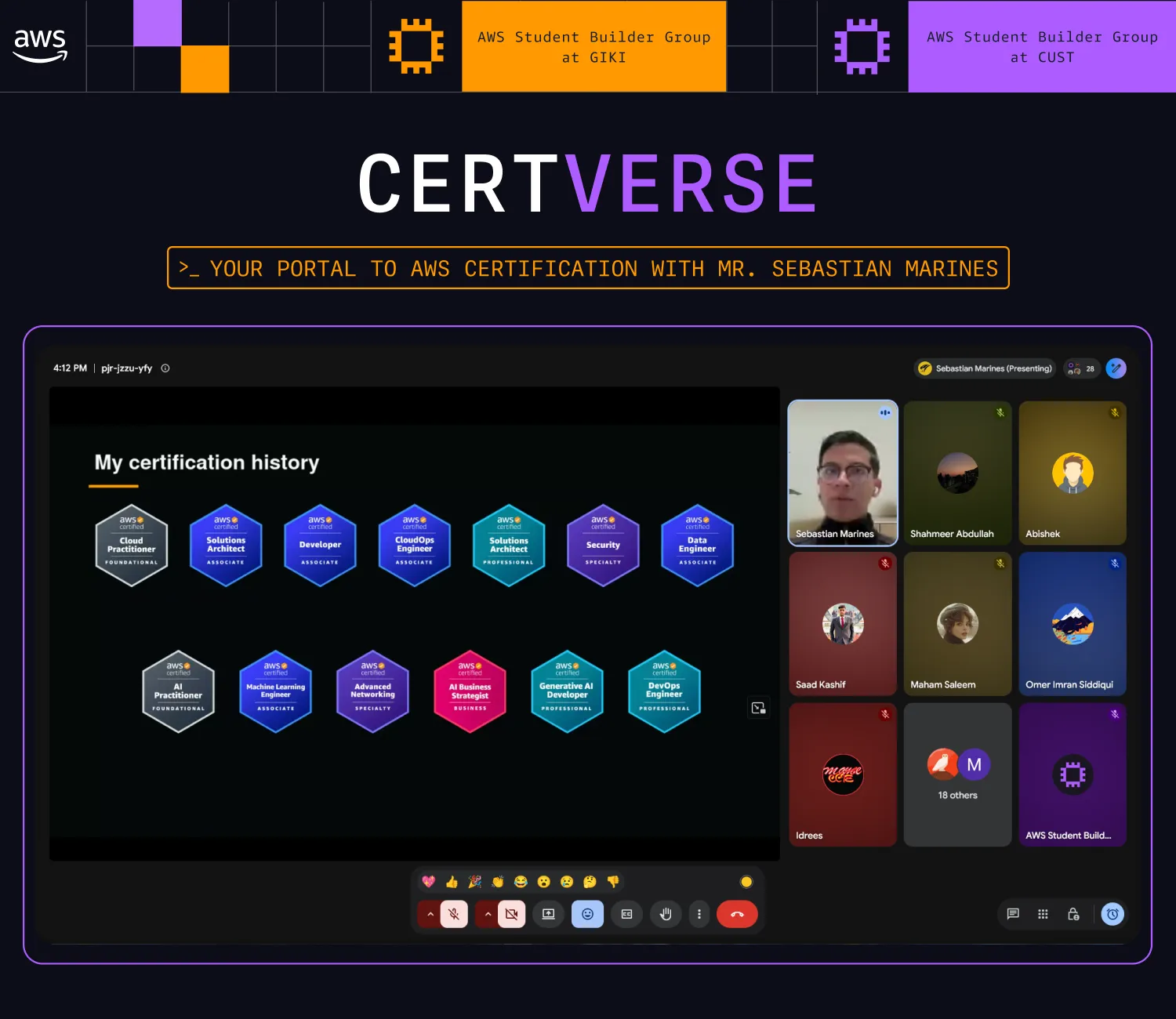
When I began planning a certification event, I thought of GIKI. They were new, and they were already doing well on their own. I didn’t partner with them to prove anything. I wanted us both to learn from each other. That collaboration became CERTVERSE, an AWS certification, initiative that helped CUST students work toward their certifications, and it reached beyond our own campus.
Student communities that operate in isolation each have to learn everything alone. Communities that collaborate share what they’ve learned, and every student benefits.
Build for the People, Not the Pictures
It’s easy to measure a community by turnout, photos, and social media posts. I’ve come to think that’s the wrong scoreboard.
Students give up their time to attend. They deserve to leave with something valuable: a new skill, a useful connection, a clearer understanding of a technology, or the confidence to try something they hadn’t considered. Swag is nice, but it shouldn’t be the reason an event is worth attending.
The numbers we have so far matter to me for what they represent. My term will end in February 2028, but our four sessions have already reached more than 250 attendees. We also partnered with DataCamp to provide 500 licenses to students, at many universities and around the globe, thanks to our community. What I care about is whether those students learned something, made a connection, or took their next step.
I've also had the opportunity to connect with people from other AWS student communities, including Ali Mumtaz from QAU and Shahmeer Abdullah from GIKI, along with members of communities at other universities. These relationships have brought guidance, collaboration, and friendships that I wouldn't have gained by staying within my own campus.

Why it’s worth the effort
People sometimes ask why we put so much time into organizing events when it’s exhausting and may not bring an obvious personal benefit. It’s a fair question. The effort behind an event is invisible to the people attending it.
Then a student thanks you, says an event helped, or follows up because they want to learn more, and that’s what makes it worth it. There’s personal satisfaction too, and I don’t think it’s wrong to admit that. But validation shouldn’t become the purpose. It should come from doing something useful, not from being seen doing it.
Working with other universities has also shown me that meaningful initiatives can come from our campus, too
If you’re thinking of starting or joining a student community
1. Research the community before you commit. Make sure it matches your genuine interest. If you’re joining a design community like Canva Student Community, you should be interested in design. If it’s a tech community like AWS, MLSA etc. you should be interested in tech. Some students become campus ambassadors and later realize the opportunity isn’t for them. Finding that out early saves you and the community a lot of time.
2. Once you lead, put the community first. A community should be by the students, for the students. It is not a line on your CV or a platform for yourself. Every decision gets easier when you ask whether it serves the people in the room.
3. After every event, ask three questions. Did someone learn something? Did someone make a connection? Did someone feel encouraged to take a next step? If the answer to all three is no, great photos won’t change that.
4. Find people to learn from, and communities to learn with. Ask for guidance, learn from people who have done it before, and reach out to other student communities.
I’m still learning how to lead, and I don’t think community building has a final lesson you eventually master. Every event, collaboration, setback, and conversation is another chance to improve. I started because someone trusted me with an opportunity. I’ve continued because I’ve seen what that opportunity can make possible for others.
I’m still learning how to lead, and I don’t think community building has a final lesson you eventually master. Every event, collaboration, setback, and conversation is another chance to improve. I started because someone trusted me with an opportunity. I’ve continued because I’ve seen what that opportunity can make possible for others.
Thank you to my core team at AWS Student Builder Group CUST, who showed up, took ownership, and made every event possible. And thank you to Fasih and Abdullah, who trusted me and kept guiding me along the way.
Enjoyed reading this content? Let the author know!
Your likes, comments, shares, and saves help creators reach more builders.

Loading recommendations
Loading article